








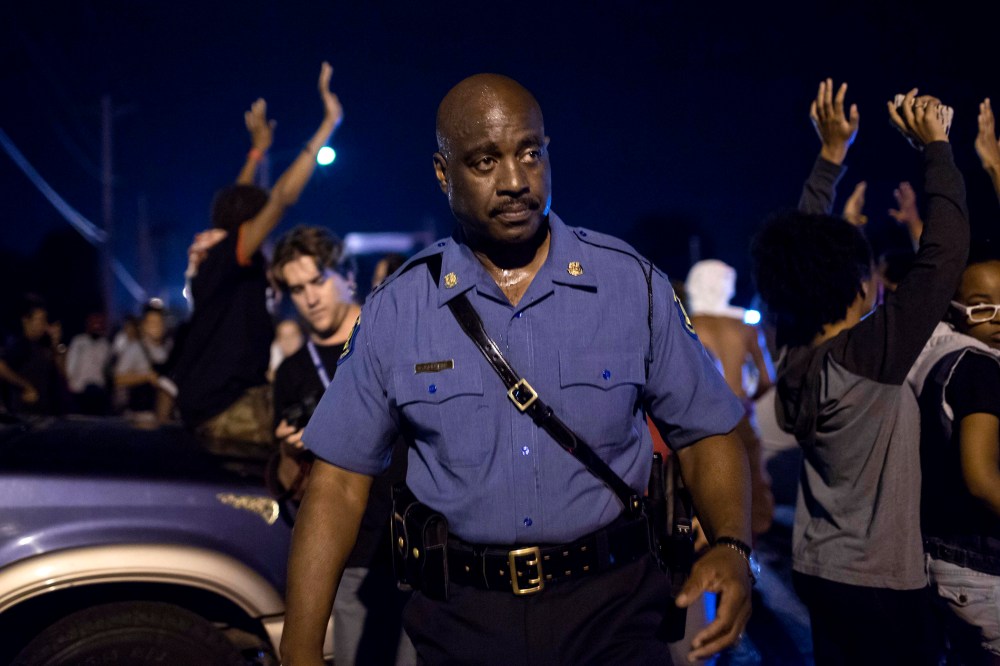
After days of a militarized police response to protests over the police shooting of unarmed black teenager Michael Brown, state Highway Patrol Captain Ron Johnson last Thursday was put in charge of the police response. Under Johnson’s leadership that day, police traded gas masks and rubber bullets for hugs.
Johnson, who is from Ferguson, embraced protesters, both figuratively and literally. He stood in front of television cameras holding a photograph of Brown. He joined them marching down the street.
But empathy alone is not enough. An unequal system cannot be fixed merely by making a black person the face of that system. And if officials had hoped Johnson’s emergence would end days of confrontations between protesters and police, they were mistaken.
%22Did%20Johnson%20keep%20his%20promise%20to%20protect%20Ferguson%20residents%20and%20their%20right%20to%20protest%3F%20They%20probably%20didn%27t%20feel%20very%20protected%20Sunday%20night.%22′
The worst night of clashes came on Sunday, just hours after Johnson delivered a riveting speech at a memorial for Brown at the Greater Grace Church in Ferguson. “I wear this uniform, and I should stand up and say that I’m sorry,” Johnson told the audience. “This is my neighborhood, you are my family, you are my friends, and I am you … I will stand and protect you, I will protect your right to protest.”
But the militarized police seen last week returned Sunday as protests again turned violent. Johnson told reporters he had been forced to escalate after police were targeted by firebombs and gunshots, saying he was “determined to restore peace and safety to the people of Ferguson” and that disturbances were the result of “preplanned agitation.” St. Louis alderman Antonio French said on Twitter that the people acting out Sunday night “are not protesters. This is something different and has little to do with #justiceformikebrown.”
Did Johnson keep his promise to protect Ferguson residents and their right to protest? They probably didn’t feel very protected Sunday night.
Many of those still in the street were tear gassed by police. Guardian reporter Jon Swaine spotted a woman in a wheelchair trying to escape. The Huffington Post’s Ryan Reilly saw an eight year old hit with tear gas. Reporters saw a small number of individuals looting, but gas — which was launched hours before the curfew — struck nonviolent protesters. Some police also threatened reporters, including msnbc’s Chris Hayes, who was told he would be maced if he stepped outside of the assigned media area. A police officer reportedly threatened to shoot the Boston Globe‘s Akilah Johnson. Two reporters were arrested Sunday night, apparently on Johnson’s orders.
By early Monday morning, Missouri Gov. Jay Nixon was calling out the National Guard after Johnson explicitly said such a step wouldn’t been necessary. The optimism that the protests might end with Johnson’s emergence had dissipated.
Ferguson residents are outraged that police have produced little evidence about the circumstances of Brown’s shooting. On Friday, they released — reportedly against the advice of the Justice Department, and without consulting Johnson — an incident report and surveillance video of Brown allegedly robbing a convenience store shortly before his death, but little information about the shooting itself other than to release the name of the shooter, Officer Darren Wilson, after withholding it for days. Wilson, whom police say shot Brown in self-defense after Brown tried to grab his weapon, has left the area and has not been arrested. Witnesses say Brown was shot while attempting to surrender.
The release of the convenience store video struck Brown’s family and other Ferguson residents as a cynical attempt by the police to retroactively justify Brown’s death and shield the police from criticism. Police claim the video had been released in response to media requests — but media have requested much more information that has yet to be released. An independent autopsy commissioned by Brown’s family and released Sunday night found the boy had been shot six times, all from the front — contradicting a witness who said Brown was first shot from the back.
Ferguson residents’ frustrations go beyond Michael Brown. The police force is overwhelmingly white despite the fact that the town is mostly black — and many Ferguson residents have told reporters they have had feel targeted and mistreated by the police on a regular basis. There are few black elected officials owing to low black turnout, the manner in which Ferguson elects city council and school board members, and the timing of local elections, which take place in the spring instead of November — a well worn method of reducing minority turnout.
In the short term, protests in Ferguson might be abated if more information is released about the shooting and the investigation leads charges against Wilson. The problems in Ferguson however, are reflective of larger inequities in law enforcement that have long frustrated black Americans all over the country. Brown was the fourth black unarmed black man to be killed by police in the last month. Blacks are imprisoned for drug offenses at ten times the rate of whites despite breaking drug laws at similar rates, according to the ACLU. Black motorists are far more likely to be stopped than white motorists even though white motorists are just as likely to be caught with contraband. Black offenders are more likely to face harsh sentences than white offenders for the same crimes. The consequences of policing approaches like “zero tolerance,” in which police prioritize punishment for minor offenses — have fallen most heavily on minority communities. Black people in America are simply more likely to find their lives — their families, their educations, their career prospects — irreversibly harmed by contact with the criminal justice system then white people. Johnson undoubtedly shares some of these fears and frustrations. “This is my neighborhood, you are my family, you are my friends, and I am you,” Johnson said. During his speech, he spoke of “my black son, who wears his pants sagging, wears his hats cocked to the side, got tattoos on his arms, but that’s my baby.” Yet Johnson cannot, simply by existing, assuage Ferguson residents’ frustrations with police, anymore than Barack Obama being president can magically end black poverty. “We all oughta be thanking the Browns for Michael, because Michael’s going to make it better for our sons, so they can be better black men, better for our daughters so they can be better black women,” Johnson said at Greater Grace Church on Sunday. “Better for me so I can be a better black father, and you know they’re gonna make our mamas even better than they are today.” The people of Ferguson might settle for better police.
Adam Serwer Recommended


