A voting report released Wednesday by a bipartisan presidential panel offers a frank rebuke to Republicans working to make voting harder—especially through cuts to early voting. And the GOP is already working to limit the report’s impact.
“The administration of elections is inherently a state function so I do not believe that new one-size-fits-all Washington mandates would be of assistance,” Rep. Candice Miller, a former Michigan secretary of state and the House GOP’s point person on voting issues, said in a statement.
The Republican National Lawyers Association, a group of GOP election lawyers that has played a key role in advancing voting restrictions, echoed Miller’s view.
The report has mostly been applauded by voting rights groups and those looking to expand access to the ballot. “The commission’s recommendations are a significant step forward,” said Wendy Weiser, director of the Democracy Program at the Brennan Center, in a statement.
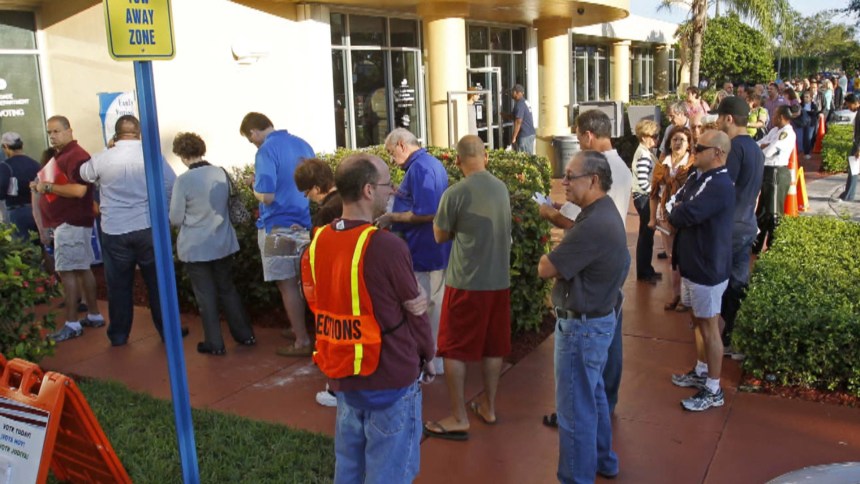
President Obama appointed the Presidential Commission on Election Assistance last year to help fix long lines at the polls, after some voters in Florida and Virginia waited up to eight hours to cast a ballot in 2012. It was chaired by the top lawyers for Obama’s and Mitt Romney’s campaigns, Bob Bauer and Ben Ginsberg, respectively.
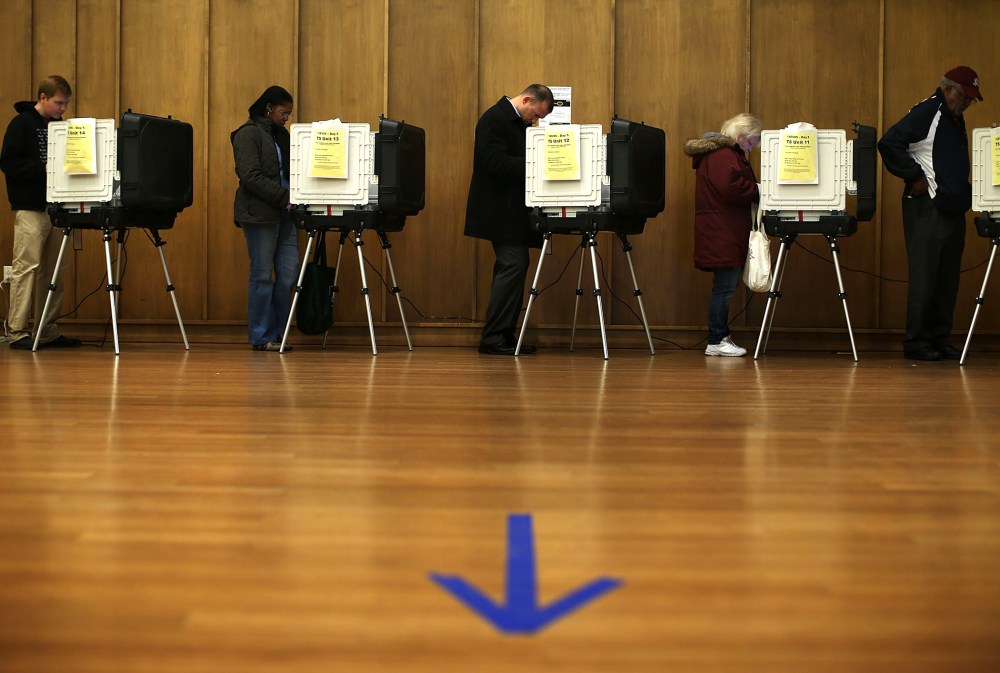
The panel’s report didn’t touch on what’s currently the most controversial voting issue, voter ID, saying the topic was outside its mandate. But one of its key recommendations dealt with another hot-button issue: early voting. “States should expand opportunities to vote before Election Day,” the report advises, in order to reduce the chances of long lines at the polls.
This was among the clearest pieces of advice the panel received in hearing from state and local election officials around the country, Nathaniel Persily, the commission’s executive director, said Wednesday at a briefing on the report.
“It was unanimous among those who testified, whether Democrats or Republicans, that channeling all the voting into one day magnifies the potential for election disaster,” Persily said.
The report also set a specific, low target—30 minutes—for maximum wait times at the polls. That half-hour target, highlighted by Obama on Wednesday, “is now likely to become a benchmark against which election systems and administrators are going to be judged,” Richard Pildes, a prominent election law expert and a top lawyer on Obama’s campaign, wrote online.
Several Republican-controlled states are trying to pare back, rather than expand, early voting.
In a sweeping voting law passed last summer, North Carolina cut the state’s popular early-voting program by a week and ended same-day registration. Noting that blacks are disproportionately likely to use early voting, the U.S. Justice Department is challenging the cutbacks, as well as the law’s voter ID provision, as racially discriminatory under the Voting Rights Act.
Ohio is looking to go even more head-on against the commission’s recommendations. It already passed a law late last year to reduce the minimum number of voting machines that counties are required to have on hand for elections. Now it’s poised to pass cuts to early voting, an end to same-day registration, and a measure that would make it harder to cast an absentee ballot. Experts say that’s a recipe for longer lines on Election Day.
Wisconsin, too, is mulling cuts to its early voting program. The Republican sponsor of a measure to cut weekend voting told msnbc it’s already easy enough to vote. Though the commissioners have said they plan to be “evangelists” for the project, don’t expect them to flat-out condemn efforts to cut early voting. “The report does not get into the business of individual states,” Ginsberg said Wednesday at the briefing, responding to a question from msnbc. “It’s up to individual states to decide on their hours as they see fit.” Indeed, there is debate over how broadly the panel’s non-binding recommendations will be taken up by state and local election officials, who oversee most details of election administration. Heather Gerken, an election law professor at Yale Law School, is optimistic. ”The commission doesn’t just give election administrators yet another a ‘to do’ list,” Gerken wrote online Wednesday. “Unlike any commission I can remember, the president’s commission has given reformers the tools they need to do what the commission is urging them to do.” Both Gerken and the commission assume good faith – or at least a desire to avoid Election Day disasters—on the part of administrators. But Republican officials, especially at the state level, have a partisan incentive to avoid making voting smoother, since doing so tends to advantage Democrats. “To the extent that states want to make it easy for everyone to vote and are willing to devote the resources to achieve that, it’s great that they’ll now have a path to do so,” writes Jonathan Bernstein of Bloomberg News. “But I just don’t see ‘make it easy for everyone to vote’ as a goal that most, or even many, states share.”
Zachary Roth Recommended