








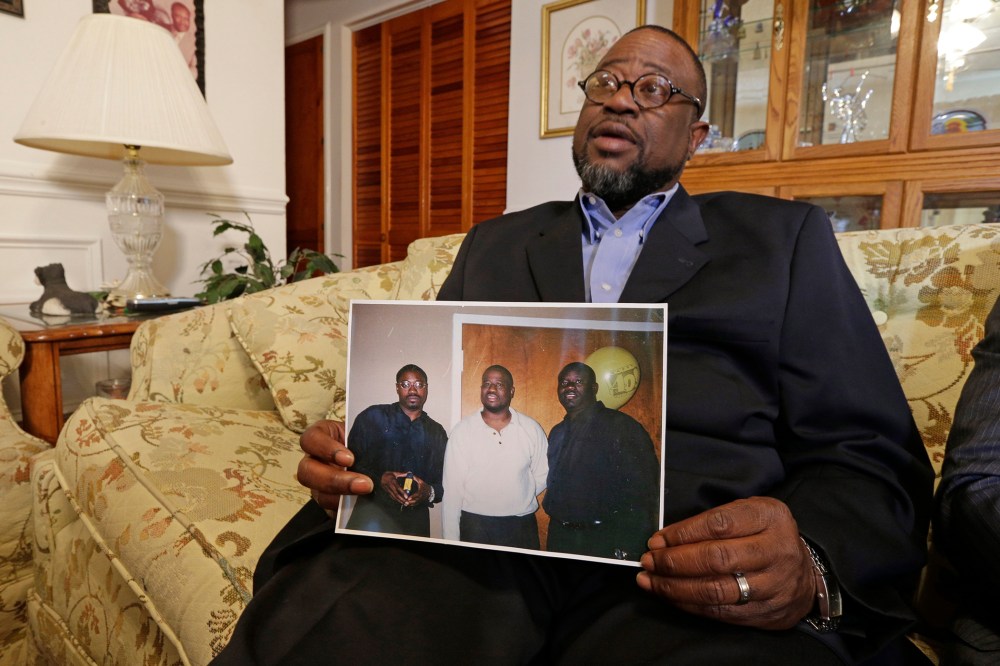
Even before the video surfaced of North Charleston police officer Michael Slager shooting Walter Scott, his family and friends had told the press that they didn’t believe the story that Scott had scuffled with police, that he was not a “violent guy.”
But Scott ran from Slager, family members said, because he feared the police. One reason was because Scott, who had four children, owed back child support, something that in South Carolina and across the country can carry jail time. “I believe he didn’t want to go to jail again,” Scott’s father said on “The Today Show” on Wednesday morning.
Though all 50 states have laws on the books that include jail time for non-payment of child support – a penalty that concerns civil libertarians and children’s advocates alike — South Carolina has one of the harshest regimes in the country when it comes to punishing parents who don’t pay. And there’s no evidence that the punitive measures are working: According to federal data, the state is actually below the national average in every single measure of how effectively it is collecting child support funds.
RELATED: Officer fired but many demand fuller accountability
Two surveys of county jails in the South Carolina conducted in the last decade found that at least one out of every eight incarcerated people were there because they had been held in contempt of court for not paying child support. Under South Carolina law, if a family receives public benefits, it takes only five days of a non-custodial parent, usually a father, falling behind on a payment to trigger a civil contempt hearing that could mean ending up in jail for up to a year. And unlike many other states, South Carolina doesn’t allow modifications for how much child support is owed if the parent is incarcerated, whether for owing child support or another reason. The result in states without such modifications is that people can easily leave jail owing $15,000 to $30,000 in child support, in addition to other fees related to their incarceration.

All this, according to a brief filed before the Supreme Court co-written by the former director of the South Carolina Department of Social Services, has created “a modern day debtors’ prison for poor noncustodial parents who lack the ability to pay support.”
These penalties are levied in the name of supporting children and families, of cracking down on “deadbeat dads” who create “welfare moms.” But, says Ann Cammett, a professor at CUNY School of Law and an expert on incarcerated parents who owe child support, “We have zero evidence that it works.” She adds, “If the goal of the child support system is to get support for children, parents can’t do that if they’re incarcerated.”
Incarceration doesn’t help a parent spend more time with his or her kids, or make it any easier to find a job after being released. “From our perspective, the important thing is for women and children to get reliable and timely support payments,” sats Joan Entmacher, vice president at the National Women’s Law Center. “And that usually doesn’t involve the threat of horrendous penalties that make it harder to earn a living.”
In South Carolina, the state gets involved unusually early: If the non-custodial parent, usually a dad, is only five days behind on payments, that triggers a civil contempt hearing. “I looked nationally, and I could find only one other jurisdiction that had a time frame like that,” Elizabeth Patterson, the law professor who used to run the state department of social services, told msnbc.
If the custodial parent, usually a mom, receives public benefits, the county is automatically involved, whether the custodial parent wants it or not. Any money collected from the non-custodial payment goes to the state, not the family. That’s generally true nationally, though some states pass on some of the money to the family. South Carolina is not one of them.
“What child support enforcement was intended to do was to transfer the responsibility of child support from the state to non-custodial parents,” says Cammett. She argues that this logic has gotten bipartisan support – conservatives because they thought it would encourage two-parent households with male breadwinners and cut down on welfare payments, liberals because they were worried about single moms being left with all the childrearing.
RELATED: South Carolina officer charged with murder
Patterson says in her experience, those who have the ability to pay usually respond to other coercive means – seizing assets, revoking a driver’s license – and it is only the poor who will end up in jail because at a hearing, the court simply doesn’t believe they can’t pay.
At South Carolina’s civil contempt hearings, the non-custodial parent has to show that he or she is trying to pay child support or why they can’t afford to – or else face up to a year in jail. That’s what happened to Michael Turner, who then sued, arguing that because he didn’t have a lawyer at his hearing, his constitutional right to due process had been violated. But when Turner’s case reached the Supreme Court in 2011, Justice Stephen Breyer wrote for the court that there is no automatic right to counsel at such a hearing, because it’s not criminal, even if a year in jail is at stake. Breyer did say a state had to have “procedural safeguards” against jailing someone just because they can’t pay, rather than just refusing to. Ability to pay can sometimes be in the eye of the beholder. A researcher Patterson hired attended hundreds of such hearings in 2010. “Our general impression was that the hearings were too short to look at what the courts need to be looking at, and that there was a very high level of suspicion of what the individual said about why he had not paid. In many instances they were just not believed … unless he had some kind of documentation from a source that was considered more credible than himself,” like a doctor’s note. “Low income persons tend not to be great record keepers,” Patterson added, leaving a system that benefited people who were “more capable of dealing with the system.” Still, Patterson believes the Supreme Court decision had a positive impact, including in South Carolina. The federal government issued guidelines that noted, “There is no evidence that incarceration results [in] more reliable child support payments that families can count on to make ends meet” and urged states to find alternatives wherever possible. The guidelines highlighted debt management, jobs programs, and alternative dispute resolution programs in some states, which keep the proceedings out of the courts except as a last ditch option. In at least one state, failure to fully pay child support can also mean the loss of voting rights. Tennessee gives felons a path to vote again, but in a provision added to the law in 2006, “a person shall not be eligible to apply for a voter registration card and have the right of suffrage restored, unless the person is current in all child support obligations.” Despite a 2010 challenge from men who said their constitutional rights were violated by the law, a federal appeals court upheld it. Once the threat of further jail time for failure to pay child support becomes reality, experts say the incentive is to work in the underground economy or to flee. “It is a major motivator to do anti-social things,” says Patterson. She keeps a collection of news clippings of child support enforcement gone terribly wrong: The man who murdered his child rather than pay support, the man who held up a convenience store to get money for child support. She said she plans to include Walter Scott, the man whose family believed he ran for fear of jail for owing child support, and who was shot in the back by a police officer now charged with murdering him. In an interview with msnbc Wednesday, Walter Scott’s brother Rodney Scott said of the moments before his brother’s death, “He said that’s what he would do, he would run, because he’s not going to jail for child support.” But, choking up as he spoke, he said his brother was a “family man.” “We talked about him buying this big van and taking his kids to Sea World,” Rodney Scott said. “He’s not going to be able to do it.”
Irin Carmon Recommended


