








Updated 10:30 p.m.
Internal Revenue Service staff improperly targeted Tea Party groups for extra scrutiny thanks to poor management at the agency, a highly anticipated internal report has found. The report was made available just hours after the U.S. Justice Department announced a criminal investigation into the scandal.
“Ineffective management .. allowed inappropriate criteria to be developed and stay in place for more than 18 months,” and “resulted in substantial delays in processing certain applications,” the report, prepared by the IRS inspector general and obtained by msnbc and other news outlets Tuesday afternoon, concluded.
In a statement released Tuesday evening in response to the report, President Obama called the IRS’s actions “intolerable and inexcusable,” and “wrong,” and pledged that those responsible would be held accountable.
Treasury Secretary Jacob Lew also released a statement, saying, “While the Inspector General found no evidence that any individual or organization outside the IRS influenced the decision to use these criteria, these actions were inappropriate and did not reflect the high standards which I expect and the public deserves.”
IRS agents are said to have used keyword searches for terms like “Tea Party,” “Patriot,” and “9/12” in order to single out conservative groups for special scrutiny when they applied for nonprofit status.
The report added: “The criteria developed by the Determinations Unit gives the appearance that the IRS is not impartial in conducting its mission.”
The IG also appears to differ with IRS leadership over whether the problems raised by the report have been fully addressed.
“The IRS’s response also states that issues discussed in the report have been resolved,” Michael McKenney, the acting deputy inspector general for audit writes in a memo accompanying the report. “We disagree with this statement as well. Nine recommendations were made to correct concerns we raised in the report, and corrective actions have not been fully implemented. Further, as our report notes, a substantial number of applications have been under review, some for more than three years and through two election cycles, and remain open. Until these cases are closed by the IRS and our recommendations are fully implemented, we do not consider the concerns in this report to be resolved.”
You can read the highlights of the report here and the full report here.
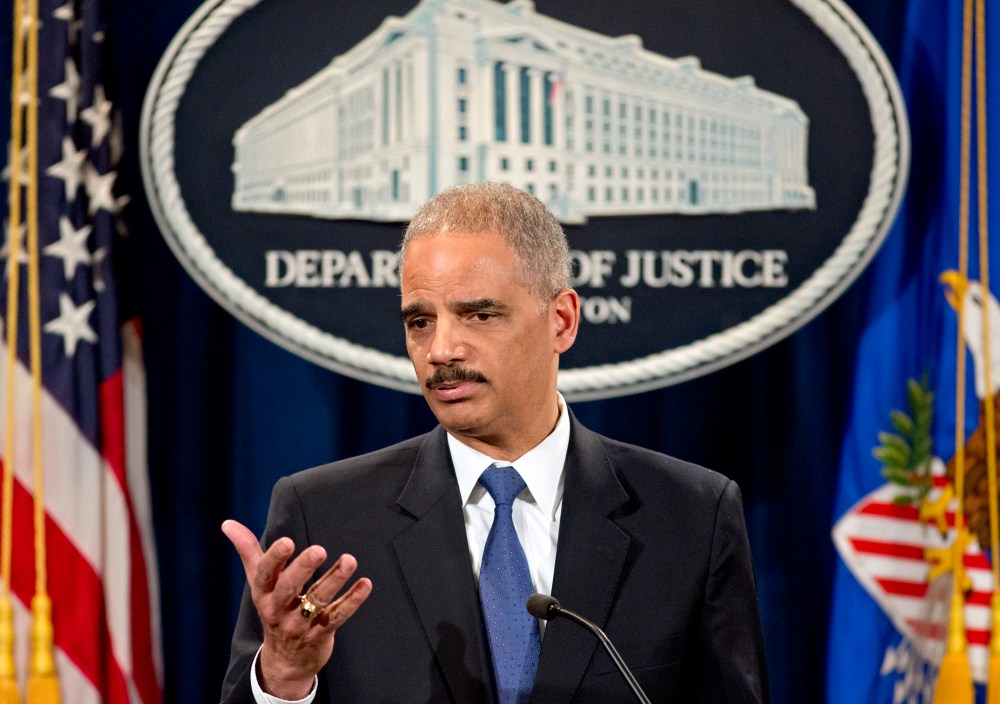
In announcing the Justice Department probe, Attorney General Eric Holder said: “The FBI is coordinating with the Justice Department to see if any laws were broken in connection with those matters related to the IRS. We are examining the facts to see if there were criminal violations.”
The twin developments came as the focus on the scandal intensified across Washington. The House Ways and Means Committee plans to hold a hearing Friday on the issue, and the committee’s Republican chairman, Rep. Dave Camp, and its ranking Democrat, Rep. Sander Levin, have together asked the IRS for all documents relating to the issue, setting next Tuesday as a deadline. Other committees have also pledged to conduct investigations. An IRS inspector general’s report on the episode is set to be released this week.
White House Press Secretary Jay Carney said at a Tuesday afternoon press briefing that those responsible for the targeting “should be held accountable.”
Questions continue to mount not just about the original targeting effort, but about whether IRS leadership informed Congress about the inappropriate targeting in a timely and candid manner.
In a letter sent Tuesday to Lois Lerner and provided to msnbc, the director of the IRS’s Exempt Organizations Division, Reps. Darrell Issa and Jim Jordan wrote: “It appears that you provided false or misleading information on four separate occasions last year in response to the Committee’s oversight of IRS’s treatment of conservative groups applying for tax exempt status.”
An agency official told Congress last year that the IRS routinely brings in the office of its top lawyer to help agents avoid bias when considering applications from advocacy organizations, raising the question of whether senior IRS leadership were aware of an inappropriate effort to target conservative groups for special scrutiny earlier than the agency has said.
In an April 2012 letter to Issa provided to msnbc, Lerner wrote that “tools are available to promote consistent handling” of cases. For example, she continued, “in situations where there are a number of cases involving similar issues (such as…advocacy organizations), the IRS will assign cases to dedicated employees to promote consistency. Additionally, in these cases, EO Technical (an office of specialists in Exempt Organizations) works with the IRS Office of Chief Counsel to develop educational materials to assist the revenue agents in issue spotting and crafting questions to develop cases consistently.”
Issa, the chair of the House Oversight and Government Reform Committee, had written to Lerner requesting information on the IRS’s process of handling applications for nonprofit status, after news reports suggested that the agency had targeted some conservative groups for special scrutiny. Asked by msnbc whether the IRS chief counsel’s office was consulted at the start of the process in which the agency’s Cincinnati office singled out Tea Party groups, an IRS spokesman pledged to respond, but has not yet done so. If the chief counsel’s office was brought in on the front end of the process, it could mean top agency personnel in Washington, D.C., were aware of the targeting much earlier than the IRS has previously said. According to a draft of the inspector general’s report that has been seen by congressional offices, the effort began in March 2010, and the agency’s chief counsel was not briefed on the issue until August 2011. If the chief counsel’s office wasn’t brought in, it would raise questions about whether Lerner provided misleading information in response to a congressional inquiry. In response to Issa’s March 2012 inquiry, Lerner sent both a 10-page letter quoted above, and a more detailed 45-page followup the following week. Lerner also met with committee staff in March and May 2012. But at no point did she mention that Tea Party groups had been targeted, according to committee staff and a review of the letters. According to the IG’s draft report, Lerner was told of the targeting in June 2011, and quickly ordered a halt to the effort, though a modified version of the targeting later restarted. Lerner isn’t the only top official who may have withheld information about the targeting from lawmakers. Around the same time that Issa was making inquiries, Rep. Charles Boustany also wrote to the agency asking specifically whether Tea Party groups had been targeted. In a June 15 response, Steven Miller—then the IRS deputy commissioner, now its acting commissioner—wrote that the agency “took steps to coordinate the handling of the case to ensure consistency,” but didn’t say that the groups had indeed been targeted, the AP reported. The following month, Miller testified before the House Ways and Means Committee and was asked whether the IRS had harassed political organizations, but again did not mention the targeting of Tea Party groups. It’s a serious problem for agency officials to be less than forthcoming in response to inquiries from Congress, one former IRS commissioner told msnbc. “One of the fundamental obligations you have as the head of the service is to communicate with the American people and their representatives about what’s going on at the service,” Mark Everson, who led the IRS from 203 until 2007, said. “So you need to be candid and forthright with the Congress.” Everson said that’s especially true given the widespread public antipathy toward the nation’s tax collecting agency. “It’s good sport to criticize the IRS. Nobody sticks up for the IRS,” Everson said. “So the only way you can mitigate that is to at least make sure that you’ve been entirely candid and you can’t be criticized for withholding things.”
Zachary Roth Recommended


