








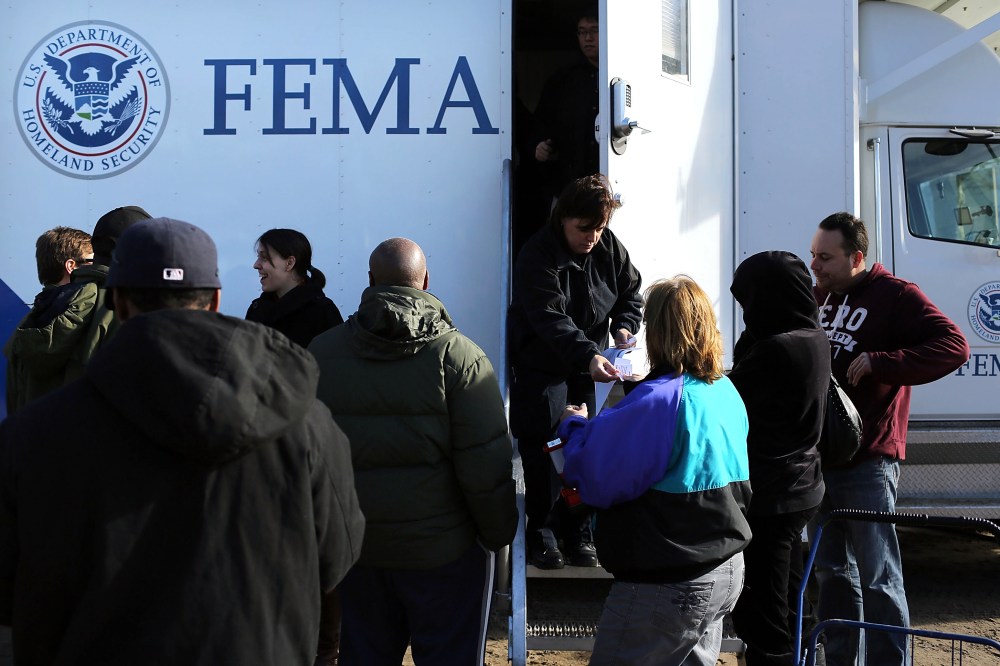
Nearly $40 million of relief aid distributed by the Federal Emergency Management Agency in response to Hurricane Sandy may have been “improper or fraudulent,” according to a new report released on Friday.
According to the Government Accountability Office, an independent watchdog for Congress, $39 million in possible improper payments were discovered, representing about 2.7% of the $1.4 billion doled out by FEMA to almost 183,000 survivors following the 2012 hurricane.
RELATED: Angry residents sound off on Sandy aid
%22We%20don%E2%80%99t%20know%20whether%20it%20was%20inadvertent%20or%20intentional%2C%20or%20a%20combination%20of%20the%20two.%22′
The GAO report does note, however, that the percentage of funds deemed at risk for being improper or fraudulent is much lower in comparison to the percentage in the aftermath of Hurricanes Katrina and Hurricane Rita in 2005. In those natural disasters, 10% to 22% of relief assistance was deemed at risk. GAO attributes the decline to new governmental controls and oversight implemented since the mid-2000s.
Examples of improper payments include money going to ineligible recipients or the duplication of assistance, Seto J. Bagdoyan, the director of forensic audits and investigative services at the GAO, told msnbc. Bagdoyan said it is not possibly to definitely determine whether or not the payments were improper without inspecting each on a case-by-case basis, but red flags and indicators suggest they may have been.
“We don’t know whether it was inadvertent or intentional, or a combination of the two,” Bagdoyan said. RELATED: A Sandy aid mystery in New Jersey FEMA did push back on the GAO’s findings, insisting that at least $6.1 million of the $39 million were not used improperly or fraudulently. The GAO could not independently confirm their conclusion. Republican Rep. Michael McCaul, who asked for the report, told NBC News that the potential misuse was “reckless and simply unacceptable.” McCaul, chairman of the House Homeland Security Committee, added that while the percentage of improper payments may have dropped, “it isn’t enough.”Recommended


