








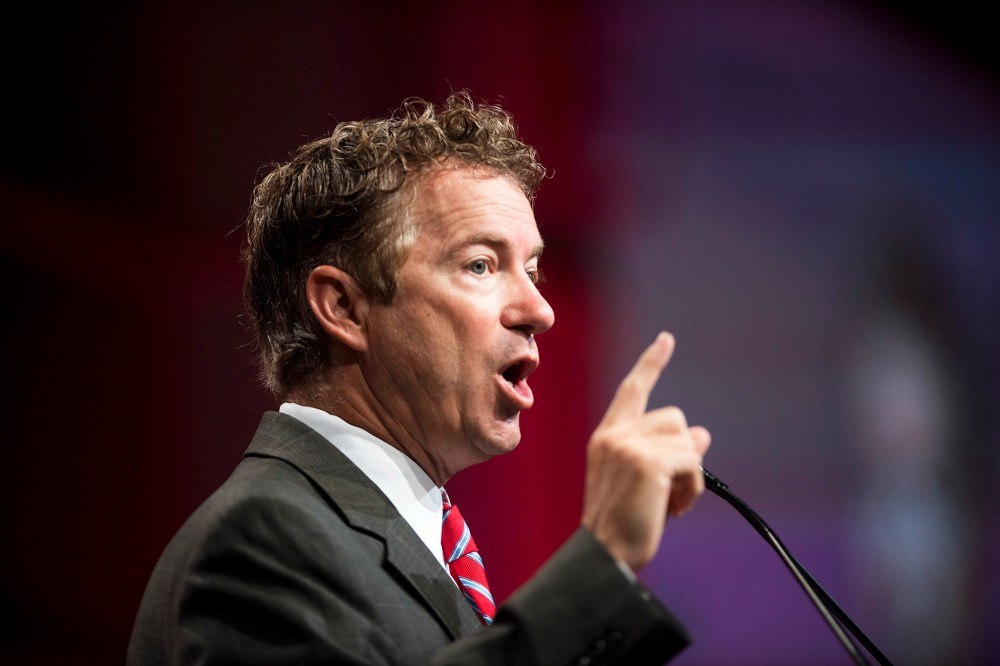
Threading the needle between his noninterventionist roots and the GOP’s hawkish center, Rand Paul laid out what he called a “foreign policy that recognizes our limits and preserves our might” in a speech in New York on Thursday.
“We can’t retreat from the world, but we can’t remake it in our own image either,” Paul said at a dinner hosted by the Center For The National Interest, a think tank founded by former President Richard Nixon.
RELATED: Rand Paul: Government isn’t telling truth about Ebola
Paul’s foreign policy views are under intense scrutiny in the run up to what is an expected presidential run in 2016. The libertarian movement led by his father, former Congressman Ron Paul, is highly skeptical of engagement abroad, either through military action or humanitarian aid, and often traces conflicts with hostile governments to avoidable provocations by America and its allies. This take often puts its leaders at odds with a GOP that traditionally favors a more muscular policy abroad, a tendency exacerbated by the rise of the Islamic State.
As Paul made clear in his speech, however, he has taken care over the last four years to differentiate himself from his father’s views, however, while still advocating for a broad wariness of military and diplomatic entanglements overseas. After previously calling for ending all foreign aid, he backed down over criticism that his proposals would cut support to Israel. He also came out in support of operations to dismantle ISIS last month, overcoming initial doubts over whether it was a feasible goal in the national interest.
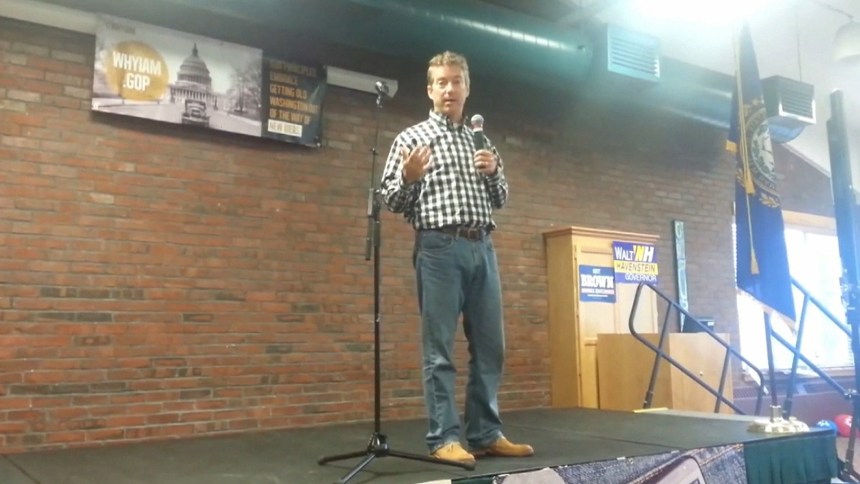
In his remarks, Paul reiterated his support for airstrikes, but stressed that America should not overstep its limited objectives of disrupting an immediate terrorist threat. “Although I support the call for defeating and destroying ISIS, I doubt that a decisive victory is possible in the short term, even with the participation of the Kurds, the Iraqi government, and other moderate Arab states,” he said. “In the end, only the people of the region can destroy ISIS.”
Those in the GOP’s neoconservative wing hoping Paul’s speech might mark a conversion to their cause were likely disappointed. The senator reiterated his opposition to arming Syrian rebels and to President Obama’s 2011 air campaign against Libyan dictator Muammar Gaddafi. He frequently dinged the current Democratic White House and his own party’s hawks from the left.
As a cautionary tale, Paul cited the war in Afghanistan, which he called “an example of a just, necessary war” when it was initially launched with a clear goal of targeting al-Qaida terrorists. After routing the Taliban, however Paul said the war morphed into a “nation building” mission with no end in sight.
“We have now spent more money in Afghanistan than we did for the Marshall Plan and yet after the killing of bin Laden and the toppling of the Taliban, it is hard to understand our exact objective,” he said. “Stalemate and perpetual policing seem to be our mission now in Afghanistan, Iraq, and Syria.”
RELATED: Rand Paul slams ‘barnacled enablers’ of war in Senate barnburner
Panning the camera out, Paul complained that Obama and past presidents had fueled radicalism abroad by supporting strongmen like Egypt’s deposed dictator Hosni Mubarak and by waging unpopular air campaigns against suspected terrorists in unstable countries.
“Some anger is blowback, but some anger originates in an aberrant and intolerant distortion of religion that wages war against all infidels,” Paul said. “We can’t be sentimental about neutralizing that threat, but we also can’t be blind to the fact that drone strikes that inadvertently kill civilians may create more jihadists than we eliminate.” He quoted recent Nobel Prize winning Pakistani activist Malala Yousafzai, who told CBS News last year, “It is true that when there’s a drone attack … terrorists are killed. But 500 and 5,000 more people rise against it and more terrorism occurs.” A delicate balance It’s an open question how well Paul will be able to maintain a delicate balance between demonstrating his willingness to protect American interests abroad while challenging his party to reconsider their underlying causes. Sensing a potential wedge, other possible 2016 rivals like Rick Perry have already picked fights with Paul on foreign policy over the last year. Democrats, preparing for a likely run by former Secretary of State Hillary Clinton, are already signaling that they’ll use Paul’s foreign policy pronouncements over the years to portray him as an isolationist kook. “Paul’s been clear about his goal: he wants to see America retreat from our responsibilities around the world,” Democratic National Committee spokesman Michael Czin said in a statement before Paul’s speech. “That includes support for a fringe proposal to end our membership in the United Nations, ending all aid to our allies like Israel and slashing programs that help developing nations combat major public health crises.” RELATED: Rand Paul’s hawkish turn breeds unease at libertarian conference Given that Clinton hails from her party’s own relatively hawkish wing, Paul’s candidacy may represent the best chance in 2016 for a true, no-holds barred debate over foreign policy that takes partisan on both sides out of their comfort zone. With reports suggesting Paul may be among the first presidential hopefuls to declare his candidacy, that debate begins in earnest now.
Benjy Sarlin Recommended


