








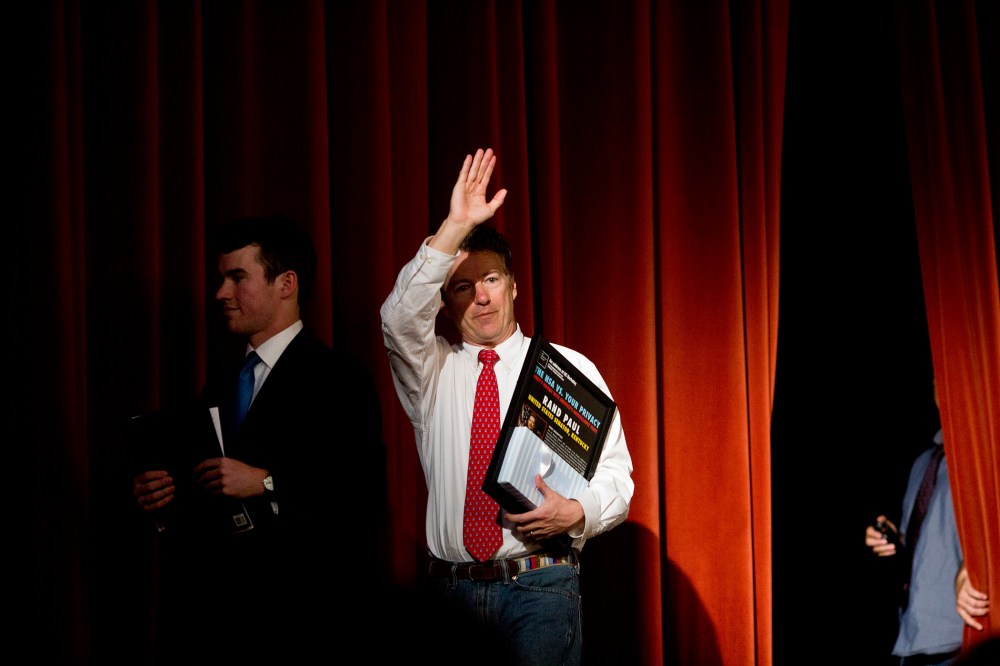
Rand Paul has had it up to here with these billionaires.
“We cannot be the party of fat cats, rich people, and Wall Street!” he told conservative activists at the New Hampshire Freedom Summit earlier this month. The summit was organized by the Americans For Prosperity Foundation, a project of the billionaire industrialist brothers Charles and David Koch.
“We can’t be the party of the plutocrats and the rich people!” Paul added later.
With that call to arms, Paul exhorted conservatives to don their culottes, grab a pitchfork, round up the big business elites and cut off their … tax rates.
“What did Ronald Reagan do, did he come forward and say ‘Oh, lets just cut taxes for low-income people?” he said. “No! He said forthrightly ‘Let’s cut everyone’s taxes.’ He did dramatically. The top rate, that’s what rich people pay, the top rate was 70%, he lowered it to 50% then he lowered it again to 28% and 20 million jobs were created!”
Mocking the naysayers who might think better of cutting taxes on the 1% during a period of exploding inequality, Paul quipped: “Anybody here ever work for a poor person?”
That’s a message that might go over well when Paul meets with top donors for Mitt Romney’s 2012 campaign. But it also illustrates the struggle GOP candidates face in getting past the party’s rich guy image, which the Republican National Committee warned was “doing great harm to the party and its candidates” in its autopsy of Mitt Romney’s presidential loss in 2012.
Democrats are preparing to run harder than ever on income inequality in 2014 and beyond, and their latest round of Koch-related attacks are part of a broader effort to paint the GOP as hopelessly captured by the ultra-rich. Republicans know it’s coming, but there isn’t any clear consensus as to what to do about it. Nobody has figured out an answer that satisfies the party’s competing goals of securing tax cuts for the donor class, balancing the budget, and appealing to the 99%.
Paul’s pitch to the plutocrat wing is that you can still get your tax cuts if he’s elected president. He’ll even fight for the tax cuts the multimillionaire Romney was too chicken to endorse, like eliminating the capital gains tax, a move that would reduce Romney’s own tax bill to almost nothing. All that rich folks have to do is to stand by and let Paul complain about corporate subsidies a bit and run against the NSA in order to bring in some young voters.
“It’s not that young people don’t like our message of low taxes and less regulation and balanced budgets, they just don’t have any money,” Paul said in New Hampshire.
Heck, one of Paul’s proposals to woo minority voters is to cut taxes for rich people even more. How hard is it to say yes to that?
Paul’s isn’t the only emerging pitch to wealthy donors out there, though it’s the most explicitly mapped out. For Mike Huckabee, it might be “You can keep your tax cuts, let’s just talk about social issues more and so we can turn out evangelicals.” For Paul Ryan: “You can keep your tax cuts, let’s just talk about poverty too.” For Marco Rubio: “You can keep your tax cuts, let’s just pass immigration reform.”
As a libertarian true believer, Paul might be more concerned with purity than how his combination of massive tax cuts for billionaires and draconian cuts to the welfare state will play out politically. But for pragmatic candidates who are more worried about the rich guy issue, the quest for a better approach remains problematic.
Republican leaders run into trouble reconciling their fervent devotion to lower taxes with their other stated goals. If you cut taxes on the rich, you have to blow up the deficit, take a hatchet to social spending, or raise taxes on the non-rich to pay for it. For Paul, the answer so far seems to be the “blow up the deficit” route on taxes – he sneers at the phrase “revenue neutral tax reform” in speeches and argues that explosive economic growth will close fiscal gaps — and the “take a hatchet to social spending” route on spending. In other words, peak plutocrat. Romney tried to get around this problem in 2012 by proposing a revenue-neutral 20% cut on tax rates, which he pledged to offset by eliminating tax breaks that primarily benefit the wealthy. But as the nonpartisan Tax Policy Center quickly figured out his plan was mathematically impossible without raising taxes on vast swaths of the middle class, making it an easy target for Democratic attacks. Notably, the same report mentioned that Ryan’s plan to cut tax rates even further, a version of which is included in his most recent budget, encountered the same problem. Senators Rubio and Mike Lee, who are collaborating on a plan to expand tax credits for middle class families, are running into problems of their own — an early draft of Lee’s idea reduced revenues by $2.4 trillion over ten years. They’re still working out the kinks, but part of the reason the gap is so big is that Lee’s supposedly populist proposal still slashes taxes for the ultra-rich. Any of these plans could offset the revenue losses elsewhere, but that means even more severe cuts would be necessary to achieve the GOP’s other ironclad goal: eliminating the deficit. Ryan effectively abandoned his much vaunted poverty focus in his latest budget, which reduced spending on anti-poverty programs even more than his previous proposals. As the GOP’s base gets older, the party is also getting more reluctant to tear into big ticket entitlement items like Medicare. The various GOP proposals could tweak the math to keep things both revenue neutral and from getting more regressive, but that would just enrage the rich guys who are the main force behind the party’s tax cut platform in the first place. Just look at GOP Rep. Dave Camp, whose recent plan took the most ambitious stab yet at lowering income tax rates, protecting the non-rich from a tax increase, and maintaining revenue. He achieved his goals with a package that included new taxes on the finance industry and a 35% top rate versus Ryan’s 25%. Republican leaders blew it off, 50 GOP members of Congress signed a letter decrying Camp’s ideas, and Camp announced his retirement soon after. Finally, Republicans could just accept a tax increase, full stop, as part of a deficit cutting deal. Of the major prospective candidates, only Jeb Bush has even flirted with the idea and it promises to be one of his biggest vulnerabilities if he runs for president. Jeb’s older brother, George W. Bush, got around all these issues by putting his entire tax cut on the national credit card while bumping up spending too, effectively having his political cake and eating it. None of the candidates running in 2016 will have that option, which means that absent a stunning reversal of party leaders’ priorities, the GOP’s plutocrat problem isn’t going anywhere.
Benjy Sarlin Recommended


