








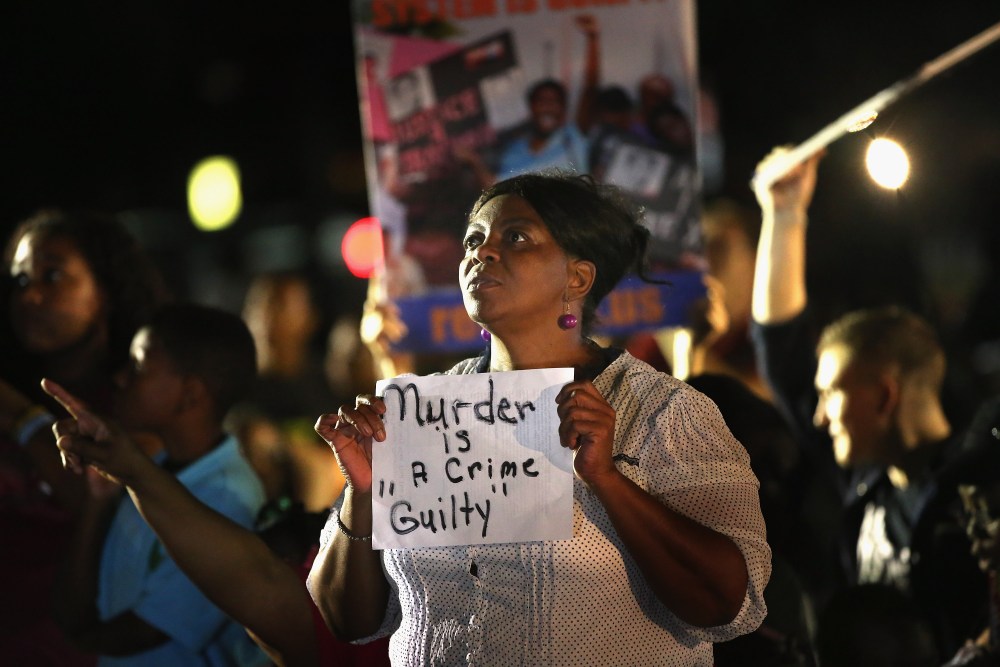
A Florida jury has acquitted George Zimmerman on charges of murder in the second degree in the killing of Trayvon Martin. When Martin’s slaying first captured media attention, most African-Americans coalesced around the belief that racism explained the teen’s death and the decision by prosecutors not to file charges. On the other hand, many whites believed the case did not warrant so much media attention and that Zimmerman likely killed Martin in self-defense.
Martin’s death, however, is not a simple tale of two competing racial narratives. Instead, it involves complex questions about procedural aspects of criminal justice and the ongoing relevance of race in the United States.
The Constitution requires that prosecutors establish guilt “beyond a reasonable doubt.” This extraordinarily high standard exists in order to protect individuals from governmental abuse of power. Although the meaning of reasonable doubt sounds precise, deciding whether such doubt exists is not reducible to a mathematical equation. Instead, as many prosecutors and criminal defense lawyers would attest, reasonable doubt exists when a jury says it does.
Admittedly, extreme cases occur in which a defendant is clearly guilty or not. Many cases, however, fall somewhere in the middle where rational jurors can disagree on the issue of reasonable doubt. If this were not true, then hung juries would never occur and verdicts would never stun defense lawyers or prosecutors.
Criminal law research has shown that in tough cases, implicit biases regarding race, gender, class and other factors, often, but not always, allow jurors to fill in evidentiary gaps. This research makes room for a discussion of race in the decision by a nearly all-white jury to acquit Zimmerman.
There was enough circumstantial and direct evidence presented in the trial for a reasonable juror to find that Zimmerman initiated physically aggressive contact with Martin. This finding would virtually negate Zimmerman’s claim of self-defense. Zimmerman admitted that he followed a much younger Martin in his car at night in the rain. Martin was walking home while having a telephone conversation with a friend. As he pursued Martin, Zimmerman muttered angry statements about criminals “always getting away” with their crimes.
Zimmerman, however, killed the most reliable eyewitness for the prosecution. Accordingly, the prosecution lacked direct evidence about what actually occurred when Martin and Zimmerman first met. As a result, a rational juror has room to make inferences based on all of the evidence. A juror could rationally conclude that after getting out of his car and following Martin, Zimmerman either attacked or frightened the teen. This finding would have legitimated Martin’s use of force against Zimmerman. On the other hand, a rational juror could decide not to reach such a conclusion, due to the lack of direct evidence. Circumstantial evidence is indisputably evidence, but it is not always enough for jurors.
Outside of the requirement of reasonable doubt, no rules dictate which choice jurors must make. So long as the verdict is reasonable in light of the evidence, the jury has satisfactorily executed its duty. Moreover, the prosecution cannot appeal an acquittal or demand that the jury explain its decision.
Psychological data regarding non-conscious bias suggests that people often rely unknowingly on cultural biases to make a decision in close cases. Because black men are pervasively depicted as violent and threatening, unconscious stereotyping could lead a fair-minded juror, in a tough case, to dismiss the victim status of a black male decedent and to treat him, instead, as the aggressor. This same research could explain why Zimmerman believed that Martin was “up to no good.” Determining the significance of race in Martin’s death and Zimmerman’s acquittal requires a more complicated analysis than simply asking whether Zimmerman is a bigot or deciding that he is not racist because he has a black grandmother. Addressing this issue cannot rest on accusations that cops, prosecutors, jurors, and “the system” hate black people or bald assertions that justice is colorblind. Race does not matter here because the media and civil rights activists conspired to make it relevant. Instead, race matters because it is subtly and culturally embedded within American social interactions and institutions. Had Martin been a white female and Zimmerman a black male, the media narrative regarding the case and the verdict would have likely differed. Statistical data supports this claim. Several Florida and national studies, for example, demonstrate that self-defense claims result in more acquittals or dismissals when the victims are black. These patterns become even more pronounced in interracial cases — ones with white victims and black defendants. Racial disparities in self-defense cases are also more common in jurisdictions, like Florida, with controversial “Stand Your Ground” laws (see, e.g, reporting by Frontline, the Urban Institute, and the Tampa Bay Times). Racial patterns related to self-defense and other aspects of criminal justice require creative and sustained thinking regarding legal reform. A concentrated public effort to deny the relevance of race and to denounce people who believe it remains significant is unjustifiable in light of substantial academic research and United States racial history.
Darren Hutchinson Recommended


