Charlie Hebdo is coming out swinging — and Muslim leaders aren’t happy.
The satirical news magazine, whose staff was massacred last week after publishing cartoons of the Prophet Muhammad, plans to confront its attackers with a new issue that features an image of the Islamic holy figure on the cover. While Muslim leaders condemned the attacks unilaterally last week, on Tuesday, they pushed back ahead of the new issue’s publication. Some interpret the Koran as forbidding visual depictions of Muhammad.
The planned cover depicts a bug-eyed prophet Muhammad with a hook-nose and a single tear on his cheek, holding up a sign that says “Je suis Charlie” or “I am Charlie.” “Tout est pardonne” — all is forgiven — is scrawled along the bottom of the cover.
Charlie Hebdo will print 3 million copies of the next issue in 16 languages. It will be released Wednesday and become available for wider purchase in two weeks. A traditional run of the publication includes 60,000 copies, all of which are in French.
Muslim leaders in Egypt have urged the magazine not to publish the issue; the official Religious Edict Authority, Dar El Ifta, warned that Charlie Hebdo risked offending 1.5 billion Muslims, insisting that the publication could further aggravate relations between Muslim and non-Muslim communities. Dar El Ifta’s edicts are widely respected and followed, though not compulsory, within the Muslim world.
RELATED: Surviving staff will not be silenced
But the magazine won’t back down. In a press conference on Tuesday, the magazine’s chief editor, Gerard Biard, said the issue was produced both “in sadness and in joy” but that the staff “are pleased we have done it.” “I am not worried about the cover because people are intelligent,” Renald “Luz” Luzier, who drew the image, said.
The fear of reprisals comes amid the continued search for accomplices – and a possible terror cell hidden in Paris – as France attempts to recover from a three-day string of terror attacks that left 17 dead.
A French national with apparent links to one of the alleged Charlie Hebdo killers was arrested in Bulgaria as he tried to enter Turkey, officials confirmed Tuesday. The man, 29-year-old Fritz-Joly Joachin, was arrested on Jan. 1, but on Tuesday, Bulgarian officials confirmed to NBC News that Joachin had alleged links to Cherif Kouachi, one of the alleged gunmen in last week’s massacre. The Bulgarian prosecutor’s office released a statement Tuesday saying that French authorities originally wanted Joachin for kidnapping, but later issued a second warrant Tuesday alleging that he’d been involved in an “organized crime group plotting terrorist acts.”
French Prime Minster Manuel Valls said Monday that “without a doubt,” there are still accomplices in Paris; on Tuesday, Le Figaro reported that French authorities were working feverishly to track potential accomplices, determine who trained them, and learn how they obtained firearms.
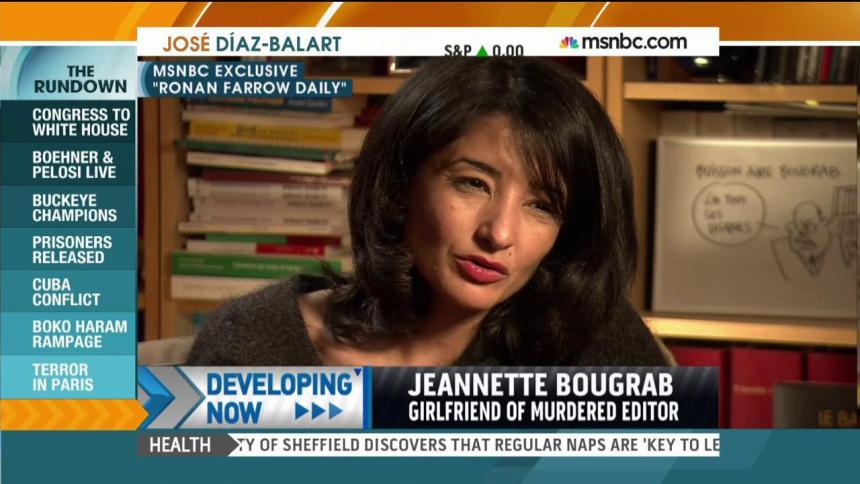
RELATED: Exclusive interview with the editor’s widow
As the hunt for accomplices continues — just days after more than 10,000 security personnel were mobilized to search for slain suspects Cherif and Said Kouachi, and just days after the violent stand-off with the alleged gunman at the kosher grocery store, Ahmed Coulibaly, Paris has begun to mourn and bury its fallen citizens. Still, a handful of key questions remain.
1. What group, if any, did the gunmen represent? Cherif Kouachi said he was working for al-Qaida in the Arabian Peninsula, and officials have confirmed he visited Yemen, meeting with al-Qaida operatives including Anwar Al-Alwaki in 2011, while his friend, Coulibaly, pledged his allegiance to the Islamic State in a video posted online. Neither group has claimed responsibility for the attacks, though the Islamic State has celebrated them.
White House spokesman Josh Earnest said Tuesday that the U.S. had provided France with intelligence on the travel behaviors of the suspects involved in the attack.
There is some fear that Coulibaly could have been part of a larger terror cell in Paris, as one of the weapons he used at the kosher supermarket shooting was linked to another shooting in Montrouge. If that shooting was committed by a different individual, it could indicate that there’s a larger terror cell involved. A video of Coulibaly talking about the attacks appears to have been edited and posted by someone after the gunman died, Le Figaro added. PHOTOS: Photos from largest-ever rally in France Coulibaly’s common-law wife, Hayat Boumeddiene, and a fourth individual are the targets of an international manhunt for their connection to the Paris attacks. Boumeddiene is believed to be in Syria, crossing into the country the day Coulibaly allegedly shot a police officer in Montrouge. 2. Where did the gunmen get their firearms? The weapons used in the three attacks did not come cheap. A weapons specialist tells Le Figaro that the Kouachi brothers’ weapons would have cost 7,000 euro and Coulibaly’s would have cost 6,000 euro. 3. The Kouachi brothers are thought to have paid with counterfeit bills, but how did Coulibaly – a common criminal in the eyes of the police, with robbery and drug convictions – obtain such weaponry? Meanwhile, Paris and the Jewish community continue to mourn the victims. In Paris, French President François Hollande led a ceremony at police headquarters honoring the three police officers who died in the attacks, where he posthumously awarded the fallen officers the country’s highest honor, France’s legion d’honneur. In Israel, the funerals of the four Jewish victims who died in a kosher grocery store last week were held in Jerusalem, led by Israel’s president and prime minister. “We didn’t want to see you come to Israel this way. We wanted you alive. The whole country is mourning your loss,” President Reuven Rivlin said at the funeral, which attracted thousands of mourners in the Givat Shaul neighborhood of the city. “We just witnessed your huge sorrow. I know what you are feeling. The whole state is embracing you. Your relatives were killed only because they were Jewish. I say today the terrorists are not only our problem, but the world’s problem,” Prime Minister Benjamin Netanyahu said.
Jane Timm Recommended