








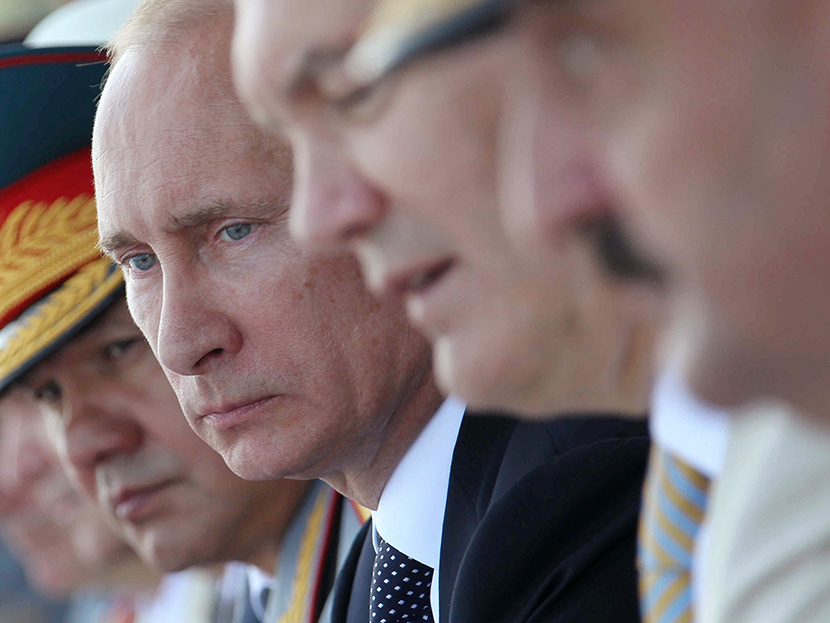
Russian president Vladimir Putin Saturday rejected the need for any western intervention in Syria on the grounds that the regime of President Bashar al-Assad used chemical weapons against civilians Aug. 21, calling the charge a “provocation.”
“With regard to our American colleagues and friends, who say that the government forces have used chemical weapons of mass destruction and who say that they have proof of this—let them show this evidence to the U.N. and the Security Federation. But the references to the fact that they have such evidence but that it is secret—cannot give way to any kind of criticism,” Putin said from Vladivostock. “It is just not respectful to their partners and international figures. If there is evidence, it must be provided. If they are not provided, that means it’s not there.”
In an aggressive speech Friday outlining the intelligence that the U.S. has gathered on the attacks, Secretary of State John Kerry said that “the U.N. can’t tell us anything we haven’t shared with you or we don’t already know.” More specifically, Kerry argued that “Russian obstructionism” on the U.N. Security Council would make an international coalition to move against Assad unlikely.
Disagreement over Syria is the latest source of tension between the U.S. and Russia. Putin’s protection of N.S.A. leaker Edward Snowden, and Russia’s draconian LGBT laws ahead of the Sochi Olympic games have both drawn criticism from the White House. President Obama will head to the G20 segment in St. Petersburg next week.
Putin added that Syrian forces have been closing in on rebels and that, “to give the prize to those who constantly call for foreign military intervention, is utter nonsense. It does not follow any logic.”
“This is why I am sure this is just a provocation of those who want to drag other countries into a Syrian crisis—those who want the support of powerful international players—primarily the United States,” he said.
President Obama said Friday that he had not yet made a decision about what kind of action the United States would take, but that he was considering a “limited narrow act” against the Assad regime after what his administration said was undeniable proof that more than a thousand people, including more than 400 children, had died after a nerve gas attack by the Syrian government.
“We have currently rules in place dealing with the proliferation of weapons of mass destruction, we have international norms that have been violated,” Obama continued. “The U.N. has put sanctions in place, but if there’s a sense no one is willing to enforce them then people won’t take it seriously.” U.N. weapons inspectors left Damascus early Saturday morning, possibly clearing the way for an American strike. Shortly before Obama’s statements Friday, Kerry delivered his forceful remarks, arguing for Syria to be held accountable for the weapons use, and the administration released a non-classified intelligence report describing its proof of the use of chemical weapons. “It matters to our security and the security of our allies,” Kerry said of responding to Assad. “It matters to Israel. It matters to our close friends in Jordan, Turkey and Lebanon, all of whom live just a stiff breeze away from Damascus. It matters to all of them where the Syrian chemical weapons are–and if unchecked they can cause even greater death and destruction to those friends.”
The place for in-depth analysis, commentary and informed perspectives. Recommended


