








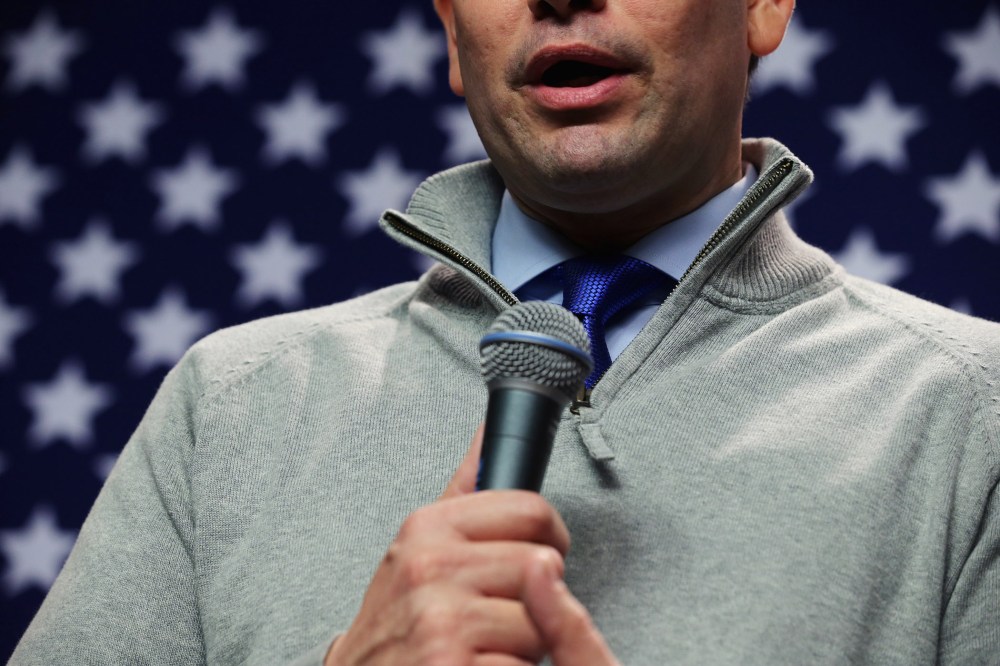
Monday was a good night for Florida Sen. Marco Rubio for more reasons than one. While he placed better-than-expected in the Iowa caucuses, representatives from the super PAC supporting him was hobnobbing with some of the wealthiest Republican donors in the country.
Jon Lerner, media consultant with Conservative Solutions, the super PAC backing Rubio, is one of several pro-Rubio fundraisers to meet with donors at Charles and David Koch’s exclusive retreat.
The response from the donors was “very positive,” a source with knowledge of the group’s fundraising efforts told NBC News.

The attendance of pro-Rubio officials, however, is another sign that the Kochs like the young first-term senator and an opportunity for Rubio to tap into the networks’ deep pockets.
The Kochs, who spent an estimated $400 million in the 2012 cycle, have not committed to endorsing in the Republican primary, but they are closely monitoring the field.
The Kochs play close attention to policy positions the candidates take that would promote a small-government and free-market. They also are looking at viability, according to a source within the Koch’s organization Freedom Partners.
Of the preferred candidates, Rubio and Sen. Ted Cruz are currently the best performing. Kentucky Sen. Rand Paul dropped out this week, former Hewlett Packard CEO Carly Fiorina is struggling to gain attention and former Florida Gov. Jeb Bush is stuck in the single digits in polling.
One thing is clear: they don’t like Donald Trump.
Rubio’s third place finish in the Iowa caucuses, just one percentage point behind Donald Trump, has given him momentum heading into upcoming contests. The Florida senator gained the support of 23 percent of Iowans, which was well above the mid-teens where he was polling.
RELATED: Koch brothers’ network considering anti-Trump campaign
Rubio’s team was happy with his finish because he placed well above any other candidate vying in the establishment lane of the party, including former Florida Gov. Jeb Bush, New Jersey Gov. Chris Christie and Ohio Gov. John Kasich. The four candidates don’t just compete for votes but for the same type of donors.
After an incredible fundraising start by Bush, Rubio is playing catch up. Rubio raised $14.2 million in the last quarter of 2015, behind Sen. Ted Cruz’s $20.5 million and Carson’s $22.6 million. Bush raised $7.1 million in the last quarter. As for the super PAC race, the pro-Rubio Conservative Solutions PAC, raised $14.4 million in the second half of 2015, according to FEC records. The PAC’s fundraising efforts mirrored Right to Rise, Bush’s super PAC in the last half of the year. It raised $15.1 million, far less than the $103 million it raised in the first six months of 2015. The outcome in New Hampshire is likely to continue to mold the field. While the individual donors, many of which have contributed to presidential campaigns, are not a monolithic group supporting a variety of candidates, Rubio was a candidate several could get behind. “I would love Rubio because he’s the most electable,” Liz Wright, a donor at the Koch retreat, said. This article originally appeared on NBCNews.com.
Leigh Ann Caldwell Recommended


