








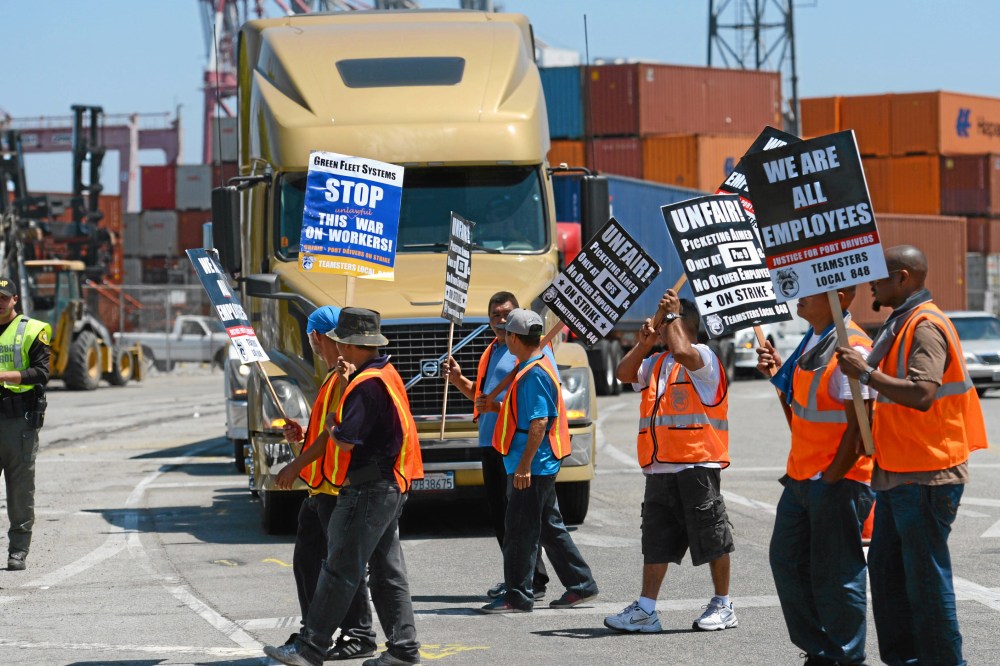
Most work stoppages don’t include a musical interlude from a celebrity guest. But on Wednesday, striking California port truckers were joined at the Port of Los Angeles by Tom Morello, lead guitarist for the popular ’90s band Rage Against the Machine. Morello, a left-wing political activist and solo performer in his own right, played a few songs at the picket line to demonstrate his support.
In terms of sheer numbers, the port truckers’ strike is not a major action. Only about 120 drivers walked off the job on Monday, when the strike began. Yet in terms of significance to the labor movement, this small workplace disruption is a national event. And Tom Morello isn’t the only one paying attention.
On Tuesday, the Teamsters — the union behind port truck organizing efforts — began soliciting donations for the Justice for Port Drivers Hardship Fund, an unofficial strike fund intended to support the port truckers until they return to work. According to a statement from the Justice for Port Truck Drivers campaign, the fund had raised $50,000 within “the first few hours.” The donations reportedly included large sums from labor groups around the country, as well as smaller donations through PayPal.
Why has the strike turned into such a big deal?
1. The main issue in the port truckers strike is one that affects workers across the country.
Port truckers in Long Beach and Los Angeles are on strike in large part because the firms they work for have classified them as independent contractors instead of employees. According to the striking drivers, this amounts to illegal misclassification, and an attempt to dodge the legal obligations that businesses have toward their employees.
“If you’re an independent contractor, nobody’s paying into your social security or retirement, you’re not going to get worker’s compensation if you’re injured on the job and you’re not going to get unemployment insurance if you’re laid off,” Rebecca Smith, deputy director of the National Employment Law Project (NELP), told msnbc. Employees are legally entitled to all of those benefits.
In California, classifying workers as independent contractors also allows firms to deduct certain expenses from their paychecks. As a result, “the cost of the truck is deducted from their wages, as is the fuel and insurance, maintenance expenses, and all of those expenses of owning and operating a truck,” according to Smith. State law forbids automatic deduction from employees’ paychecks for these purposes, but trucking firms in California argue that their drivers are independent owner-operators. In other words, the drivers are essentially entrepreneurs, under contract and responsible for maintaining their own trucks.
That’s not how many truck drivers see it, and the California Division of Labor Standards Enforcement (CDLSE) has tended to agree with them. In April, the agency ruled that the transportation firm Pacer International owed more than $2 million to its so-called independent contractors because “the amount of control exhibited by the Defendant over the Plaintiffs was to such a degree that the Defendant knew or should have known that the Plaintiffs were employees.”
A NELP report co-authored by Smith alleges that roughly 80% of U.S. port truckers have been misclassified; but they’re not the only ones. The NELP report also cites research [PDF] from sociologist Annette Bernhardt, who estimates that as much as 1-2% of the American workforce has been misclassified.
2. Port truckers are a key link in the retail supply chain.
The 120 striking port truckers work for just three transportation firms in California, but those firms occupy an important position in the American retail industry, shipping goods to large retailers such as Walmart, Target, Skechers and Ralph Lauren. The two ports affected by the strike, in Long Beach and Los Angeles, handle about 40% of all imports to the United States.
If transportation firms can’t operate all full capacity, that makes it harder for major retailers to keep their inventory fully stocked. According to the National Retail Federation, a full shutdown of the Los Angeles and Long Beach ports would cost the U.S. economy an estimated $9.4 billion within the first five days. A shutdown of that scale is highly unlikely, especially given the fact that only three transportation firms out of many are affected by the strike. Yet what the port truckers are doing has the potential to indirectly affect another labor struggle happening in the very heart of the Los Angeles and Long Beach ports.
3. Other labor struggles could be affected by the strike.
Port truckers are going on strike at an awkward time for the International Longshore and Warehouse Union (ILWU). The union, which represents dock workers at the Los Angeles and Long Beach Ports, is currently trying to negotiate a new contract with the Pacific Maritime Association (PMA). The old contract expired on July 1, but ILWU members are still at work and have no plans to strike — for now. That said, a group of dock workers opted to vacate their posts on Tuesday morning, in solidarity with the striking port truckers. They returned to work after being ordered to do so by a federal arbitrator.
An ILWU spokesperson did not return multiple requests for comment regarding how the port truckers’ strike could affect contract negotiations. The port truckers’ strike also affects Walmart’s supply chain, which could put some minor strain on the retail giant at a time when it is already facing middling sales numbers and labor unrest from within its own ranks. But at least for now, Walmart says it is wholly unfazed by the port truckers’ disruption. “We’ve been working on a contingency plan for several months now, and we don’t expect any adverse material impact on our business,” said Dianna Gee, a company spokesperson. However, she also said she was not at liberty to disclose any details of the contingency plan. 4. Open-ended strikes are relatively rare. Here’s another big reason why people are paying attention to the port truckers’ strike: novelty. Strikes don’t happen as much as they used to in the United States, and that’s particularly true of open-ended strikes like this one. In 1969 alone, there were 412 major work stoppages — that is, strikes involving 1,000 or more workers — according to the Bureau of Labor Statistics. But since 1982, there have never been more than 100 in a single year. The fifty-year low was in 2009, when only five major work stoppages took place over the course of the whole year. The port truckers strike doesn’t qualify as a major work stoppage, and so it won’t show up in the bureau’s 2014 statistics. Yet the decline of major work stoppages correlates with a decline in militant labor actions overall. Joe Burns, a labor attorney and author of the book Reviving the Strike, has argued that organized labor needs to relearn how to conduct genuinely disruptive work stoppages. It remains to be seen whether the truckers’ strike qualifies, but Burns told msnbc the location of the strike was certainly “strategic.” “Here, potentially, a small number of workers going on strike could have a major economic impact, and conceivably put pressure on the ostensible employers to get the matter resolved,” he said. “Because there’s a lot of goods that need to flow through those ports.” The port truckers’ strike is also noteworthy because of its open-ended nature. Although the past couple of years have seen a spate of high-profile strikes among low-wage service and retail workers, the majority of those work stoppages have only lasted a day or two. The port truckers themselves have gone on strike three previous times, but only now have they decided to remain off the job until their demands are met. According to Burns, short-term strike are less risky, but also less effective than open-ended ones. “The traditional open-ended strike becomes less of a publicity stunt and more about actually impacting the operations of the employer,” he said. “That’ll be the question here: Whether they can sustain it and impact the operations of the employer over the course of the strike.”
Ned Resnikoff is an urban policy analyst, researcher, writer, and editor. His byline has appeared in a variety of publications, including the New York Times, San Francisco Chronicle, Dissent, and The Nation. He writes the newsletter Public Comment, which can be found at publiccomment.blog. Recommended


