








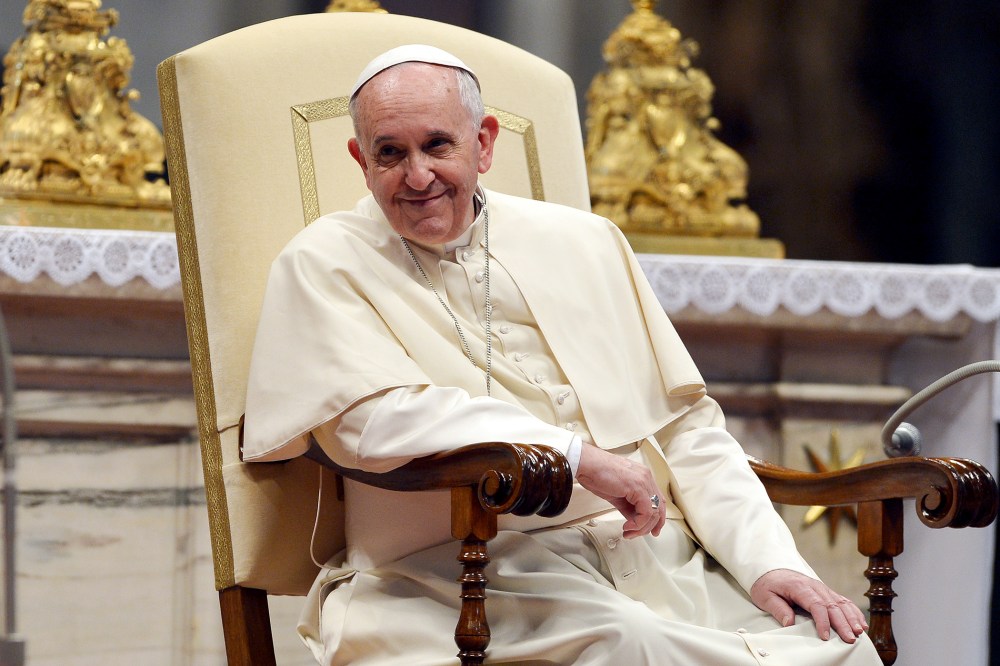
On March 13, 2013, the world watched as white smoke billowed from the Vatican, signaling the selection of a new pope. In an instant, Jorge Mario Bergoglio, the archbishop of Buenos Aires, inherited 1.2 billion followers worldwide, and became the Catholic Church’s first Latin American and first Jesuit leader. He soon chose as his papal name another first: Francis.
The year since included many more firsts and every indication that others would follow. So far, that breath of fresh air looks to have been just what the doctor ordered. Sixty percent of Catholics say that Pope Francis has renewed their faith and commitment to the church, according to the latest NBC News/Wall Street Journal poll.
Here’s a look at moves the pope will be remembered for in his first year:
1. Not judging gay people
During a candid press conference while on a flight back from Brazil last July, Pope Francis uttered five history-making words about homosexuality, one of the most divisive issues the Catholic Church faces: “Who am I to judge?”
It was a simple response to a question about a reported “gay lobby” within the Vatican, which Francis denounced, not because it allegedly included gay clergy, but because it was a lobby.
The Vatican teaches Catholics to accept gay men and women as members of the church, but it classifies homosexual acts as sinful. Because Francis was talking about priests, who take a vow of celibacy when they become members of the clergy, many Catholic groups insisted his remarks did not stray from church doctrine.
Others heard a marked shift in tone from that of his predecessors, such as Pope Benedict XVI, who suggested that homosexuality was a choice running counter to God-given nature; and Pope John Paul II, who declared that family “must never be undermined by laws based on a narrow and unnatural vision of man.” It remains one of the most memorable moments of Francis’s first year as pontiff.
2. Washing feet of inmates
The washing of feet is an important ritual to mark Holy Thursday, the day in Christianity that commemorates Jesus’ Last Supper before his crucifixion. But rather than washing the feet of priests in the Basilica of St. John, as his predecessors had done, Francis chose to kneel down before inmates at the Casal del Marmo Penitentiary Institute for Minors last March. Two women were among the group of 12 to have their feet washed and kissed by the leader of the Catholic Church, marking the first time a pope had included females in the rite.
3. Signaling openness to civil unions
In a wide-ranging interview last week with the Italian daily newspaper Corriere della Sera, Pope Francis once again signaled a softening on homosexuality when he suggested that the Catholic Church could be open to civil unions for people in “diverse situations of cohabitation.”
“Matrimony is between a man and a woman,” said Francis, reaffirming the church’s position on that issue. However, he added, civil unions could be tolerated because of “the need to regulate economic aspects among persons, as for instance to assure medical care.”
Francis said it was necessary to examine and evaluate relationships “in their variety.”
4. Advocating for women
In January, Pope Francis addressed the Centro Italiano Femminile (Italian Women’s Center), where he expressed a desire to expand the role of women in the workplace and in the Catholic Church, which limits ordination to men.
“This is important, for without these attitudes, without these contributions of the women, the human vocation would not be realized,” he said.
Francis later followed up on that sentiment in the Corriere della Sera interview, during which he said, “Women must be present in all of the places where decision are taken.” Catholic leaders are expected to discuss the issue during two major meetings, or synods, next October.
5. Scaling back emphasis on social issues
Calling the church’s focus on homosexuality, contraception, and abortion “small-minded” last September, Pope Francis advocated for striking “a new balance” between controversial social issues that divide Catholics, and the principles of forgiveness and community that unite them.
“The church’s pastoral ministry cannot be obsessed with the transmission of a disjointed multitude of doctrines to be imposed insistently,” he said in an interview with La Civiltà Cattolica. “We cannot insist only on issues related to abortion, gay marriage and the use of contraceptive methods. This is not possible.”
Francis did not go so far as to offer an alternative position on any of those issues other than what church law instructs, but his willingness to scale back the rhetoric could allow for a broader range of opinions.
6. Making Popes John Paul II and John XXIII saints
In one of the first major acts of his papacy, Francis declared last September that he would canonize Pope John Paul II and Pope John XXIII on April 27, 2014 — the first time two former popes are to become saints on the same day. The beatification of John XXII marks a bending of Vatican rules, as Francis decided he did not need a second miracle to be canonized. Meanwhile, John Paul’s path to sainthood, which Benedict XVI began in 2005, will go down in history as the shortest one to date. 7. Speaking out against the church’s condemnation of divorce During a February mass at the Vatican, Pope Francis seemed to buck the church’s restriction on divorce when he called for Catholics to accompany, not condemn, those whose marriages have failed. “When this love fails — because many times it fails — we have to feel the pain of the failure,” he said. “Accompany those people who have had this failure in their love. Do not condemn. Walk with them.” The Catholic Church bars re-married people from taking part in Holy Communion unless their previous marriages have been annulled. Fifty-eight percent of Catholics worldwide oppose this position, according to a recent survey by Univision, and many analysts believe Francis may try to change it in the coming years. 8. Appointing cardinals from non-western countries In January, Pope Francis added 19 cardinals to the existing batch from a multitude of countries,including Nicaragua, Canada, the Ivory Coast, Brazil, Argentina, South Korea, Chile, Burkina Faso, the Philippines, and Haiti, among others. Sixteen of those appointees were under 80-years-old, meaning they’ll be eligible to elect a new pope from among their ranks. Francis is the first non-European pope in centuries, and his selection of cardinals increases the likelihood of there being more diversity at the helm of the Vatican in the future. 9. Defending the church’s response to sex abuse crisis Pope Francis angered many when he recently defended the church’s response to a scourge of allegations involving sexual abuse of children by the Catholic clergy. In an interview last week with Corriere della Sera, Francis said that contrary to public perception, the church had done “perhaps more than anyone” to solve the problem. “Statistics on the phenomenon of violence against children are shocking, but they also clearly show the great majority of abuses occur in family and neighborhood settings,” Pope Francis said. “The Catholic Church is perhaps the only public institution to have acted with transparency and responsibility. No one else has done more. And yet the church is the only one attacked.” Earlier in the year, documents obtained by the Associated Press showed that Benedict defrocked nearly 400 priests between 2011 and 2012. But the United Nations recently published a damning report accusing the church of failing to acknowledge the scale of the problem and implementing policies that led to the continuation of abuse. A top Vatican official rejected the findings. 10. Rejecting housing perks A day after greeting the world for the first time as pope, Francis headed back to the church-run boarding house where he was staying during the electoral conclave to pay his bill. The move was surprising considering Francis was now leader of the church to which the boarding house belonged, but he wanted to give a good example of what priests and bishops should do, a Vatican spokesman said. Later, Francis chose to make his home in that same boarding house (albeit, in a nicer suite) rather than in the papal apartments at the Apostolic Palace. Francis is the first pope in more than a century to shun the lavish papal residence. “I’m visible to people and I lead a normal life – a public Mass in the morning, I eat in the refectory with everyone else, et cetera,” he said in a letter to Father Enrique Martinez, a priest at the Church of the Annunciation in La Rioja. “All this is good for me and prevents me from being isolated.” In October, Francis ramped up his insistence that Catholic prelates should lead humble lives when he suspended the spendthrift German Bishop Franz Peter Tebartz-van Elst — aka, the “Bishop of Bling” — and ordered him to temporarily vacate the Diocese of Limburg.
Emma Margolin
Emma Margolin is a reporter at MSNBC.com. Recommended


