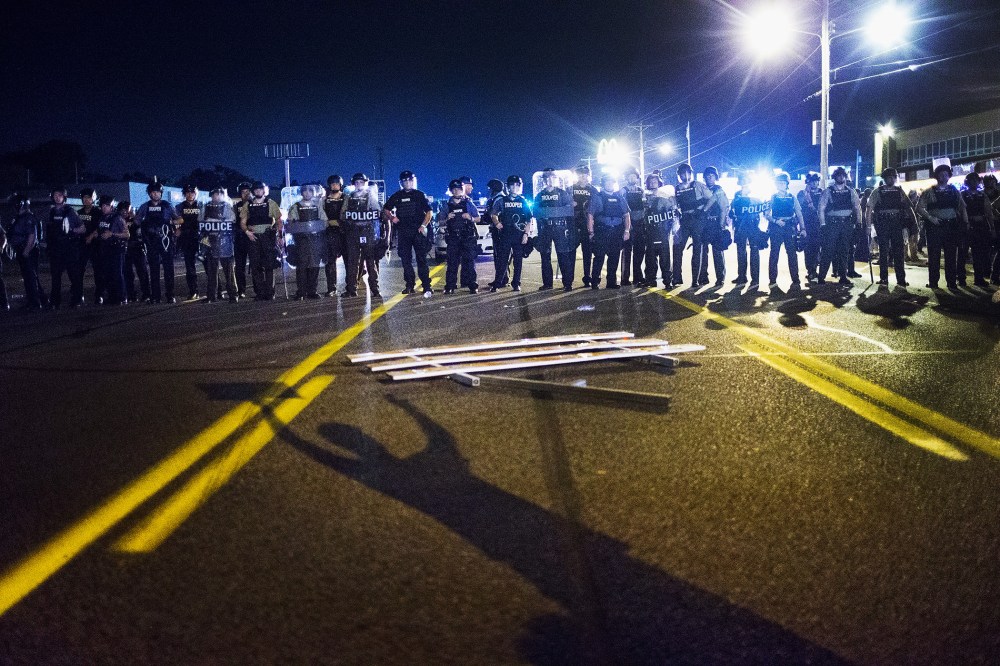
If 2014 was a year of protest and mass resistance, many hoped 2015 would be a year of mass reform. The fledgling movement born out of Ferguson, Missouri, calling for greater police accountability and an end to extrajudicial killing has matured into a legitimate political platform, one that has demanded the attention of high-profile politicians including a number of those vying for the presidency of the United States.
The movement swelled from the streets to college campuses and grew emboldened even as the list of African-Americans killed or brutalized by police continued to grow astonishingly long. Led largely by black women and members of the LGBTQ community, it expanded the focus from black men in particular to shine a much brighter light on women of color who too often end up trapped in the dangerous space between patriarchy and police misconduct.
RELATED: Chicago grandmother killed by police was ‘being a good citizen’
In one high-profile but under-reported case of police abuse, former Oklahoma City police officer Daniel Holtzclaw, who was accused of raping more than a dozen, poor black women while on-duty, was convicted earlier this month on 18 counts of rape and sexual battery. Holtzclaw now faces more than 250 years behind bars, a coup for those who’ve long rallied on behalf of those who don’t feel they have the agency or a voice to call out police for misdeeds.
Indeed, prosecutors in a number of high-profile cases have taken the unusual step of charging officers with murder, including six officers involved in the death of Freddie Gray in Baltimore, the killer cop who fatally shot Walter Scott in the back in North Charleston, South Carolina, and a University of Cincinnati campus officer who shot and killed unarmed Sam Dubose with a blast to the face.
The year was also one in which the Department of Justice continued to flex its investigative muscle. The DOJ launched investigations into a number of police departments across the country where patterns of abuse and discrimination have allegedly been left to fester and eventually exploded in the killings of black men followed by mass civil unrest. Those inquiries include investigations into the police departments of Baltimore, Chicago, Cleveland and Ferguson.
In Ferguson, the DOJ issued a scathing rebuke of its police department and court system, which the feds likened to a cash-milking scheme that targeted poor minorities to bolster the city’s coffers. The release of the blockbuster Ferguson report, detailing the toxic environment that was nurtured by local officials and ultimately fueled the uprising that followed Michael Brown’s killing in the summer of 2014, was seen by many as a feather in the cap of outgoing Attorney General Eric Holder.
RELATED: Grand jury declines to indict officers in Tamir Rice case
The DOJ also issued new guidance on the use of race in police interactions, and President Obama convened the President’s Task Force on 21st Century Policing, a collection of law enforcement officials, activists, community builders, and more, which compiled a report full of recommendations on how to rebuild trust between police and the communities they serve, another rare move by an administration, particularly given the current state of race and police relations.
Legislation that would require law enforcement agencies to report the age, gender, race and other demographic data for anyone they kill, known as the Police Reporting of Information Data and Evidence Act (PRIDE) was introduced by Sens. Barbara Boxer and Corey Booker. And Congress also saw legislation introduced that would divert millions of dollars from funding federal prisons to police training on dealing with the mentally ill.
Yet, while much has changed in relatively short order, much has remained the same.
On Monday, the long and painful investigation into the killing of 12-year-old Tamir Rice in Cleveland last year ended with a decision by an Ohio grand jury not to indict the officers involved in his killing, stoking anger and indignation over a senseless killing but also what many have believed from the outset was a lackluster effort by the local prosecutor.
Rice was young and black and held a toy gun tucked in his waistband. Despite calls to 911 by a passerby describing the gun as “probably fake,” officers Timothy Loehmann and Frank Garmback drove into a park where Rice was sitting and Loehmann opened his door and opened fire almost immediately.
RELATED: Obama commutes sentences of 95, pardons 2 in year-end spree
Surveillance video of the shooting went viral, salting a collective wound that had blistered since the 2012 killing of Trayvon Martin. Rice was killed on Nov. 22, 2014, just days before a grand jury in Missouri declined to indict former offers Darran Wilson in Brown’s death.
In announcing the grand jury’s decision on Monday, Cuyahoga County Prosecutor Timothy McGinty described the boy’s shooting as “the perfect storm of human error” and that the evidence “did not constitute criminal action by police.”
“It has been clear for months now that Cuyahoga County Prosecutor Timothy McGinty was abusing and manipulating the grand jury process to orchestrate a vote against indictment,” Rice’s family said in a statement shortly after the announcement.
The family accused McGinty of hiring “experts” that presented testimony that seemed akin to that of defense witnesses for the police, that he allowed the involved officers to read prepared statements to the grand jury without be questioned on cross-examination, and that he afforded the officers special treatment that smacked of something fishy.
“The way Prosecutor McGinty has mishandled the grand jury process has compounded the grief of the family,” the family’s statement continued.
In the hours after the decision not to indict Rice’s killer, Twitter was ablaze with condemnation but also, questions about the veracity of a broader system that seems routine in its grinding up of black life, and equally as consistent in its forgiving of those who do the grinding.
“We should be mad. Protest & disturb the peace. Yes. But how do we change the complicit guilty system? That’s the convo,” read a tweet by the author and journalist Raqiyah Mays.
RELATED: Activists cheer as cop convicted of rape and assault
“Prosecutors continue to wield unchecked authority over Black communities,” said Rashad Robinson, executive editor of ColorOfChange.org, a civil rights and advocacy group. “A prosecutor pressing charges against an officer is a rarity that often only occurs with a mass swell of protests and mainstream media attention.
“Meanwhile,” Robinson continued, “far too many prosecutors go out of their way to over-prosecute and incarcerate Black folks for far less damaging crimes.”
Many of those who have championed calls for reform have had much to celebrate over the gains made in 2015. But the Rice case is an example of how the high of real, substantive change has been mixed with demoralizing lows.
“In 2014 we came out with a lot of energy,” said James Gilmore, a public policy analyst with the Lawyers’ Committee for Civil Rights Under Law and a member of the Civil rights coalition on Police Reform. “While we went into 2015 hoping for a lot of progress and change we saw a lot of the same issues between law enforcement and communities of color.”
Gilmore riddled off a list of social justice gains this past year, including the successful #SayHerName campaign which spawned from the death of Sandra Bland while in the custody of the Waller County, Texas jail, charges in several police involved killings including the caught-on-camera shooting of Laquan McDonald in Chicago and President Barack Obama’s push for wide criminal justice reforms.
Yet, all of those things are just a well-healed start, he said. “When you’re dealing with issues of law enforcement, which are so deeply rooted and systemic, it’s going to take a lot of work,” Gilmore said.
RELATED: Chicago mayor calls for complete police reform
With each passing day it seems another video of a police officer gunning down an African-American is going viral, played on a loop like a perverse sort of national snuff marathon. For perhaps the first time America is also getting close to seeing the true extent of police killings in this country. The Washington Post, The Guardian and the Mapping Police Violence project have all launched ambitious projects aimed at calculating the true number of people killed by cops in 2015. There is no federal law requiring the nation’s 17,500 or so law enforcement agencies to report how many people their officers kill each year. So just a fraction of law enforcement agencies would report. A tally of those that would generally averaged about 400 people killed by police a year. As of Dec. 27, the number of people killed in 2015 was 965, according to the Post.
Police have shot and killed nearly 80 people over the past 30 days. Those numbers, the true extent of police violence, had long been obscured. This new data is revelatory in many ways, but for the purpose of movement building, organizers see a powerful tool to illuminate those still blind to what amounts to a daily bloodletting. To be clear, that sum is a whole, not divided by those victims who were armed, who posed an immediate threat to others or were acts of suicide by cop. But a deeper dive into those numbers reveal a startling amount of violence perpetrated by police against blacks and whites, those armed and unarmed. According to the paper’s investigation, more than 50 police officers involved in fatal shootings in 2015 had previously been involved in deadly on-duty shootings. For a number of officers it was their third fatal shooting. And in one case an officer was involved in four such killings. According to Mapping Police Violence, which has worked closely with Campaign Zero, an organization whose agenda includes ending police violence, 59 of the nation’s 60 largest police departments killed someone in 2015. Their calculation of police killings is even higher than The Washington Post’s tally with 1,152 between Jan. 1 and Dec. 15. RELATED: Top cops from 6 departments ousted in last year over police violence While a number of officers who have killed have gone on to face charges, prosecutors by and large remain reluctant to charge officers. For those seeking full accountability, officers going to trial are no slam-dunks. Just last month, a judge in Baltimore presiding over the trial of the first officer involved in Gray’s death announced a mistrial after jurors were deadlocked on charges of manslaughter and other related charges. Gilmore, with the Lawyers’ Committee, said those interested in reforms will need to continue pushing from all sectors, including the streets, Congress and beyond. “I think that while some will need to continue to lobby on the Hill and pass Civil Rights reform, others are going to lobby on the streets to raise awareness of a national dilemma,” Gilmore said. “I think for those two movements, the professional and the protester, is while we are taking this divide an conquer approach we must also stay united in our purpose and our mission to reform … ensure accountability and create lasting and sustainable relationships between communities and police.” Scores of law enforcement professionals, including chiefs of police from major cities, have come together on a similar accord, one that includes trying to rebuild frayed trust but also police and criminal justice reform more broadly. The group, Law Enforcement Leaders to Reduce Crime and Incarceration, has as their third tier patching the broken bridges particularly in communities of color. The group’s chairman, Ronal Serpas, who is a former police superintendent in New Orleans, said there are many police leaders who desperately want reform but many have their hands tied by bad collective bargaining agreements and toxic politics, police union and otherwise. He said that better educated police departments generally face fewer complaints and use less force than their less educated counterparts. College educated officers get all sorts of training on methodology, justice and legitimacy, reducing incarceration, “all these new and complex theories of delivery of service,” he said. RELATED: Quintonio LeGrier’s father sues city of Chicago after fatal shooting Yet, few police departments have college credit mandates. Serpas said that city councils have to be willing to pay officers and departments would serve their communities well if they made diversity a priority. He pointed to law enforcement agencies across the country adopting body cameras and calls from many police leaders in major metropolitan areas to reform policies that contributed to the over-incarceration of minority youth. “Those things all have one thing in common as it relates to police officers in the street in the middle of the night,” Serpas said. “Less opportunity and more alternatives instead of arresting so many people in our country in communities of color.” Mass-incarceration and police violence are considered by some two-heads of a criminal justice monster that has ravaged black, brown and poor communities. In tandem with the Black Lives Matter movement, which has snagged the ear of Democratic presidential candidates Hilary Clinton and Bernie Sanders, the Obama administration and the Department of Justice have pushed to dismantle policies that fueled mass incarceration. President Obama has met face-to-face with prisoners and the Justice Department has begun releasing some 6,000 non-violent federal prisoners sentenced under harsh War on Drugs era guidelines. Those efforts have signaled a remarkable break from the status quo. But among the deepest marks left by the Black Lives Matter movement was forcing the hand of liberals to take true stock of the general Black Lives Matter agenda. Protesters interrupted campaign stops. Heckled politicians that conventional wisdom would suggest were natural allies. And a few activist had a rather tense debate with Clinton in August over systemic racism and white privilege. Per a sign of the times, the 15-minute encounter was captured on video that eventually went viral. RELATED: 2015: The year in criminal justice “Look, I don’t believe you change hearts,” Clinton said of America’s deep and abiding racism. “I believe you change laws, you change allocation of resources, you change the way systems operate. You’re not going to change every heart. You’re not. But at the end of the day, we could do a whole lot to change some hearts and change some systems and create more opportunities for people who deserve to have them, to live up to their own God-given potential.” Members of Campaign Zero, including two of its founders Deray McKesson and Johnetta Elzie, later met with Clinton and discussed the prospect for a presidential agenda aimed at holding police accountable. With no centralized leadership, many members and many more methods of disruption, Black Lives Matter supporters have also formed super PACs to boost candidates of who support their agenda, shifting some of their vast pool of energy from the streets to politics. “At this point, marching and protesting, it’s not going anywhere,” Tarik Mohamed, a founder of one of the PACs told The New York Times recently. “So we’re trying to find new avenues of engaging people for change.”
Trymaine Lee
Trymaine Lee is an NBC News correspondent. Recommended