








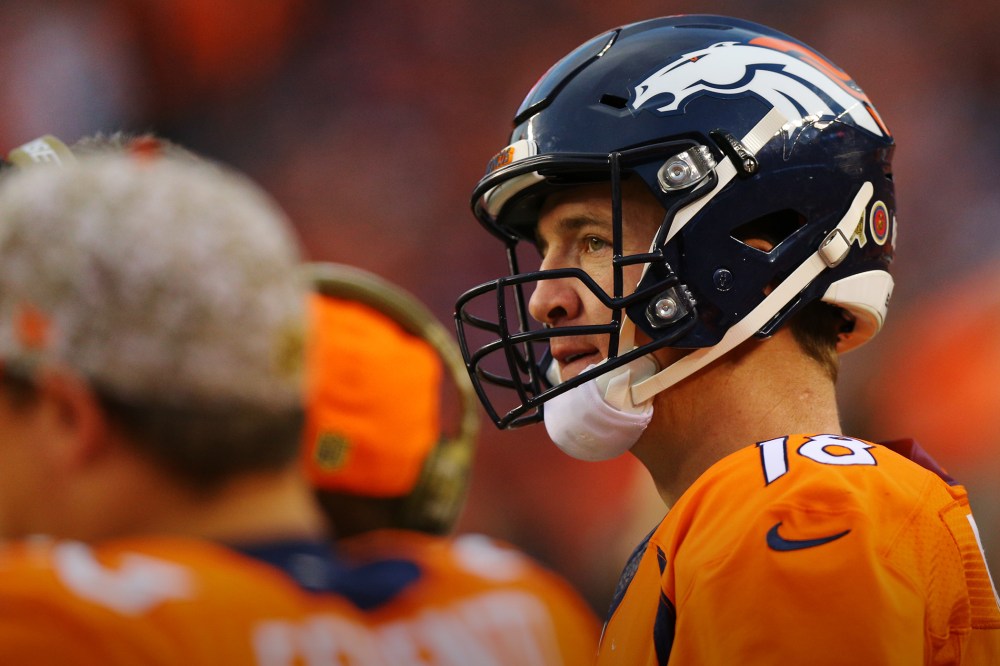
Peyton Manning is aggressively denying doping allegations, saying a story reporting that his wife received a human growth hormone (HGH) is “garbage” and “defamation” and that he will “probably” sue over the explosive report from Al Jazeera.
The Denver Broncos quarterback may have a case.
“The Dark Side,” a new Al Jazeera documentary that tracks the use of performance-enhancing drugs in professional sports, features Charles Sly, a former intern at an anti-aging clinic, saying he mailed HGH to Manning’s wife.
Sly recanted those statements over the weekend, however, saying they were “false” and “incorrect” and were recorded without his knowledge.
That reversal could help Manning’s potential case, but as a public figure, he has a high burden in any defamation lawsuit.
A three-step case
If Manning sues in Colorado, where one of his homes is located, he could argue the doping allegations violate the state’s defamation law against particularly harmful statements.

Like many other states, Colorado singles out certain categories of false statements as automatically defamatory, or “defamation per se,” because they so obviously damage one’s reputation.
“You can defame someone per se by accusing them of a crime or impugning their profession or their ethics and integrity,” said Ed Hopkins, a plaintiff’s defamation lawyer in Colorado.
The thrust of the new allegations fits those categories, because doping would impugn Manning’s professional reputation and could be illegal.
Yet that is just the first step in Manning’s case.
Second, he would have to prove that the allegations were actually false. That means going way beyond the general denials he has offered. Instead, his lawyers would have to specifically disprove that HGH was mailed to his home or was provided for his use.
Third, because Manning is famous, he would face an extra requirement. He would have to prove that the allegations were also made knowingly or recklessly. Media law requires the additional hurdle for public figures to protect reporters from facing costly lawsuits when they make honest mistakes.
“Defamation law treats public figures differently,” Hopkins said.
“Manning would have to prove Al Jazeera or the source made a false statement,” he told NBC News, “and he’d have to prove Al Jazeera knew the statement was false when they published it — or that they recklessly disregarded whether it was false.”
Al Jazeera reporter Deborah Davies is standing by the story, however, telling MSNBC on Monday that the reporting is accurate. She said the network has “20 hours of recordings” of Charlie Sly and argued that those are more reliable than his recent, short recantation.
Legally, Al Jazeera doesn’t even need to have every detail correct — it just needs to have the basics right.
As a Colorado appeals court explained in 2004, “absolute truth is not required” for defamation defendants to win. They “need only show substantial truth,” the court said, such as showing that “the gist … of the matter is true.”
Suing the press and the source
Manning could also try to sue both Al Jazeera and Sly himself, essentially arguing that Sly knew his accusations were false, while Al Jazeera should have known.
In that case, Al Jazeera might prevail by showing that it applied responsible reporting methods — even if it got something wrong — while Sly could face a harder time defending statements he has now admitted were false.
The distinction between source and reporter arose in one of Colorado’s leading defamation precedents, a 1994 state Supreme Court case about accusations that a public official was corrupt. The state’s top court ruled that a newspaper was not liable for publishing unproven bribery accusations — but it ruled against an individual for making similar accusations. In other words, the court cracked down on the person launching false attacks — not on the newspaper for covering them. Public plaintiff and private health Still, a suit by Manning against either party would launch a factual inquiry into delicate claims about not only his health, but also about his wife’s potential use of HGH. While public interest in the Manning story is all about whether he was doping for an edge on the field, on Monday, reporter Davies emphasized that Al Jazeera’s report doesn’t specifically say that. “Let’s be clear what the allegation is and what it’s not: What Charlie Sly says is that Guyer Institute shipped human growth hormone to Ashley Manning in Florida,” she told MSNBC. “I have not heard anyone deny that.” It’s an allegation Manning may not want to explore in court, even if he believes it would ultimately vindicate him. “The real problem with litigation is discovery, and whatever comes out about his relationship with the clinic and his wife’s relationship,” says Andrew Brandt, a former vice president of the Green Bay Packers. “I’m not suggesting anything nefarious but something he may want to protect regarding his wife,” said Brandt, who directs the Moorad Center for Sports Law at Villanova Law School. “The more it heads down that path,” Brandt told NBC, “the more the possibility that whatever his relationship his wife had with them becomes public.” Manning’s advisers, who include former White House spokesman Ari Fleischer, say they are reviewing Al Jazeera’s documentary before he decides whether to sue. Brandt said the makeup of that advisory team is also telling. “Hiring Ari Fleishcer, instead of an attorney, to speak for him would suggest that the immediate reaction was not to go legal,” Brandt says, “but rather to go more P.R. protection.”
Ari Melber
Ari Melber, an Emmy Award-winning journalist, writer and attorney, is the host of “The Beat with Ari Melber” airing nightly at 6 p.m. ET on MSNBC. He also serves as MSNBC’s chief legal correspondent and an NBC News legal analyst. Before joining MSNBC, Melber practiced First Amendment law and served as a legislative aide in the U.S. Senate. He received a J.D. from Cornell Law School and is a member of the New York Bar. Recommended


