








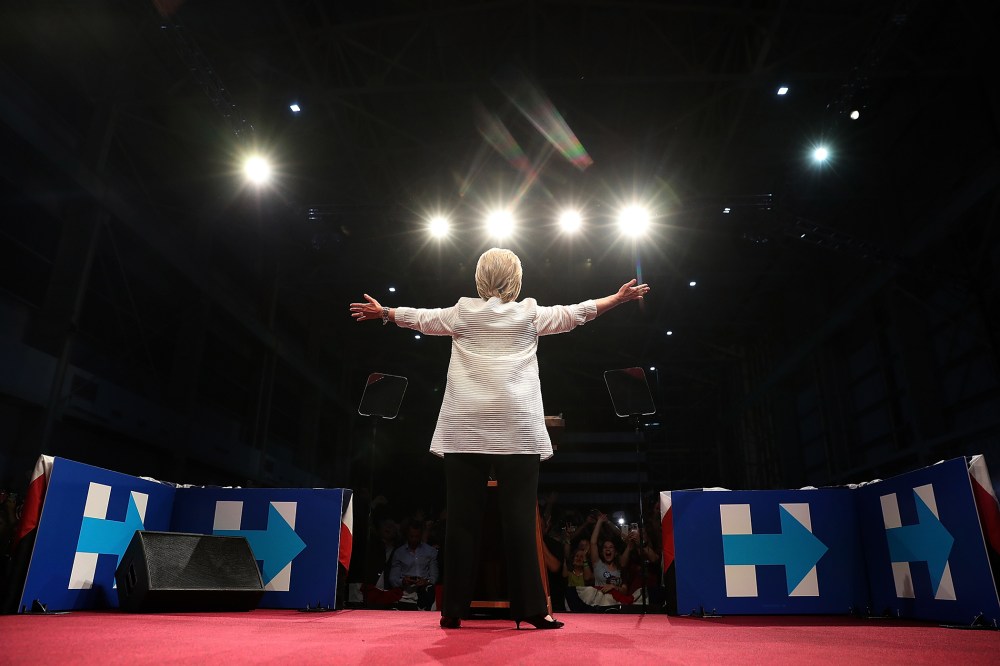
Tuesday was Hillary Clinton’s night.
Her victory speech was not about progressive red meat or even a call for Democratic unity. It was savoring a moment that she worked hard for and that is now part of American history.
Bernie Sanders is now thinking about what comes next for his candidacy, his ideas, and the movement he built this past year.
As the Democratic Party looks ahead to November, it stands at a crossroads. There will be many calls for “unity,” but unity can have two vastly different meanings at this moment.
One is a process argument and almost a guilt trip toward Sanders voters — functionally telling them to get in line because the only thing that matters is defeating Donald Trump. This message would not have the intended effect, especially with independents and new voters who have less allegiance to the process of party unity than habitual Democrats do.
RELATED: Where do Democrats go from here?
The more strategic approach to Democratic unity would be for Clinton to signal very soon that she will unify millions of Clinton and Sanders supporters around big, bold, progressive ideas that both candidates campaigned on – such as expanding Social Security benefits instead of cutting them, debt-free college, breaking up too-big-to-fail banks, and jailing Wall Street bankers who break the law.
On Tuesday, Sanders signaled why that approach would be more effective when he told supporters, “We understand that our mission is more than just defeating Trump. It is transforming our country.”
The 15 people who begin meeting to draft the Democratic Platform today will have an important role to play in uniting the party around a popular progressive agenda – and the signals sent by Clinton during this process will be pivotal.
The good news is: This does not have to be hard.
This primary was not a battle over the direction of the Democratic Party. Both candidates marched in the same direction toward a robust role for government in forging economic, racial, social, and environmental justice. The contest was about how big to go on various ideas and how best to achieve big progressive ideas.
In addition to the Platform Committee etching in stone both candidates’ commitment to expanding Social Security, debt-free college, and strong Wall Street reform, it should not be hard to add other ideas endorsed by Clinton and Sanders that were lacking in the 2012 platform: overturning Citizens United, public financing of congressional elections, banning for-profit prisons and detention centers, restoring voting rights, ending mass deportations, combating police brutality, greater protections for access to women’s health care, opposing the TPP, slowing the revolving door between Wall Street and government, and making major infrastructure investment.
Where there were differences, they landed miles away from where the national debate was just a couple years ago.
In 2013, a $10 minimum wage was seen as pie in the sky. Now, Sanders is proposing a $15 federal minimum wage, Clinton endorsed a $15 minimum wage in some areas of the country, and she promised to sign a $15 federal minimum wage into law if it came to her desk.
RELATED: Why does Sanders do better than Clinton against Trump? After Obamacare, the book was closed on health care reform. Now, Clinton is calling for Americans to have the option of buying insurance through Medicare (one version of Medicare for all) and Sanders is calling for single-payer health care (another version of Medicare for all). In 2008, Clinton’s student debt plan was $8 billion per year. Now, she proposes $350 billion over a decade while Sanders proposes $700 billion over a decade. The rhetorical debate between “debt-free” and “free tuition” is a stark contrast to the debate just two years ago about tinkering with college loan interest rates. The Platform Committee should be able to figure out how to legitimize Sanders’ ideas and stay true to Clinton’s positions. Ultimately, unifying around big, bold, progressive ideas is about winning in November. Polling conducted for the Progressive Change Institute show those are the ideas popular with voters across the political spectrum. That’s why Trump is trying to woo blue-collar Reagan Democrats with populist themes on issues like Social Security and trade. Democrats cannot afford to be outflanked on our own issues. When the story of the 2016 election is told, one of Sanders’ main contributions will be helping the Democratic Party turn up the volume around big economic populist ideas in a way that empowers Democrats to defeat Trump. But that opportunity could be squandered if Democrats take the wrong approach at this moment. The sooner Clinton and Platform Committee members publicly signal they will seek unity around bold progressive ideas, the sooner Sanders and his supporters will know they have achieved the mission of helping to transform the future of America — and the more likely Democrats will win big in November. Adam Green is co-founder of the Progressive Change Campaign Committee, a million-member grassroots advocacy organization that did not endorse in the Democratic primary.
Adam Green Recommended


