








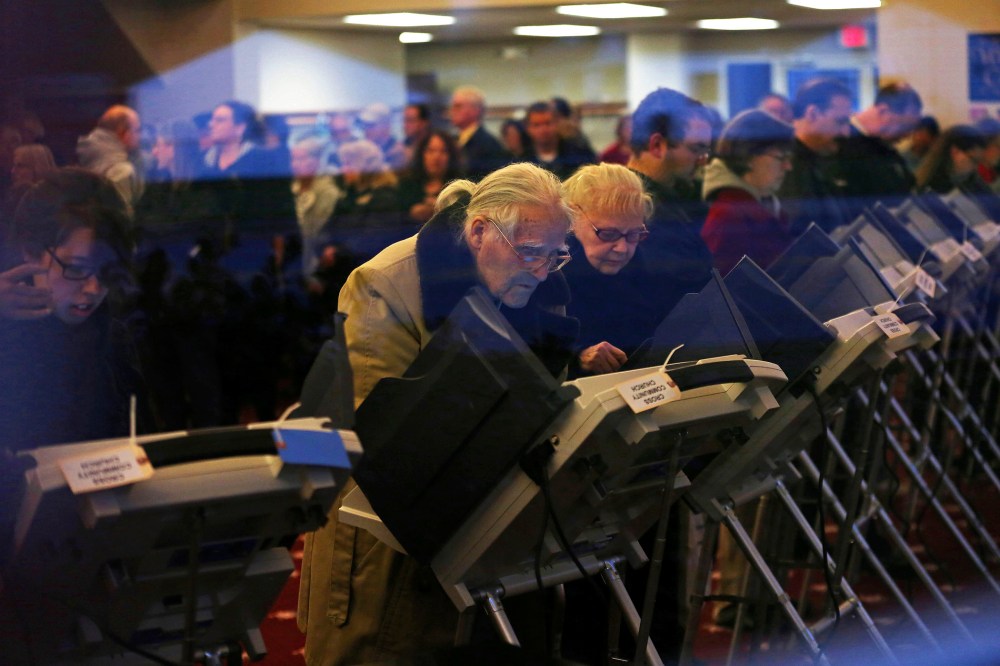
The effort by Ohio Republicans to make voting harder in the nation’s most pivotal swing state has triggered a furious response—one that could yet succeed in fighting off some of the worst effects of the new restrictions.
“Since these bills have been passed, we have seen an incredible response from all corners of the state,” State Senator Nina Turner, who has helped lead the effort, told msnbc. “Ohioans are just plain tired of their ballot access being made into a political tool. From local leaders stepping out, to the court system, to the ballot, we are seeing the people push back against an effort to limit their voice using all the tools at their disposal.”
Last month, Ohio lawmakers passed GOP-backed bills that cut six days of early voting, ended same-day voter registration, made it harder to vote absentee, and made it more likely that provisional ballots will be rejected. Just days after the bills were signed, Secretary of State Jon Husted, a Republican,announced the elimination of Sunday voting, effectively ending the “Souls to the Polls” drives organized in recent years by many African-American churches.
But in response, supporters of voting rights have launched a vigorous, multi-pronged resistance campaign involving new legislation, potential lawsuits, political ads, public education, and even a bid to change the state constitution to strengthen voting rights.
The latest step came Tuesday afternoon, when Cuyahoga County Executive Ed FitzGerald was set to introduce a bill to allow the county—Ohio’s largest—to continue mailing absentee ballot applications to all registered voters without the sign-off from the legislature that the new state law requires.
Hours earlier, Turner, a Democrat who is challenging Husted this fall, led a rally at the state capitol building in Columbus, aimed at highlighting the impact of the changes on students and seniors in particular. A similar rally, organized by Turner last week, featured church and community leaders denouncing the changes.
In 2012, 1.2 million Ohioans voted absentee, after Husted agreed as part of a settlement to mail absentee ballots to all registered voters.
FitzGerald, a Democrat who is running for governor, also has said he plans to propose amending the county’s charter to make voter protection a core function of county government, and he has announced a volunteer voter protection task force.
It’s just not Cuyahoga. The Akron City Council last week passed a resolution denouncing the new laws—”this is America, it’s not a Third World country,” one councilwoman said—and other counties with large urban populations are said to be considering efforts similar to FitzGerald’s.
There are also potential lawsuits in the works. FitzGerald and other Democrats are mulling a challenge to Husted’s elimination of Sunday voting, which FitzGerald called “a blatant and transparent attempt to make it more difficult, especially for lower and middle-income families, to vote.” In 2008, black voters were 56% of all weekend voters in Cuyahoga County, even though they made up just 28% of the county’s population.
And the state Democratic Party has said it is planning its own lawsuit against the legislature’s cuts to early voting and its elimination of same-day registration. Based on recent history, those legal challenges might stand a decent chance of succeeding. In 2012, Husted tried to scrap the last three days of early voting, including the weekend before the election, for everyone but military voters. The Obama campaign and civil rights groups successfully challenged the move in court, and the early voting days were restored. As the election law scholar Rick Hasen has shown, the courts have been relatively aggressive in blocking many of the GOP-backed voting restrictions. It suggests that judges are increasingly skeptical “of efforts to make it harder to vote for no good reason,” Hasen recently told msnbc. Then there’s the push for a constitutional amendment. Right now, the Ohio Constitution, like the U.S. version, contains no explicit right to vote. A group of African-American Democratic lawmakers is working to get a proposed amendment on the ballot this fall to change that, establishing a Voters Bill of Rights. Republicans are doing all they can to obstruct the effort, which would make it far harder for future restrictions to be enacted. Some Democrats are trying to make supporters of the restrictions pay a political price. iVote, a group of Obama campaign veterans that’s working to elect voting-rights champions as secretary of state in Ohio and three other states, unveiled an online ad campaign last week targeting Husted in response to the voting cuts. And FitzGerald has repeatledy attacked Republican Gov. John Kasich for signing the restrictive laws.
Zachary Roth Recommended


