








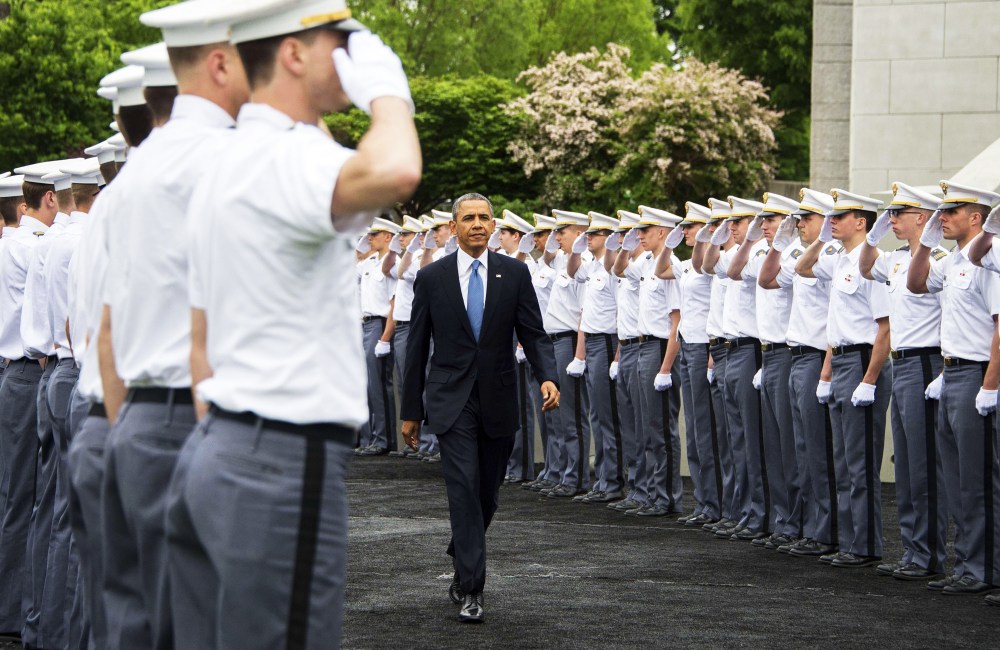
President Barack Obama used his commencement speech Wednesday at the U.S. Military Academy at West Point to counter his foreign policy critics and to lay out a broader vision for the country’s role in the world for the remainder of his presidential term.
The U.S. should rely on multilateral diplomacy instead of military intervention, the president said, adding that the country will use all the tools in its arsenal without over-reaching. The policy, Obama said, should be both interventionist and internationalist without being isolationist or unilateral.
The commander-in-chief told the approximately 1,000 graduating cadets that those who believe America is in decline are “either misreading history or engaged in partisan politics.” He pointed to last year’s typhoon in the Philippines, the recent kidnapping of hundreds of Nigerian school girls, and masked individuals occupying buildings in Ukraine.
“It is America that the world looks to for help,” said Obama.
The president has faced a slew of international challenges in his second term, including the chemical weapons attacks in Syria, Russian President Vladmir Putin’s annexation of the Crimea region in Ukraine, nuclear negotiations in Iran, and China provoking maritime tensions in the South China Sea. Obama has come under fire from critics – namely Republicans—who argue he has acted with too much passivity and caution in response to the crises.

Polls also show Americans are skeptical about Obama’s approach to global affairs. According to a Wall Street Journal/NBC News poll from last month, nearly half of respondents – 47% — said they’d like to see the U.S. take on a smaller role on the world stage.
In laying out his foreign policy vision, Obama acknowledged self-described realists, who believe many international problems are not America’s to solve, in addition to interventionists who argue America’s willingness to apply forces around the globe is the “ultimate safeguard.”
“I believe neither view fully speaks to the demands of this moment,” said Obama, who offered a middle-of-the-road strategy. “… Here’s my bottom line: America must always lead on the world stage. If we don’t, no one else will. The military that you have joined is, and always will be, the backbone of that leadership. But U.S. military action cannot be the only – or even primary – component of our leadership in every instance. Just because we have the best hammer does not mean that every problem is a nail.”
Obama said the U.S. will use military force –unilaterally if necessary—when the country’s core interests are at stake. When conflicts don’t pose a direct threat to the U.S., the threshold for military action, he said, should be higher. “In such circumstances, we should not go at it alone. Instead, we must mobilize allies and partners,” he said.
The president also said the U.S. needs to shift its counter-terrorism strategy and partner more effectively with countries where terrorists are trying to mobilize. “A strategy that involves invading every country that harbors terrorist networks is naïve and unsustainable,” he said.
Obama, of course, was elected on a platform based on ending the expensive, long wars in Iraq and Afghanistan. The last U.S. troops left Iraq two-and-a-half years ago, and in advance of the commencement speech, the president announced on Tuesday that all U.S. troops will leave Afghanistan by the end of 2016. He added that the U.S. will reduce the force from 32,000 American military personnel to 9,800 and end the U.S. combat mission by the end of this year. On Wednesday, the president acknowledged his last speech at West Point in 2009 – when the U.S. had more than 100,000 troops in Iraq and was preparing a surge in Afghanistan. “You are the first class to graduate since 9/11 who may not be sent into combat in Iraq or Afghanistan,” he said to cheers from the graduates. Obama also spent a large portion of his 20-minute speech giving a full-throttled defense of his response to foreign policy crises that have gripped his administration. Notably, he made no mention of the Veterans Affairs scandal and outrage over the alleged falsification of records to cover up long waits at VA medical facilities during his address. On Syria, Obama said not putting American troops in the middle of an escalating, sectarian civil war was the “right decision.” On Ukraine, Obama touted the effectiveness of working with allies to impose sanctions and isolate Russia. “Standing with our allies on behalf of international order has given a chance for the Ukrainian people to choose their future.” On Iran, Obama insisted that due to combination of diplomacy and imposing sanctions on Tehran “for the first time in a decade we have a very real chance of achieving a breakthrough agreement.” The president’s speech at West Point came just days before Obama heads to Europe, where his prowess on the world stage will be tested once again. On Monday, he’ll go to Warsaw, Poland to reassure Eastern Europeans that the U.S. will not stand for any aggression from Moscow. He’ll also go to Brussels to meet with G7 leaders, and then to Normandy, France to mark the 70th anniversary of D-Day, a major turning point for the allied forces during World War II. In what could be an awkward setting, the Kremlin has also announced that Putin will join Obama and other European leaders at the June 6 commemoration. The White House has said Obama will not meet one-on-one with Putin. Recommended


