








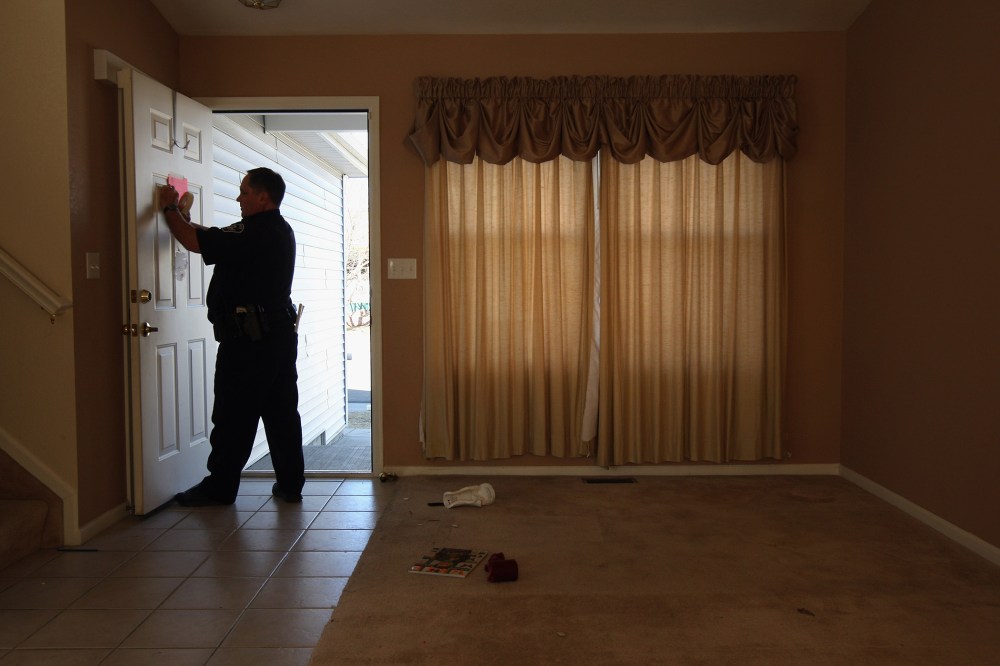
When Nancy Markham called 911 multiple times between March and August 2014 because of her abusive ex-boyfriend, the single mother didn’t know that her calls for help would only lead to more fear and insecurity. Instead of serving and protecting her, the police department of Surprise, Arizona, tried to silence and get Markham evicted from her rental home — all because of an ill-conceived nuisance ordinance the city passed in 2010.
Under the law, landlords in Surprise faced civil and criminal penalties if they rented to tenants who called the police four times within 30 days, or when two or more crimes occurred at the property at any time, with no exception for tenants who needed emergency assistance. The law also required landlords to adopt “crime-free” leases that authorized the eviction of tenants when any criminal activity occurred at the property, even when the tenant was the victim of the crime. All three parts of the law applied to Markham’s circumstances, and the police pressured her landlord to start the eviction process, even though they had finally arrested her ex for domestic violence after four months of violent and threatening behavior.
RELATED: Commentary: Countries must commit to fighting discrimination in the law
Markham, however, fought back with the ACLU’s help, and this week the city repealed the nuisance ordinance that empowered police to silence victims of crime who called 911 and force their evictions. While this is an important victory, her story is just one example among many. Local nuisance laws penalizing tenants and landlords for calls for emergency assistance or for any criminal activity occurring at the property are widespread and growing in popularity.
Harvard sociology professor Matthew Desmond describes the devastating impact of these laws in his newly released book, “Evicted: Poverty and Profit in the American City.” His study of Milwaukee’s ordinance concluded that calls about domestic violence — including incidents where perpetrators beat pregnant women; used box cutters, knives, or guns against women; or threw bleach or lighter fluid at them — were the third most common reason for a nuisance citation. In 83 percent of cases where landlords received a nuisance citation for domestic violence, they either evicted or threatened to evict the victim if she called police again.
The St. Louis nuisance ordinance stopped domestic violence victims from calling police — for any reason, according to Saint Louis University professor Gretchen Arnold, who studied its impact. One survivor told her, “If you getting abused, raped, stabbed, shot, you’re not allowed to call police ‘cause they say it’s a nuisance law … We just in danger. If anything happens to us, we can’t call no police. We just got to deal with it.’”
When%20are%20people%20considered%20victims%20of%20crime%2C%20deserving%20of%20help%2C%20and%20when%20are%20they%20seen%20as%20nuisances%3F’
An ACLU study done with the Social Science Research Council similarly determined that two New York nuisance laws were enforced against people who were victims of a variety of crimes, including larceny and assault. In both cities, domestic violence incidents made up the single largest category of criminal activity resulting in enforcement of the ordinance.
These laws contribute to the cycle of homelessness, poverty, and crime that too many low-income people face — especially African-American women. Desmond’s research found that racial bias influenced police enforcement decisions: A tenant living in a black neighborhood in Milwaukee was three times more likely to receive a nuisance citation compared to a tenant in a white neighborhood who had also violated the ordinance. Black women are both kicked out of their homes and blocked by these laws from accessing a fundamental government service — police protection.
As police practices come under scrutiny nationwide, the prevalence of these laws raises serious questions about police bias against survivors of domestic violence, most of whom are women. When are people considered victims of crime, deserving of help, and when are they seen as nuisances? Shouldn’t people be able to exercise their First Amendment right to seek police assistance without regard to their gender, race, income, or status as tenants? In December, the U.S. Department of Justice issued landmark guidance to law enforcement agencies on “Identifying and Preventing Gender Bias in Law Enforcement Response to Sexual Assault and Domestic Violence.” The guidance explains that providing less protection to victims of domestic violence and sexual assault violates survivors’ civil rights. Nuisance laws clearly run afoul of the guidance. Not only are police withholding protection from victims, they are punishing them for asking for help in the first place. We sued Surprise on behalf of Nancy Markham, and the city agreed to completely repeal the ordinance and compensate her. But it shouldn’t take a federal lawsuit for cities to recognize how counter-productive these laws are. Reducing the number of calls to police means that a city no longer receives reports of crime, not that it has reduced crime. Forcing a crime victim to move does nothing to actually address the crime itself, it may simply make her more vulnerable to it. Homelessness and domestic violence are serious issues, requiring thoughtful policy solutions and adequate funding for services. Nuisance laws contribute to housing instability and crime. One simple step forward that cities can take is to repeal these ordinances and send the message: Reaching out for police aid won’t result in an eviction notice. Sandra S. Park is a senior attorney at the ACLU’s Women’s Rights Project and lead attorney in Nancy Markham v. City of Surprise.
Sandra S. Park Recommended


