








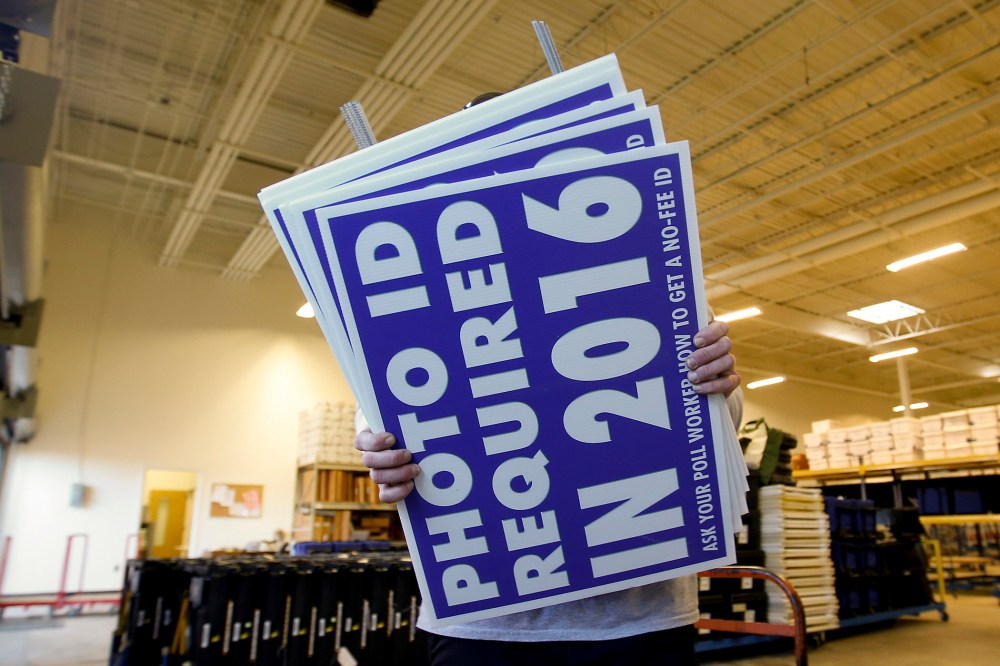
A strict voter ID law will be in effect for the first time in Tuesday’s primary in North Carolina, where an estimated 218,000 registered voters don’t have the identification they’ll need to vote. Two other presidential battleground states, Florida and Ohio, also vote Tuesday and have restrictions in place.
There have already been voting problems in North Carolina, especially in student-heavy areas, according to reports. Student IDs aren’t accepted under the law, and neither are out-of-state driver’s licenses. One senior at UNC Chapel-Hill who voted in the 2012 presidential election said he showed his Pennsylvania license and was forced to cast a provisional ballot, which may not be counted. His was one of numerous anecdotes to emerge in recent days of North Carolinians prevented from voting.

In the state’s early voting period, 2,567 people have had to cast provisional ballots—865 because they didn’t bring one of the types of ID allowed under the law, according to a report by The Nation. They’ll need to return in the next week to make their vote count. A group of 391 people said they had a reasonable impediment that prevented them from getting an ID. (Of course, these figures don’t include the unknown number of voters who were deterred even from showing up thanks to the ID requirement.)
The reasonable impediment provision was added by Republicans looking to ensure that courts don’t strike down the law, but it appears to be poorly understood. Sen. Richard Burr, a Republican, was one of those who used the provision at a polling place after forgetting his ID.
RELATED: Sanders campaign praises Ohio ruling that allows 17-year-olds to vote
North Carolina’s restrictive voting law was passed in 2013 after the Supreme Court weakened the Voting Rights Act. In addition to the ID provision, which was delayed until this year, it also shortened early voting, scrapped same-day registration, banned out-of-precinct voting and in several other ways made it harder to cast a ballot. In 2014, the law disenfranchised an estimated 30,000 people, even without the ID provision. Meanwhile in Florida, more than 1.5 million people and more than one in five black people will be barred from voting Tuesday by the state’s longstanding felon disenfranchisement law, the strictest in the country. In 2007, then-Florida Gov. Charlie Crist issued an order to automatically restore the rights of felons who had completed their sentences. But it was reversed in 2011 by Gov. Rick Scott, meaning ex-felons looking to vote must have their applications personally approved by the governor. And in Ohio, Republican cuts to early voting have reduced the number of hours during which voters can go to the polls. But in a win for voting, a judge rejected an effort by Secretary of State Jon Husted to stop 17-year-olds who will be 18 by the November general election from voting in the primary. Husted’s move was challenged by the Bernie Sanders campaign, which is popular with young voters.
Zachary Roth Recommended


