








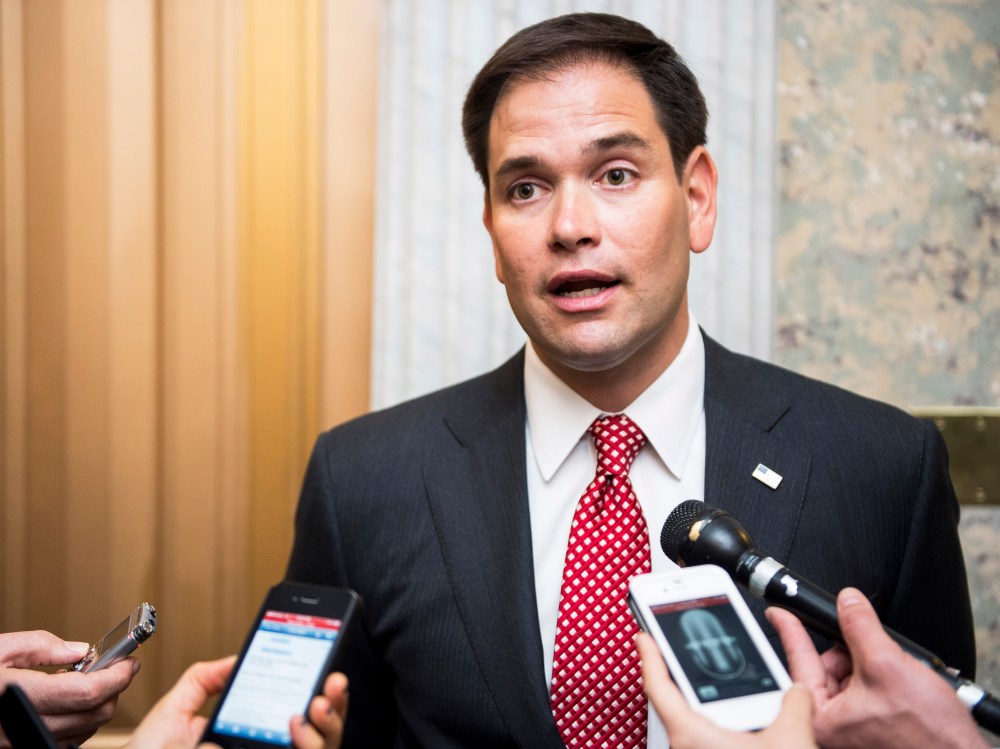
Sen. Marco Rubio may run for president in 2016, or he may not. The Florida Republican hasn’t made up his mind. That’s perfectly natural at this early stage. What’s not natural is Rubio’s inability to make up his mind about anything else.
Rubio’s latest somersault concerns Syria. On Sept. 4 Rubio voted in the Senate Foreign Relations Committee opposing the use of force against the regime of Syrian President Bashar al-Assad. Rubio had told Fox News that he was “very skeptical” about any planned retaliation against the Aug. 21 chemical attack that killed 1,400 Syrians.
Could this be the same Rubio who two years ago called on the Obama administration to “stop dithering as innocent Syrians die at the hands of a merciless regime” that “directly acted against the national security interests of the United States”? The Rubio who, one year ago, said in a speech to the Brookings Institution, “The nations in the region see Syria as a test of our continued willingness to lead in the Middle East”? And “If we prove unwilling to provide leadership, they will conclude that we are no longer a reliable security partner”?
Rubio says he changed his mind because now it’s too late. “What we’re seeing here now is proof and an example of when America ignores these problems, these problems don’t ignore us,” he said at a Foreign Relations Committee hearing.
The situation in Syria has indeed changed. The rebel forces have been infiltrated by al Qaeda, making a satisfactory outcome to regime change much harder to achieve. Had the U.S. intervened more aggressively at an earlier date, al Qaeda might have been prevented from getting a foothold. Or it might not.
“When the facts change, I change my mind,” John Maynard Keynes famously said (though like many memorable quotes, it’s probably apocryphal). “What do you do, sir?” That would be a reasonable rejoinder coming from almost anybody else. But for Rubio, the facts change with suspicious frequency.
Before Syria there was immigration. In the Florida House of Representatives, Rubio co-sponsored college tuition breaks for undocumented immigrants (2003-4), and as House Speaker he smothered multiple bills imposing restrictions on them (2008).
Then, as a U.S. Senate candidate, Rubio blasted his opponent, Charlie Crist, for favoring an “earned path to citizenship” that Crist said wasn’t amnesty. Rubio said it was, too, amnesty. “It is unfair to the people that have legally entered this country to create an alternative pathway for individuals who entered illegally and knowingly did so,” Rubio said (2010).
As Senator, Rubio was asked by National Journal whether he still favored tuition breaks for undocumented immigrants. First he hedged by saying in a written statement that they should be limited only to immigrants who came as children and have “exhibited good moral character.” A week later, he said they shouldn’t be given at all (2011).
A few months after that, Rubio objected to “harsh and intolerable rhetoric” used by fellow Republicans on the issue (2012). Then, after Latinos demonstrated their electoral muscle on the immigration issue in the 2012 election, Rubio came out in favor of the Senate’s Gang of Eight immigration bill (2013), which contained several elements that Rubio had denounced in 2010. This last flip-flop won him designation by Time magazine as “The Republican Savior.”
Before immigration there was climate change. As Florida House Speaker, Rubio promoted several climate-change bills,” including cap-and-trade. But as a Senate candidate he said he didn’t believe in man-made global warming and slammed Crist for supporting cap-and-trade. Then there was the matter of whether he was the son of exiles from Fidel Castro’s Cuba. First he was, and then he wasn’t. The ever-evolving Rubio even hedges his bets on evolution. Asked how old Planet Earth was—a loaded question because creationists don’t like hearing that it’s four or five billion years old—Rubio told GQ that was “a dispute amongst theologians” and “there are multiple theories out there” and who was he to say? Characteristically, he was belligerent in expressing this false humility: “I think the age of the universe has zero to do with how our economy is going to grow.” Rubio’s shameless flip-flops have been treated gently in the press; they’re usually called “pivots,” a balletic euphemism that’s become a Washington cliché. The press goes easy on Rubio because he’s so obviously caught between the GOP’s ascendant lunatic fringe (which put him in the Senate) and the rational imperatives of governance. But changeable views are a lot harder to take when they’re expressed with strident contempt for anyone who might disagree in any given nanosecond. In his 2012 Brookings speech, for example, Rubio castigated fellow members of the Foreign Relations Committee (on which he’d sat, at that point, for all of 15 months) for being “so concerned about the challenges of a post-Assad Syria that they have lost sight of the advantages of it.” Now Rubio’s on their side. In 2011 Rubio said the administration was “dithering” while innocent Syrians were dying. Now that Obama favors an attack, all Rubio can talk about is what a pathetic johnny-come-lately the president is. We all change our minds. But few of us do it so obnoxiously. And Rubio isn’t even running for president yet.
Timothy Noah Recommended


