








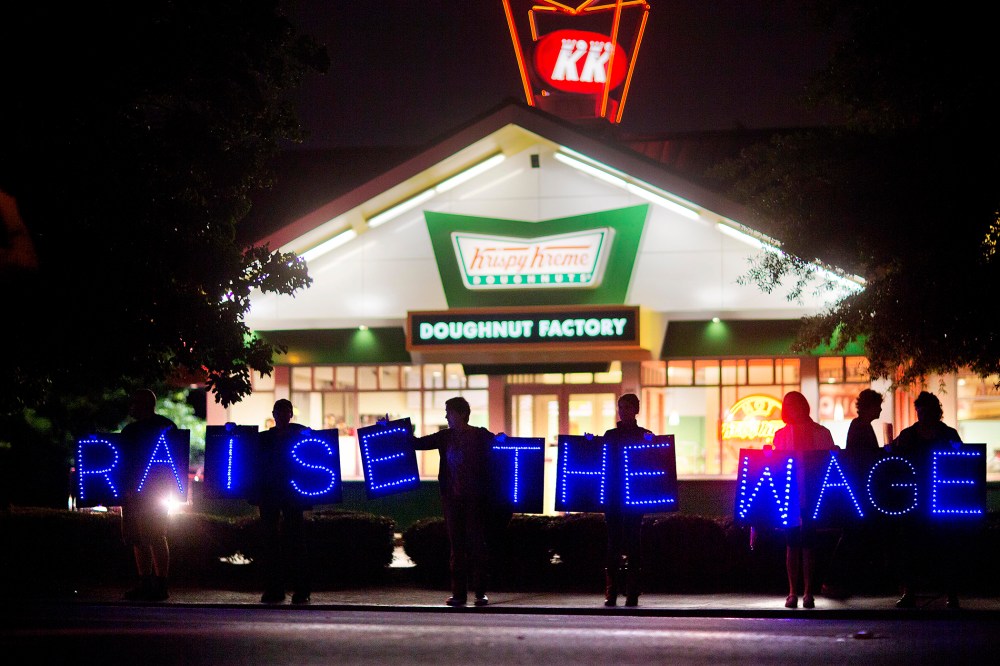
Los Angeles lawmakers last week voted to raise the city’s minimum wage to $15 an hour, joining Seattle, San Francisco, and Oakland, among others. And the low-wage worker campaign has unified around $15 as a nationwide target.
The “Fight for 15” campaign argues that with today’s high cost of living, that’s the lowest possible pay required to get by. In response, opponents say boosting the wage that high would cause employers to cut jobs, hurting the very people it’s meant to help. Advocates for workers dismiss that concern, saying the evidence shows that raising the minimum wage has little if any negative impact on jobs.
But the truth is, no one really knows, because the effect of going that high hasn’t been studied.
RELATED: New York’s fast-food workers urge board to raise their pay
“Fifteen dollars per hour is somewhat higher than the range that has been evaluated in the recent literature,” said David Card, an economics professor at the University of California, Berkeley, and the co-author of a landmark 1992 study on the jobs impact of raising the minimum wage.
Nor can we learn much from the experience of the few cities that already have moved to $15—not that both sides of the debate haven’t tried to use these examples to bolster their cases. The only place to go to $15 before recent months is Sea-Tac in Washington, a community around the Seattle-Tacoma airport. Its small size—around 27,000 people live there—makes it hard to draw many lessons.
Some cities are taking the plunge and looking at the effects later. When Seattle passed its $15 an hour measure, it also passed a resolution requiring an economic study of the impact—which began in April as the new wage was being phased in.
“We don’t yet know what the impact of today’s wage increase will ultimately be,” the economists hired to conduct the study wrote in an op-ed announcing their work.
Still, cities that are moving to $15 aren’t doing so entirely in the dark. Rather, they’re piecing together various bits of evidence that don’t definitively answer the question, but shed some light on it.
“When you take a look at evidence from the past, and the mounting evidence from places like Seattle and Sea-Tac, you see that it’s not very likely that a $15 dollar minimum wage will have a very detrimental effect on employment,” said Yannet Lathrop, an economist with the labor-backed National Employment Law Center, which supports a higher wage. “And that in fact it could possibly have a beneficial impact.”
The effect on job growth of more modest minimum wage hikes has been examined often. Card and Alan Krueger’s 1992 study compared the fast-food industry in neighboring areas of New Jersey and Pennsylvania after the former raised its wage from $4.25 to $5.05 while the latter didn’t, and found a small uptick in job growth in the Garden State. Other studies have found modest decreases.
Supporters of a raise note that after San Jose raised its minimum wage to $10.30 in 2012, its fast-food industry saw an increase in hiring. San Francisco had a similar experience after going to $12.25 in 2003. But looking at past experience isn’t the only way to shed light on the question. Economists at the University of California, Berkeley, conducted a study on behalf of the city of Los Angeles, as it mulled whether to go to $15. They projected that doing so would lead to very modest job loss, totaling 3,472 jobs—or between 0.1 and 0.2% of all jobs—when the new wage was fully phased in. “These employment changes are quite small when compared to projected job growth of 2.5 percent a year in the city,” the authors added. RELATED: Living on $1.50 a day And a University of Massachusetts Amherst study released in January looked at how the fast-food industry would respond to a phased-in $15 minimum wage. It found that because restaurants would see less staff turnover, implementing modest price increases would allow them to adjust without cutting jobs. New York City Comptroller Scott Stringer didn’t directly look at the impact on jobs when his office studied the effect on the city’s economy of mandating $15 an hour for the state’s fast-food industry, as a wage board appointed by the governor is considering. But Stringer did find that doing so would raise wages for the city’s workers by over $10 billion, benefiting nearly 1.5 million people. Economists say that because low-income people tend to spend any surplus cash quickly, to cover basic needs, boosting their wages is likely to be particularly effective at stimulating the economy. What does all this amount to? In the final analysis, no one can say for sure what the impact on jobs of a $15 minimum wage will be, because it’s uncharted territory. But it’s fair to say there’s enough evidence to suggest it won’t be catastrophic. And more and more places are deciding that the economic and human upsides—in the form of increased economic activity, and an easier life for hundreds of thousands of workers—outweigh the risks.
Zachary Roth Recommended


