








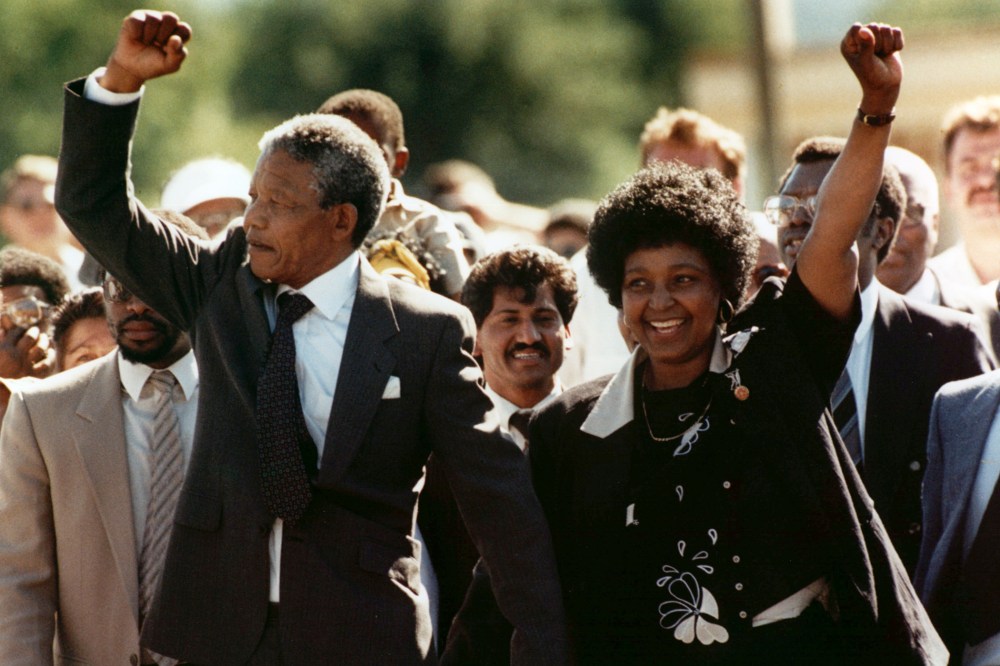
Twenty-five years ago on Feb. 11, 1990, anti-apartheid leader Nelson Mandela was freed from Robben Island prison after more than 27 years behind bars. For Mandela, life would never be the same, and he would soon make history by becoming the first black president of South Africa. But the human rights icon knew that his release represented something much more than just personal freedom: It was also a symbol of hope for a nation torn apart by racial inequities, and it elevated dreams for equality across the continent.
On the anniversary of this historic day, Mandela’s grandson, the activist and filmmaker Kweku Mandela, reflected on his grandfather’s life and legacy, as well as new human rights issues plaguing Africa and the world. His conclusion? We are not yet free; there is still much work to be done.
What is the historical significance of your grandfather’s release from prison?
I think the day has a lot of significance for a lot of people for different reasons. For South Africans, it renewed hope for our country, and I think there were a lot of unknowns, a lot of people who doubted that our country would get as far as we have today. Realizing apartheid wasn’t sustainable, President F. W. de Klerk made a bold move and went against the ideology of his party by releasing my grandfather. It was a unique step on his part, and he not only allowed my grandfather to be released, but he also met all of his [negotiated conditions]: the disbanding of all South African political parties, releasing all political prisoners from jail, and allowing those in exile return to the country.
RELATED: Nelson Mandela’s grandson answered your questions on Twitter!
What memories from Feb. 11, 1990, did your grandfather share with you?
He talked a lot about the fact that he was coming out into a world that was extremely foreign to him. For him personally, he was a bit unsure of how he would cope, if he would still have a place in the world. I know he talked about how the crowds were overwhelming. He knew he wouldn’t do it alone, but he wasn’t aware of what he would meet at city hall — a sea of people waiting for him to give his speech. There was a unique sense of optimism and hope, but there was also a fear of what was to come.
Is the long walk to freedom over? Twenty-five years later, what progress still needs to be made in South Africa?
I think my grandfather said it best when he said, “We are not yet free.” We have just started the first steps of being free. Freedom is not just casting off one’s chains. Striving for the freedom of all human beings is an eternal struggle. We’ve made large strides on the road to freedom, but we still have a long way to go. This now falls on the next generation. Obviously, in South Africa, we have our problems, like in any country in the world. But we have a lot of optimism and opportunity, and young people across South Africa are rising up and taking advantage of that and making the most of that and where our country can potentially go.
At your organization Africa Rising, you work to change the world’s perception of Africa. How will this be achieved?
I think the key to changing the global perception of Africa ultimately comes through more interaction with the world. Africans need to be regarded as global citizens on a global playing field to all people. We’ve seen great strides take place, but more needs to be done to actually showcase that in the coming years. One of the biggest things we can do is empower youth by letting them know the people they aspire to be — perhaps a political leader like my grandfather — is not out of reach. My grandfather, too, was a human being. He was not a saint or a demagogue. He came from a simple background, but he realized the impact he could have on his nation, and ultimately the world. We need to instill these values in young South Africans, and allow them to realize their dreams. The entrepreneur culture in Africa is slowly starting to see this change, and Africa will rise to be a world leader in various different industries.
RELATED: Kweku Mandela: How he continues Madiba’s legacy on HIV/AIDS
Apartheid is no longer the law of the land, but we still see issues of racial inequality around the world. Ferguson, Missouri, for instance, was recently at the center of tensions over racial inequality. Do we need to show the world that “black lives matter”?
A: I was lucky enough to sit in on a panel at Sundance, which featured some of the people from Ferguson, Missouri, taking us through their experience. I was impressed to hear of the many men and women who have come together to take a stand against what has happened and address the fact that these senseless deaths should not be repeated and that someone needs to be accountable when they do.
One of the things I said to that group, ultimately, is often I think, as a society, we jump to race really quickly, because it’s an easy point of contention, a way to divide people.
Whether it’s Ferguson, New York, other cities in the United State of America, or other places in the world, like Egypt or Ukraine, it really comes down to humanity, regardless of one’s color. If a young man had been killed by police in South Africa or the United Kingdom, whether he was black or white, at a very minimum the country would have demanded a full investigation into what happened. That’s common, decent humanity, and so what has transpired in both Ferguson and New York has taken many people by surprise. The murder trial of Oscar Pistorious is a good example. Even though he had a extraordinarily large legal team and financial resources most people do not have to defend himself, he was still sentenced to eight years in prison, because there was a full investigation. It begs the question why there isn’t a deeper investigation into what took place in Ferguson. %22We%E2%80%99ve%20made%20large%20strides%20on%20the%20road%20to%20freedom%2C%20but%20we%20still%20have%20a%20long%20way%20to%20go.%22′ How can we end the mass violence at the hands of terrorist group Boko Haram? I think there needs to be a more consistent message from the media around what’s taking place in West Africa with Boko Haram. We saw a big movement around “Bring Back our Girls” last year, but that seems to have dissipated. I recently worked with “Our Underground Railroad,” which focuses on bringing children home who have been sold into sex trafficking. This is an issue that happens all over the world. The media focuses a little bit on Boko Haram, but then goes on to the next big issue. This needs to be a focus of the entire international community, and we as a society need to put pressure on our governments to take action. In any society, 400 girls disappearing is unacceptable. We need to return them to their families and their communities. In African nations like Nigeria and Uganda, there have been anti-gay bills written into law, and the LGBT population has been blamed for HIV transmission. How can these behaviors be changed? I think the reality is that discrimination of any kind is unacceptable — whether you’re discriminating against someone because of the fact that they have HIV, or because of their sexuality. It’s going to take the youth standing up to this. There is a large gay community in South Africa, and they are a huge part of what makes South Africa so unique in business, cultural, and other spaces in society. We, as young Africans, need to push more increasingly for zero discrimination. We come from a history where we were discriminated against, and it makes no sense if we carry forward what we fought against for so long. What can South Africa, and the continent as a whole, expect along the next long road of 25 years? I think look for a continually growing African content that is being lead and driven by youth, and I would say if anything Feb. 11 should remind us of what’s possible when a large group of people come together and fight for what they know to be right — a goal greater than themselves — to liberate people and allow them the opportunity to start down the road of freedom and find true equality. It’s important that we learn from these unique moments in time, and take these lessons that we learned forward into the future. Kweku Mandela is president of Out of Africa Entertainment, a leading film production company in Africa. In 2009, Kweku co-founded with his cousin Ndaba Africa Rising, which strives to ignite a “New African Generation” that will empower itself to be at the forefront of Africa’s development. Follow Kweku on Twitter at @kwekumandela. Learn more about his films at www.outofafrica.info.
Joseph Neese Recommended


