








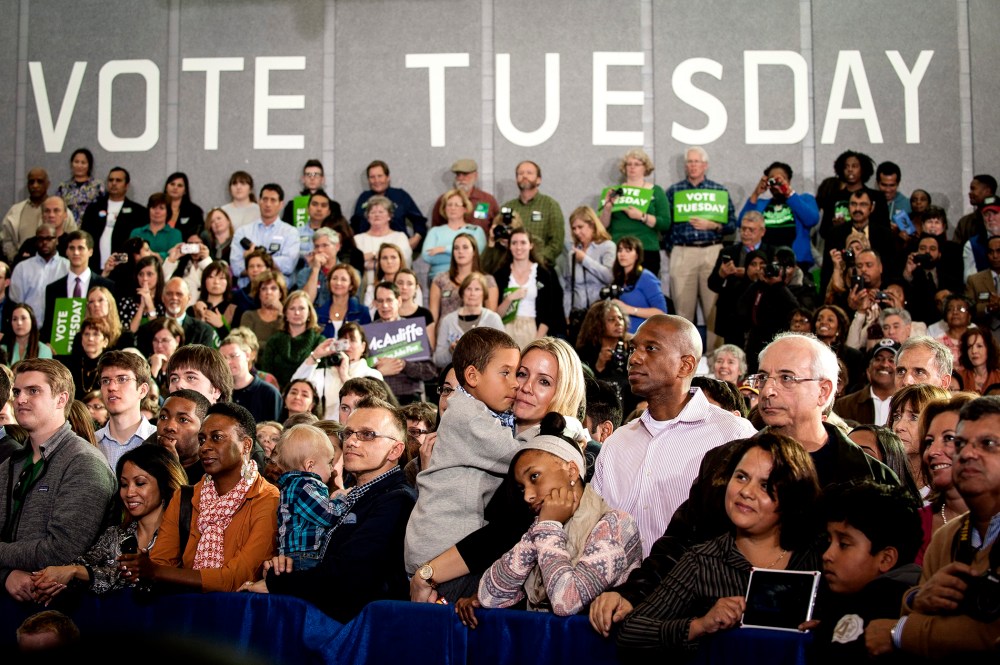
It’s Election Day and voters are deciding a number of high-profile races. In Virginia and Alabama, two races have become a referendum on the Tea Party. Boston and New York get new mayors for the first time in over a decade. And in Detroit a catchy jingle might just be the MVP.
In Virginia, once a red-state stronghold, several state offices including the governorship may go blue, bucking the state’s conservative trend for the first time in decades as Republicans face the liability of far-right social views and the tea party.
The latest poll shows Democrat Terry McAuliffe leading by six points over Republican Attorney General Ken Cuccinelli. At around 8:15 p.m., NBC News characterized the Virginia governor’s race as too close to call. Around the same time, Democrat Ralph Northam was projected the winner of the lieutenant governor’s race.
Cuccinelli’s stance on abortion issues, the environment, and healthcare were hammered by the McAuliffe campaign. Women have particularly responded in McAuliffe’s favor. While independents are split between the two candidates, women support the McAuliffe by 14 points.
Democrats have aimed to turn the gubernatorial contest into a referendum on the Tea Party, which has enjoyed extremely poor approval ratings after the shutdown.
“You have to look at Chris Christie or Bob McDonnell,” Morning Joe host Joe Scarborough said on Tuesday’s show. “There are ways to win in these purple, blue states, but you’ve got to make people think, I guess, you’re focused on jobs first and not ideology, and I don’t think Cuccinelli has done that.”
For his part, Cuccinelli attempted to capitalize on the tumultuous rollout of president’s health care bill to rally conservatives in his favor. In hopes of avoiding the Tea Party limelight during the shutdown, he co-headlined an event with Texas tea party darling Sen. Ted Cruz, but left before the freshman senator spoke and shunned the association. Libertarian Robert Sarvis is also running in Virginia, with polls giving him 8% of the electorate.
“This election is going to say a lot about Virginia’s future, and the country’s future,” Obama said while stumping for McAuliffe over the weekend.
Virginia’s own restrictive voter ID law won’t go into effect until 2014, but they did recently purge voter rolls of 40,000 reportedly ineligible voters (and according to many registrars, hundreds of eligible voters with them) just weeks before the election. In a court challenge, Cuccinelli defended the move in his role as attorney general; Democrats alleged that the purge disproportionately targeted Democratic voters and asked the attorney general to recuse himself. Cuccinelli declined.
Despite it, Virginia’s secretary for the Virginia State Board of Elections Don Palmer told reporters that voting was going “pretty smoothly” despite a software glitch that slowed down check-in processes in roughly half of one county’s polling stations.
“I’m sure it’s probably made the wait a little bit longer than it should be,” he said, according to The Washington Post.
In New Jersey, incumbent Republican Gov. Chris Christie is expected to sail to an early victory this evening over his Democratic challenger Barbara Buono—the latest polls show Christie enjoying a 33-point lead over the state senator.
On Tuesday, Christie said the governorship is the last elected office he’d seek—in New Jersey.
“I don’t know if I’ll ever have another chance to vote for myself,” he said, according to the Associated Press. “I won’t ever run for another office in New Jersey, I can guarantee that. This is it for me.”
The governor’s no-nonsense style and his recovery efforts following Hurricane Sandy prompted sky-high approval ratings that haven’t fallen much—despite recent controversial vetoes, including one that attempted to scuttle gay marriage.
Many expect Christie to run for president in 2016. One of Buono’s chief criticisms of the governor was that his presidential aspirations are governing the state and pushing him farther toward the right on matters of gay marriage and gun control (the governor notably vetoed the ban on a .50-caliber rifle, despite backing the proposal months earlier.)
Less than a month after a federal shutdown that tanked Americans’ views of their elected officials in Washington, just one congressional race will be decided on Tuesday.
In Alabama’s first congressional district, a Tea Party activist and establishment GOPer battle for the Republican nomination—a race that effectively decides who will take the extremely conservative district’s House seat.
Attorney Bradley Byrne—representing the center-right, business aligned Republican party—is up against Tea Party activist Dean Young, who just last week declared the president was born in Kenya.
Byrne earned the financial support of a number of business and Washington GOP groups hoping to keep Tea Partiers at bay—his race is likely the first in a long series of outright battles in the GOP’s civil war.
“Hopefully we’ll go into eight to 10 races and beat the snot out of them,” former Rep. Steve LaTourette of Ohio told the National Journal of their plan to fend off Tea Party challengers with a new group, Defending Main Street. “We’re going to be very aggressive and we’re going to get in their faces.” The End Spending PAC, founded by TD Ameritrade founder Joe Ricketts that funded Ted Cruz in 2012 actually opted to support Byrne over Young, al.com reported Monday, despite Young’s promise to be a “Ted Cruz congressman.” “I wonder if the fever has broken. You look at what Joe Ricketts is doing,” Scarborough said on Tuesday’s Morning Joe, remarking that there may be a swell of support toward supporting more mainstream Republicans. He added that the Chamber of Commerce has also supported Byrne. “Does the fever break tonight in Mobile, Alabama?” Scarborough asked. Boston and New York will both choose new mayors for the first time in over a decade—in New York, it’s the first time in three elections billionaire Independent Michael Bloomberg isn’t on the ballot. Voters rejected his de facto successor, City Council Speaker Christine Quinn, in favor of the uber liberal Bill de Blasio, a clear front-runner in the contest against Republican Joe Lhota, whose controversial late-in-the-game advertising push made some headlines, but did little to affect the polls. De Blasio voted around noon and kept campaigning throughout the day, posting a series of photos of New Yorkers who voted for him on Twitter. Peter just cast his ballot for Bill in Crown Heights! pic.twitter.com/V5CPHLgwt9 Boston’s legendary Tom Menino will not seek re-election for the first time in two decades. City Council John Connolly and State Representative Martin Walsh, both Democrats, are duking it out. Connolly pinned his campaign on education, while Walsh has tied himself to minorities and labor. In the latest polls, Walsh shows a slight lead. In bankrupt Detroit, one local businessman may ride a catchy jingle all the way to the mayor’s office. Mike Duggan was kicked off the primary ballot over a residency issue (the former hospital executive used to live in the suburbs), but crafted an incredibly catchy jingle of the spelling of his name encouraging voters to write his name in on the ballot in August. Months later, he holds a strong lead over Wayne County Sheriff Benny Napoleon. Duggan would be the first white mayor in roughly 40 years. Online, Duggan pushed voters to turn out. Thank you, but Mike just wants to be #DetroitMayor. Says it is last job he'll hold. RT @SILASRAGE: MIKE DUGGAN FOR PRESIDENT!!!!!!!! Elsewhere, amendments and ballot initiatives will be decided—in Washington State, the first labeling requirement for genetically modified ingredients would be the first of its kind in the country according to NBC News. Residents in the Seattle suburb of SeaTac, home to the Seattle-Tacoma International Airport, will also vote on an initiative to raise the minimum wage to $15 per hour and mandate paid sick leave for airport and hotel workers. And in Colorado, voters will weigh a 25% marijuana tax. Though many voting laws won’t kick in till next year, restrictive laws will kick in in several states, a full year after the president promised Americans that “we’re gonna fix that.” In Texas, former Speaker of the House of Representatives Jim Wright, 90, was nearly prevented from casting a vote today—the first election Wright would have missed since 1944—when he realized his driver’s license was expired and made multiple trips to government offices to procure the proper ID, which he was finally able to do on Monday. Married or divorced women whose names don’t perfectly match the voter logs may also be prevented from voting.
Jane Timm Recommended


