








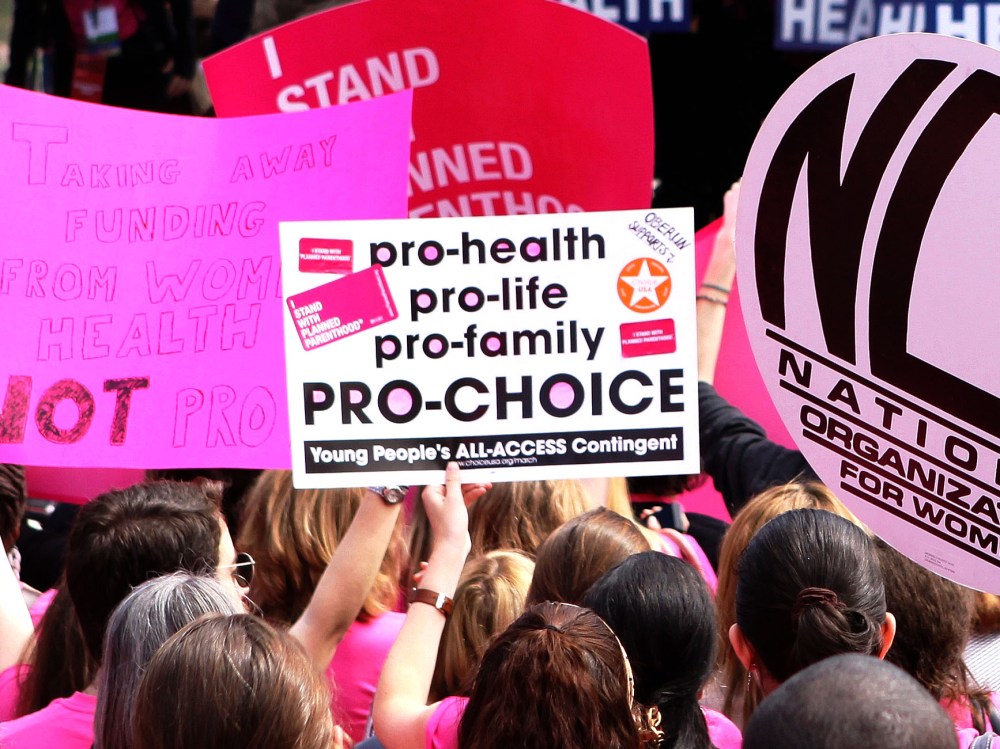
At a glance, the upcoming 40th anniversary of Roe v. Wade strikes some abortion-rights advocates as an occasion for tears. New findings from the Guttmacher Institute show that 2012 ranked second only to 2011 in the number of new state restrictions (43 provisions in 19 states)–not to mention attacks on birth control and other health services. Nationally, the number of abortion providers has dwindled by 40% since the early 1980s, and the proportion of Americans labeling themselves “pro-choice” has fallen from 56% in 1996 to 41% today.
But basic attitudes haven’t changed the way those figures suggest. In fact new polling data, released today by the Planned Parenthood Federation of America, suggest that support for reproductive rights is at an all-time high–even among people who call themselves “pro-life.” What Americans are rejecting, says Planned Parenthood President and CEO Cecile Richards, is not people’s support for safe, legal abortion but a label that no longer reflects their true feelings.
Like other recent polls, Quinnipiac University’s annual voter survey shows that supporters of the landmark Supreme Court ruling now outnumber opponents by a two-to-one margin. Some 64% voiced support for Roe v. Wade in last year’s poll, up from 60% in 2010. Only 31% said they opposed the Roe decision, down from 35% two years earlier.
Yet when pollsters phrase the same basic question this way–Are you pro-choice or pro-life?–the opposite trend emerges. In the past two years alone, Gallup has seen “pro-life” sentiment rise by four points (from 46% to 50%), with “pro-choice” sentiment falling accordingly.
Can both of these trends be real? Could a “pro-life” voter really support Roe v. Wade? Could a “pro-choice” voter oppose it? To find out, the polling firm Hart Research posed both questions to 1,007 voters last June. Not surprisingly, nearly all of the “pro-choice” respondents voiced support for Roe–but so did a large plurality of self-described pro-lifers. When asked whether the Supreme Court should overturn Roe v. Wade, only 56% of them said yes. More than a third of the pro-lifers–some 35%–said no.
Since then, still other researchers have conducted focus groups and interviews to see how people reconcile this apparent contradiction, and the findings should interest anyone talking about reproductive rights. They suggest that people from across the political spectrum are increasingly queasy about pitting “choice” against “life.” They share a strong reverence for life, but they don’t think their reverence entitles them, or anyone else, to control other people’s health decisions.
Among the “middle-ground” voters, as pollsters call those straddling the pro-life/pro-Roe divide, nearly half said their own view of abortion depended on the circumstances. But whatever their own attitudes, most agreed that a woman should be able to make her own decisions about her pregnancy. “I’m pro-life for me,” said one middle-grounder. “But for the safety of women, it’s important to keep the right to have that choice.” “There should be three [labels],” another told the pollsters: “pro-life, pro-choice, and something in the middle that helps people understand circumstances. It’s not just black or white–there’s gray.” Gray is a slippery concept, of course. Should a woman’s abortion rights depend on how her pregnancy occurred or why she wants to end it? Researchers haven’t polled the middle-grounders on that question, but their interview responses suggest they’re no more eager to restrict the right than abolish it. “Many women have a sense of how they would handle a given predicament, says Amy Phee, a managing director at the Glover Park Group, which oversaw the interviews and focus groups. “But they know it’s complicated–especially if it’s someone else’s predicament.” If “pro-life” and “pro-choice” are dead terms, are there better ones to describe the enduring standoff over abortion rights? Should we start calling people “pro-Roe” or “anti-Roe?” “Pro-fetus” or “pro-woman”? Richards, of Planned Parenthood, dreams of a world in which complex issues are not distilled to bumper-sticker labels at all. A worthy goal, to be sure. But until we get there, advocates of women’s health need to spring the “pro-choice” trap. By all indications, it’s hurting us.
Geoffrey Cowley Recommended


