








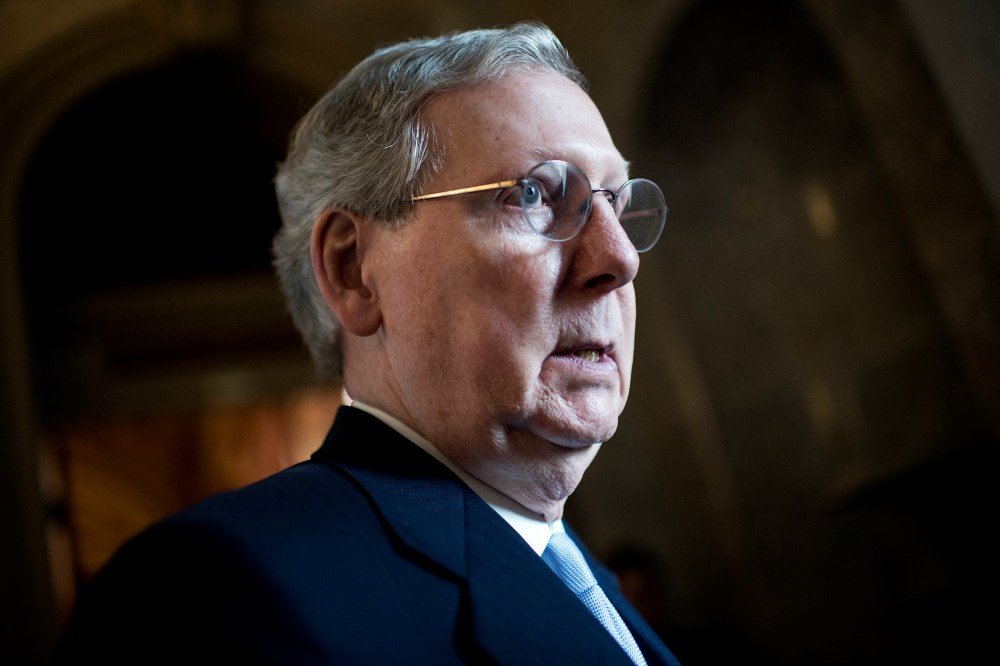
Two days after defeating tea party challenger Matt Bevin, Senate Minority Leader Mitch McConnell announced that he would no longer stand with Rand.
Ayn Rand, that is.
In a speech to the conservative American Enterprise Institute, McConnell said that Republicans “have often lost sight of the fact that our average voter is not John Galt,” a reference to the persecuted inventor in Ayn Rand’s Atlas Shrugged who leads business elites in a strike against socialism.
McConnell said this tendency was a natural outgrowth of the GOP’s emphasis on the free market and business, but one that helped cement the party’s elitist image on an electoral level.
“It’s a good impulse to be sure, but for most Americans whose daily concerns revolve around aging parents, long commutes, shrinking budgets, and obscenely high tuition bills, these hymns to entrepreneurialism are as a practical matter largely irrelevant,” McConnell said. “And the audience for them is probably a lot smaller than we think.”
McConnell’s argument was in line with the theme of the AEI event, which was organized to promote a new book of policy essays by conservative intellectuals on how to help the middle class and working poor. Ever since Mitt Romney lost big in the 2012 presidential contest stressing a business-focused message, GOP leaders have been working overtime to prove they can still be the party of the little guy, with mixed results.
Besides McConnell, the event featured House Majority Leader Eric Cantor and GOP Sens. Mike Lee and Tim Scott, who each stressed the importance of broadening the party’s appeal to voters of more modest means.
“For me, it’s very helpful sometimes to think about the working family or maybe the single mom who at the end of the hard day has put her kids to bed and then has to face how is she going to make ends meet and pay the bills at the end of the month,” Cantor said.
The event also featured an all-star cast of conservative reformers, including New York Times columnist Ross Douthat, National Review editor Ramesh Ponnuru, former Bush official Pete Wehner, and writer Reihan Salam, who encouraged party leaders to emphasize issues like student debt and child tax credits that might resonate with working families.
All of these writers have shown an impressive willingness to question party orthodoxy.
Wehner, for example, co-wrote a blistering analysis of the GOP after Romney’s loss that urged the party to, among other things, embrace climate science and stop fetishizing Ronald Reagan’s tax cutting ways, which no longer are as relevant now that the marginal rates are a fraction of what they were in 1980. Douthat and Ponnuru have argued the GOP needs to be more willing to commit serious money to a health care plan that achieves some of Obamacare’s coverage goals. The question, however, is what happens when the rubber meets the road in Congress. Thus far the prevailing trend has been for leaders like McConnell and Cantor to pay lip service to the bright young reformers growing within their party and then shelve their ideas once they meet resistance from either the party’s base or its donor class. One of the essays in the new policy book, for example, calls for putting less emphasis on reducing tax rates for the rich and more on expanding tax credits for the middle class. But when Lee, a Utah senator popular with tea party activists, attempted to do just that, he found it created a $2.4 trillion hole in the deficit, which he is still trying to fix. Lee and other speakers denounced “cronyism” in government, which they identified as various special subsidies for big business. But when Democrats or the odd Republican suggest eliminating various tax breaks for corporations as part of a deficit package, groups like Grover Norquist’s Americans For Tax Reform swoop in to declare them an unacceptable tax increase. The most ambitious Republican attempt at a revenue-neutral tax reform plan that wasn’t also a bonanza for the wealthy prompted an instant and fatal backlash from the right, who complained it made big financial firms pay too much. And on health care, Republicans have still embarrassingly failed to produce a long-promised Obamacare alternative amid fierce opposition from conservatives to almost any spending that expands coverage. Thus the GOP’s plutocrat problem remains the same. The party’s right wing base demands an immediate balanced budget and its donor class refuses to consider any reduction in their tax benefits. The two goals cannot be achieved without devastating cuts to social services that would instantly undo whatever fledgling efforts politicians have made to court the working class. No amount of paeans to the young wonk reformers will break that dynamic, only a fundamental shift in the party’s priorities.
Benjy Sarlin Recommended


