








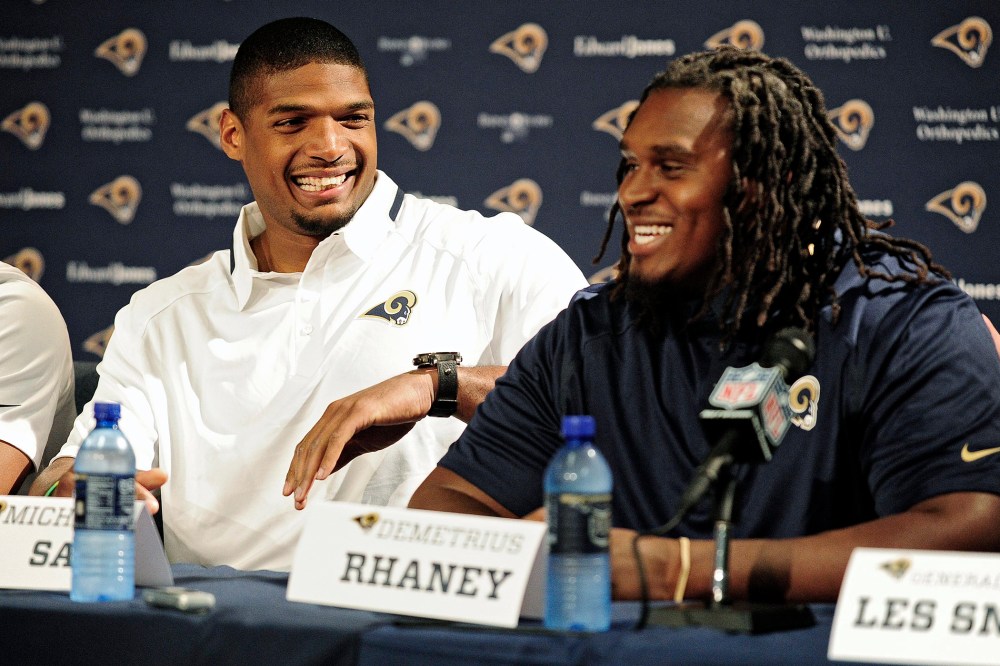
If there were any concerns that the National Football League wasn’t ready for an openly gay player, you wouldn’t know it from watching an elated Michael Sam step out for a press conference Tuesday with fellow draft picks of the St. Louis Rams.
The NFL newbies had nothing but kind words to say about each other and their shared opportunity to play professional football — casting aside, at least momentarily, lingering doubts about whether the country’s most popular sports league could accept its first openly gay player and the publicity surrounding him.
“I’m happy they gave him the opportunity to be here to play ball,” said Demetrius Rhaney, who was picked by the Rams right after Sam. “He earned it.”
“He’s a great teammate — I feel like I have to say that,” joked E.J. Gaines, who played with Sam at the University of Missouri. “He brings something different to the team, so I’m excited to see what he can do for the Rams.”
Sam, a 24-year-old defensive end, made history on Saturday when he was selected in the third and final day of the NFL draft. Three months earlier, the Mizzou alum announced to the public that he was gay, throwing his once-secure professional prospects into uncertainty. Making matters worse, Sam delivered a weak performance at the scouting combine a few weeks later.
He was the 249th and eight-to-last player to be drafted.
Without any guarantee he’d earn a spot on the team’s 53-man roster, Sam had instantaneously solidified his legacy as a pioneer for LGBT equality.
“His drafting was the most important moment for acceptance of gays in sports history,” said Cyd Zeigler, co-founder of Outsports.com, to msnbc. “He’s already broken so many barriers. If he plays, it’ll just continue to build on that.”
Though the gay rights movement made enormous strides in recent years, that progress had yet to infiltrate the sports world. Barriers began to collapse last Spring, however, when NBA center Jason Collins came out following his season with the Washington Wizards. After it looked like that decision had doomed his career, Collins was finally signed by the Brooklyn Nets.
NFL executives and coaches were wary their league would be as welcoming.
“To call somebody a [gay slur] is still so commonplace,” one NFL player personnel assistant told Sports Illustrated in February. “It’d chemically imbalance an NFL locker room and meeting room.”
So far, that hasn’t happened. “I had no nerves at all,” said Sam about meeting his Rams teammates. “They came to me and said, ‘Welcome to the family, let’s get to work.’ And that’s what we’re going to do.” Despite being drafted late and with his playing status still unknown, Sam is already on track to be one of the most popular players in the NFL. His jersey is the second-best selling of all the rookies’, topped only by that of quarterback Johnny Manziel, who was the 22nd draft pick. Not everyone was as supportive. After ESPN aired Sam kissing his boyfriend while celebrating his selection by the Rams, Miami Dolphins defensive back Don Jones tweeted “OMG” and “Horrible.” The 23-year-old was hit with a fine and forced to apologize. The Dolphins also excused him from team activities pending sensitivity training. Undoubtedly, this won’t be the last incident of its kind. But Sam says he knows how to handle it. “I’m determined to make this team, and I have every confidence in myself that I will make this team,” said Sam. “If somebody wants to say something, then you will see number 96 running down this field and making big plays.” Though Sam made clear his priority is football, not trailblazing, he did have a message to those he inspires: “It’s OK to be who you are, whether you’re gay, straight, black, or white. It’s OK to be comfortable in your own skin.”
Emma Margolin
Emma Margolin is a reporter at MSNBC.com. Recommended


