As the cost of attending college continues to rise, a growing majority of professors teaching classes are working part-time for low wages, few or no benefits, and with negligible job security.
According to a report by the Pullias Center for Higher Education, the growth of part-time faculty has far outpaced that of full-time faculty; part-time adjunct positions have increased 442.1% between 1970 and 2003 compared with the 70.7% increase in full-time jobs. Tenure and tenure-track positions were once the majority at universities, but they now make up less than one quarter of college teaching positions. On Saturday, guests on “Melissa Harris-Perry” discussed what the rise of adjunct positions means for our system of higher education.
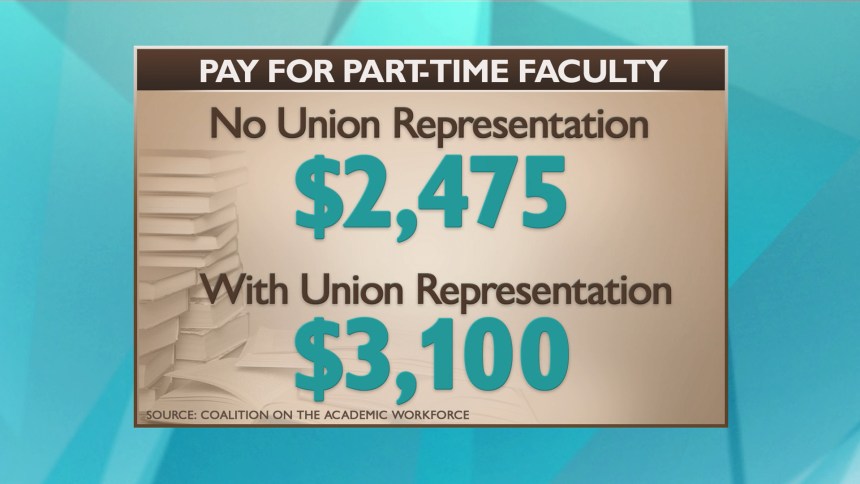
Part-time faculty have little job security and are often forced to teach multiple classes at different institutions to make ends meet. The median pay for part-time faculty per three-credit course is $2700, and according to the Chronicle of Higher Education’s Adjunct Project, 79% of adjuncts do not receive health insurance at work and 86% do not receive retirement benefits. Poor conditions have led a growing number of adjuncts to join unions like the Service Employees International Union, which currently represents more than 18,000 members at higher education institutions. Part-time faculty with union representation earn a median pay per-class that is $642 higher than their non-represented counterparts.
Adjunct professors are also less likely to have a vote in university governance, which adjunct professor Mary Ellen Bernard said feels alienating within institutions where they are teaching. A survey by the American Association of University Professors found that only one quarter of part-time faculty were eligible to serve in university governance roles, cutting them off from what AAUP calls “participation in an integral part of faculty work.”
Part-time positions additionally offer little job security; the limited-term contracts provided to adjuncts offer no guarantee of renewal, regardless of the expertise of the professor or their years of service at an institution. “It punctures the myth that all we have to do to solve our economic problems is get as much education as possible,” said Columbia University professor Dorian Warren. “These are people with Ph.Ds. and they can not find full-time work.”
The impact of the growth of part-time faculty on campuses extends beyond the professors themselves. Students suffer from reduced contact with professors who must take on large class loads at multiple institutions. A 2003 study found that part-time and full-time professors generally spend an equal amount of time on instructional activities, but for adjuncts those hours are mostly spent teaching additional classes rather than engaging with students outside the classroom. Host Melissa Harris-Perry noted that the insecurity of adjunct positions means students looking for recommendation letters or advising from past instructors may find those professors no longer work at their institution. Adjuncts’ capacity to pursue their research is also compromised by their low pay. “If you’re teaching five courses and running from campus to campus… you don’t have time to do your research, to write, to read so you can stay up on the latest scholarship,” explained Dorian. Melissa positioned the poor situation for adjuncts as fundamentally at odds with the foundations of higher education. “It undermines the other key aspect of what we’re supposed to be up to in universities, which is the production of knowledge through research,” she said. “How could one possibly be a productive researcher in this kind of context?”
Sara Kugler Recommended