








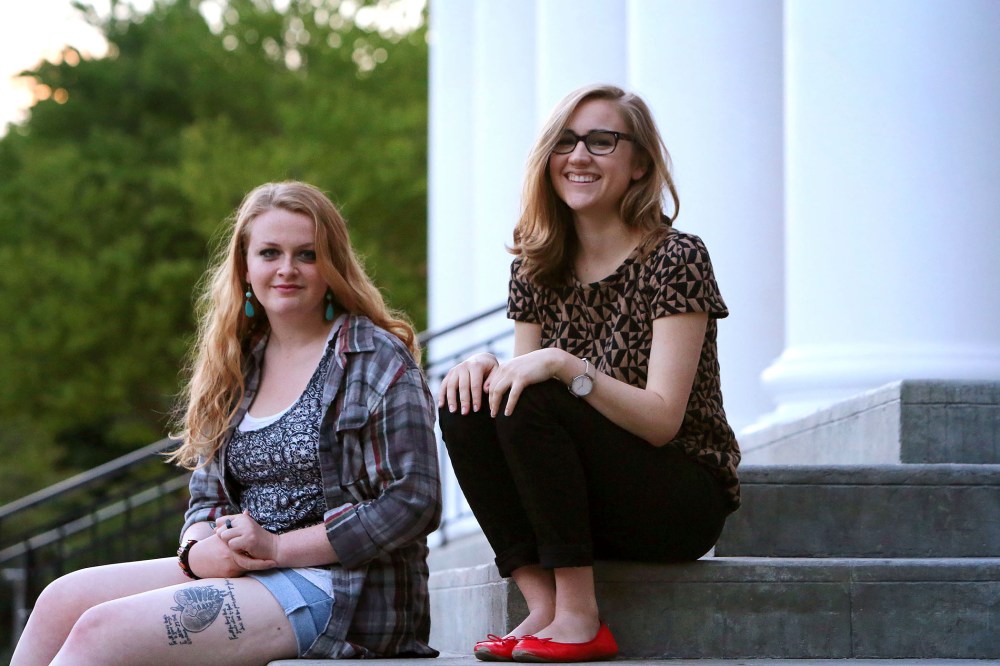
When Jordan Ashley Barney arrived at Wheaton College in Illinois and wanted to join the Christian Feminist Cabinet, she asked what the difference was between “a Christian feminist and an actual feminist.”
“Because to me,” Barney, 20, said recently, “I don’t think there should be any sort of difference.”
But when she and co-president Krista Pedersen took over, they kept “Christian” in the name. “It makes people less worried,” said Barney, meaning less worried about the stigma associated with feminism.
But, as Barney then added, “People get worried no matter what.”
It isn’t easy being a self-described feminist on one of the most famous evangelical campuses in the country, which became even better known when its case against covering some forms of contraception reached the Supreme Court on July 3.
%22I%20don%E2%80%99t%20know%20how%20they%E2%80%99d%20censor%20me%2C%20but%20they%E2%80%99d%20find%20a%20way.%22′
Wheaton had objected to signing a government form that would certify the college’s objection to subsidizing some forms of birth control, which would then notify the insurer to cover it directly. Under the Affordable Care Act, women must be provided coverage for contraception by their health care plans free of charge.
The college argued that “signing the Form would be impermissibly facilitating abortions,” equating emergency contraception and the IUD with abortion in defiance of the evidence. A majority of Supreme Court Justices said Wheaton didn’t have to sign the form while its suit went forward.
Wheaton’s president even compared its suit against contraceptive coverage to the fight against slavery. “Wheaton College and other distinctively Christian institutions are faced with a clear and present threat to our religious liberty,” Dr. Philip Ryken said. “Our first president, the abolitionist Jonathan Blanchard, believed it was imperative to act in defense of freedom. In bringing this suit, we act in defense of freedom again.”
RELATED: This is the next Hobby Lobby: The fight over contraception at Notre Dame
Wheaton is an icon of social conservatism. It took until 2003 for the school to repeal its ban on on-campus dancing (except square dancing) and on adult faculty drinking alcohol. Students are bound by a community covenant, which dictates taking “care to avoid any entertainment or behavior, on or off campus, which may be immodest, sinfully erotic, or harmfully violent.”
Barney and Pedersen say they chose Wheaton for its rigorous academics, though they both came from evangelical Christian families — Pedersen’s in Miami and Barney’s just outside San Francisco. Pederson’s mother, she said, had been praying for her daughter to attend Wheaton since she was a little girl.
Both students still identify as Christian, though no longer as evangelicals. They knew, more or less, what they were in for at Wheaton.
“I wanted to bring my different background, experience, and opinions, and blend them with the larger Christian community,” said Pedersen, 20, who is studying political science and history.
“I came into Wheaton very much a feminist, and also knowing that my surroundings weren’t going to be exactly in line with my beliefs,” said Barney, who is studying communications and pursuing a newly-created certificate in gender studies. “It’s been rough in some ways.”
But she and Pedersen aren’t entirely alone: About thirty people, out of 2,400 undergraduates, show up to the Christian Feminist Cabinet’s bi-weekly meetings. Last spring, they were among a handful of students who peacefully demonstrated in response to an “ex-gay” speaker on campus.
Barney opposes the university’s contraception lawsuit, but worries that galvanizing broader pushback on campus will be tougher than it was for the “ex-gay” speaker. “People are so adamant with everything to do with reproductive rights,” she said. “For me, even if someone is pro-life, and I consider myself pro-choice, what Wheaton is doing is not helpful at all for preventing abortion in any sort of way. I think the college should be strongly supporting the Affordable Care Act, because this is a way to prevent abortion.” %22A%20Christian%20community%2C%20supposedly%20centered%20on%20the%20theme%20of%20grace%20in%20Christ%20Jesus%2C%20leaves%20little%20to%20no%20grace%20to%20the%20college%20student%20who%20consents%20or%20is%20coerced%20into%20having%20sex.%22′ The Christian Feminist Cabinet has yet to tackle so controversial a topic. “We end up talking about women in ministry most of the time,” Barney said. She also wants to have a conversation about transgender women, and about sex and consent. “I don’t know how they’d censor me,” she said of Wheaton, “but they’d find a way.” There is a sexual education seminar at Wheaton, Barney said, but admission is limited to students who are engaged to be married. For everyone else, Pedersen wrote in an email, “What eventually ends up happening to students who do engage in sexual activity, mostly with no protection whatsoever (usually due to the shame of having to go buy a condom or other forms of birth control), is the high risk of pregnancy.” She added, referring to Wheaton’s specific objection to emergency contraception, “Not only do sexually active college students not have access to birth control, but they are also unable to avoid unwanted pregnancies after engaging in unprotected sex.” “A Christian community, supposedly centered on the theme of grace in Christ Jesus, leaves little to no grace to the college student who consents or is coerced into having sex,” she wrote. “So not only is there shame about having sex, but there’s shame about preventing pregnancy, and also terminating pregnancy. This leaves little room for the Christian young adult to endure ‘error’ in their sexuality.” Barney and a friend went to an on-campus forum about Wheaton’s suit against the Obama administration, featuring one of the attorneys in the case. “There was a kid in the back who was a biology major,” Barney recalled. “He kept asking questions about the morning-after pill that supposedly causes abortion. And it was utterly refuted by the simple facts that this biology major had learned as a twenty one year old. And the lawyer knew nothing about the scientific facts of this so-called abortion pill … He kept saying, ‘I’m not a scientist.’” At the time, she says, she didn’t expect Wheaton’s lawsuit to go anywhere. But then she read the Supreme Court’s ruling on the preliminary injunction it received from the Supreme Court. “The justices that dissented were the three women,” she said. “You have to think when a law like this has to do with women, and it’s being challenged like this by three women, you have to be like, what is going on here? Why are we trusting men to make these decisions?”
Irin Carmon Recommended


