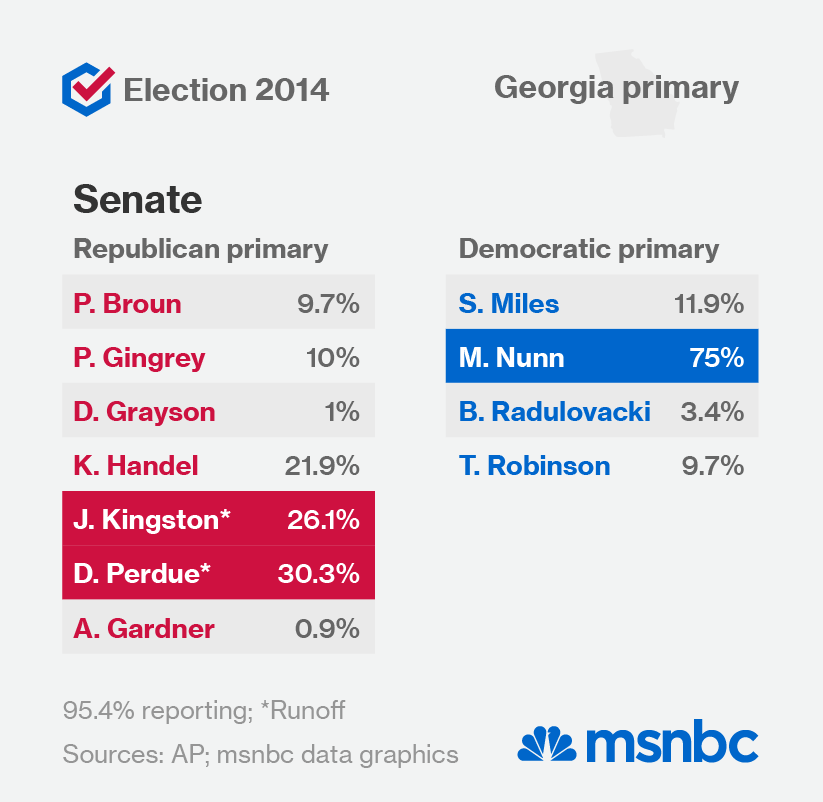
ATLANTA, Georgia — “If we want different results in Washington we have to send a different type of person to Washington,” David Perdue told supporters on Tuesday night after winning a spot in Georgia’s runoff for the GOP Senate nomination.
Perdue may not like Washington, but the capital city loves Perdue. The millionaire businessman and cousin of former Republican Gov. Sonny Perdue is considered a highly promising candidate by national Republicans who will bolster their efforts to retake the Senate. He’ll face Rep. Jack Kingston, another establishment-favored candidate, in a July runoff to determine who will go on to face Democrat Michelle Nunn in November.
GOP establishment leaders entered 2014 on a mission. No longer would they tolerate amateurish candidates like Christine O’Donnell in Delaware or allow suicidal insurgent campaigns against Republican incumbents like Richard Mourdock’s in Indiana to go unchecked. This time, they would recognize threats early and intervene as necessary.
Those leaders are likely sleeping well after watching the returns come in from Kentucky and Georgia, the only two Senate races where Republicans are on defense in 2014. With Mitch McConnell’s successful return to the GOP ticket in Kentucky and Perdue moving up in Georgia’s Republican primary, the party won’t be able to blame the grassroots for handing them unprepared candidates if they fail to win their races.
McConnell, who barely even bothered to acknowledge primary opponent Matt Bevin over the race’s home stretch, made his general election pivot official on Tuesday with a victory speech slamming Democratic opponent Alison Lundergan Grimes.
“My opponent is in this race because Barack Obama and Harry Reid want her in this race,” McConnell said.
It’s easy to overanalyze Senate primaries as “tea party” versus “establishment” contests, especially when they feature candidates who hold similar positions across the board and often sport competing endorsements from conservative groups. Georgia’s primary, for example, never broke down along such simple lines.
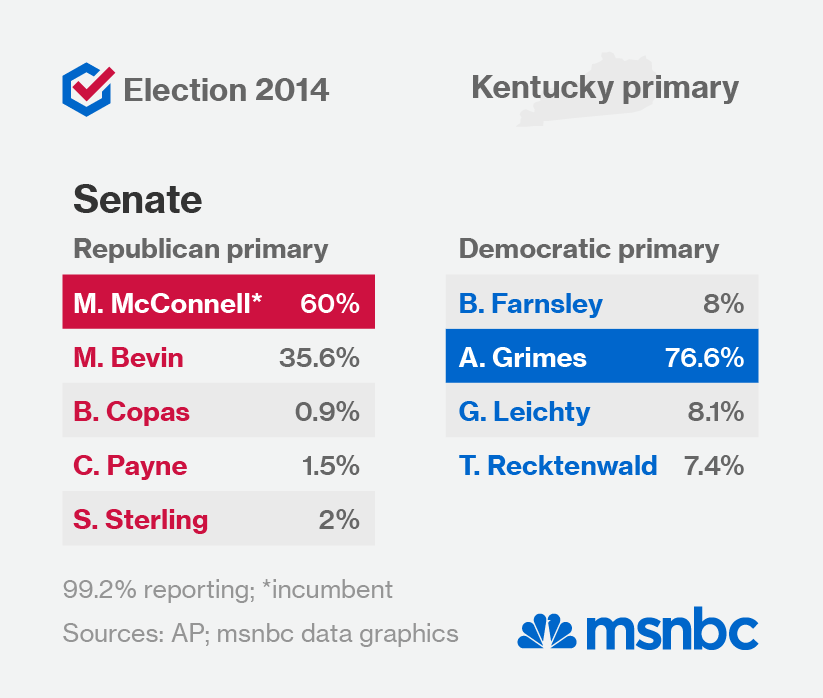
Not so in Kentucky. Matt Bevin’s defeat on Tuesday, called within minutes of the polls closing, is a humiliating moment for national tea party groups, who made unseating Senate Minority Leader Mitch McConnell one of their top priorities for 2014. As recently as last month, Bevin was described by Glenn Beck at a FreedomWorks convention as “called of God” in response to the movement’s fervent prayers.
Despite support from a wide array of conservative groups as well as popular commentators like Beck and Mark Levin, Bevin failed to ever seriously threaten McConnell in the polls and often looked hapless trying to fend off his opponent’s attacks. In the most memorable example, Bevin was caught attending a pro-cockfighting rally, then offered a deceptive denial that collapsed when video surfaced of him at the event telling attendees that the animal blood sport should be legalized. Bevin’s supporters were never able to commit either the money or the on-the-ground support to make McConnell sweat. On the other side, establishment-heavy super PACs like Kentuckians for Strong Leadership spent millions defending McConnell.
“He made me a stronger candidate,” McConnell said in his victory speech, likely the most gracious sentiment he’s ever publicly uttered about Bevin.
McConnell left nothing to chance. He spent years courting fellow Kentucky Sen. Rand Paul as an ally, tapping longtime Paul aide Jesse Benton as his campaign manager and keeping him in place even after Benton was recorded telling a friend that he was “holding my nose” in the McConnell job to help Paul in a 2016 presidential run. It may not have been the happiest marriage, but it was an effective one. Paul’s support helped cut off Bevin’s ability to consolidate the conservative grassroots that helped push Paul himself past a McConnell-favored Republican in 2010. In a final indignity for Bevin, Paul delivered a video message calling for party unity at McConnell’s victory party.
FreedomWorks president Matt Kibbe, whose group backed Bevin in the race, suggested that McConnell’s campaign to court the tea party was itself a moral victory.
“When the establishment runs on our issues, it’s clear that there is a larger cultural shift happening here,” Kibbe said in a statement. “Constitutional conservatives and libertarians are setting the agenda in the Republican Party.”
Kibbe was correct that McConnell’s — and practically the entire GOP’s — devotion to tea party issues represented a genuine kind of success. But with few exceptions, most notably McConnell’s support for the 2008 bank bailout, the tea party’s quarrel with McConnell was about strategy.
McConnell had long ago adopted a position of total opposition to Obama’s agenda – he arguably pioneered it — and was careful not to cross his base. But after Republicans took the House in 2010 he was forced into the reluctant role of wet blanket to the tea party’s most self-immolating causes, overruling colleagues like Paul and Texas Sen. Ted Cruz in order to reopen the government and then to prevent a devastating debt default. McConnell’s win on Tuesday is at least partly a validation of GOP leaders’ decision to pivot from the shutdown fight to a more fertile general election message.
The midterm battle is not over yet for McConnell. Democratic candidate Alison Lundergan Grimes is roughly tied in the polls and McConnell has to hope that the state’s conservative lean can help overcome his low approval ratings. Pointing towards the general election, McConnell said his opponent “is in this race because Barack Obama and Harry Reid want her in this race.” Part of Grimes’ strength in the polls comes from the significant number of Bevin supporters who appear sufficiently disgusted with McConnell and his brutal primary attacks to consider voting Democrat. A Bluegrass poll this week found Grimes with a statistically insignificant 44-43 lead over McConnell with 25% of Bevin voters saying they planned on supporting her over the incumbent. It’s an open question whether so many GOP primary voters would realistically shift support from an ultraconservative tea party candidate to a Democrat come November, even a relative moderate. Bevin gave at least a halfhearted start to the healing process in his concession speech, saying that he has “no intention in any race at this time in this state of supporting Democrats over Republicans.” He didn’t endorse McConnell, however. Unlike Kentucky, the GOP’s interest in the Georgia race was much less about tea party and establishment divisions than it was about quality control. Many Republican strategists feared that Georgia, more than any other state, had the potential to produce a Todd Akin-like disaster if voters selected an unpolished nominee. Congressman Paul Broun, long on inflammatory rhetoric and weak at fundraising, was the most worrisome case. But Congressman Phil Gingrey, who once said Akin was “partly right” on the subject of “legitimate rape,” could also have been vulnerable – especially against a strong female candidate like Michelle Nunn, who secured the Democratic nomination on Tuesday. Instead, businessman David Perdue burst onto the scene with an early advertising blitz introducing himself to Georgia voters as an “outsider” candidate who would focus more on pragmatism than ideology if elected. He built up a modest, but persistent, lead and never relinquished it. “One thing we did do tonight is we retired three career politicians — and we got one more to go,” Perdue said. Congressman Jack Kingston, a 21-year House veteran backed by the Chamber of Commerce, and former Secretary of State Karen Handel, who nearly won the GOP’s gubernatorial nomination in 2010, battled for the runoff spot late into the night. Both of them are polished candidates that bring their own strengths to the table and establishment GOP strategists would likely be happy to support either as the nominee against Nunn. Gingrey and Broun each found it difficult to stand out in a field where everyone was solidly conservative on virtually every relevant issue. Prominent grassroots leaders and activists never coalesced around one candidate. Herman Cain, one of the most popular tea party figures in the state, backed Perdue. Sarah Palin and Red State editor Erick Erickson, who considered a run for Senate himself, rallied behind Handel. Meanwhile, groups like Club For Growth and Senate Conservatives Fund that played an active role boosting hardline candidates in other Senate primaries sat the race out. With Broun and Gingrey out of the picture, the party’s next concern is the lengthy campaign stretch before the July 22. The candidates have been stepping up their attacks against each other in recent weeks, with both Handel and Kingston taking aim in particular at frontrunner Perdue’s business record, which includes success stories at Dollar General and Reebok and less election-friendly stints at Pillowtex, which went bankrupt, and Haggar Menswear, where he oversaw the outsourcing of jobs to Mexico. Perdue has been casting Kingston and Handel alike as career politicians. Obviously, it’s problematic if the candidates end up wasting their resources tearing each other down while Nunn continues to build a prodigious war chest. But that’s a problem for another day. For now, the GOP establishment can revel in getting the candidates they wanted in two critical races in a midterm year with the wind on the party’s back.
Benjy Sarlin Recommended