MACON, Ga. — 2014 is a Republican year. The party has the map, the candidates, and the money to finally retake the Senate after blowing the last two tries by nominating weak ultra-conservative candidates in critical races. And there’s no way that’s happening again, right?
Not if Georgia has anything to say about it.
The solid red state is shaping up as a key boost to Democratic hopes of retaining the Senate thanks to a GOP primary field both sides believe could produce a nominee too hobbled, too extreme, or too gaffe-prone to win in November.
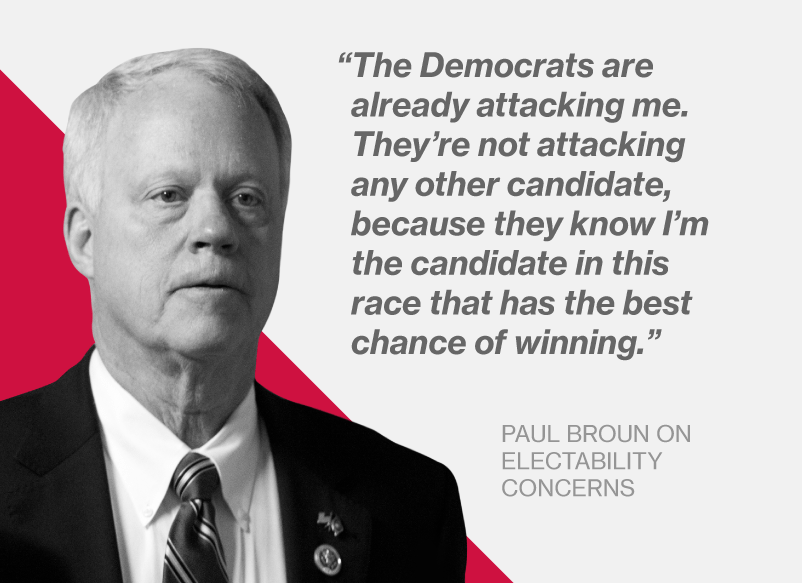
The candidate causing the biggest headache is Paul Broun, a four-term GOP congressman who opposes abortion without exception, thinks the Big Bang and evolution are “lies straight from the pit of hell,” (gravity waves be damned), and likened President Obama to Hitler and Karl Marx before he was even inaugurated.
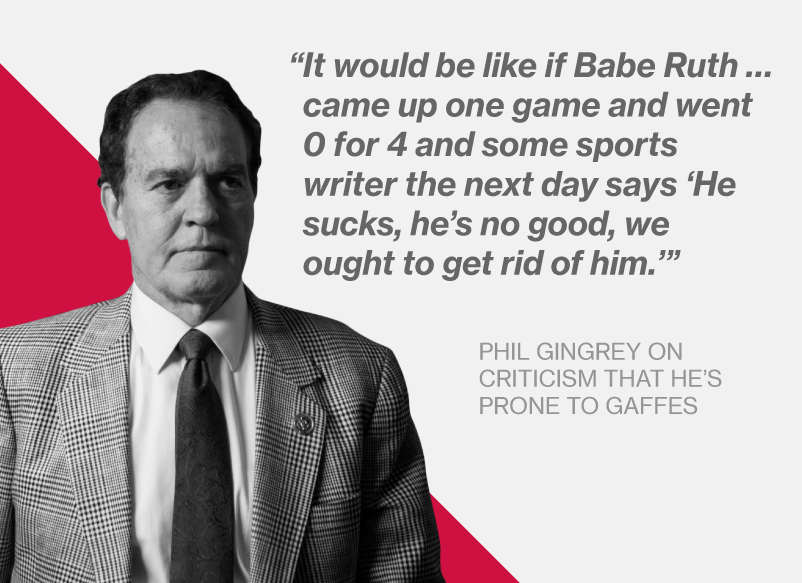
Then there’s fellow Rep. Phil Gingrey, a doctor who suggested last year that Todd Akin was “partly right” about his theories on “legitimate rape” (Gingrey later apologized).
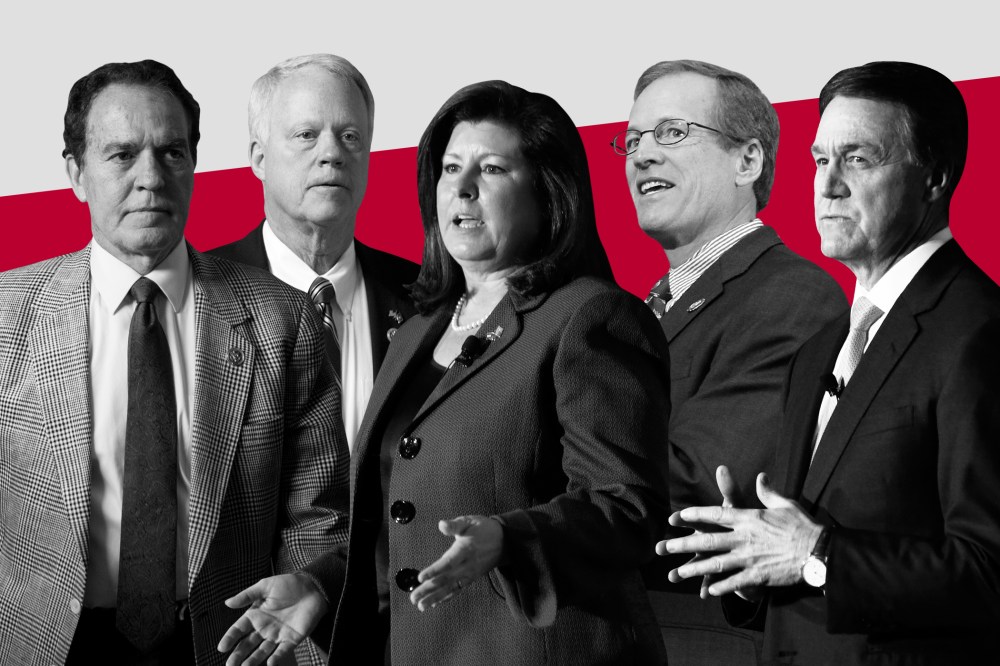
Even if Broun and Gingrey come up short in the state’s May 20 primary, Democrats are hoping a close race will pull the entire GOP field, which also includes Rep. Jack Kingston, former Georgia Secretary of State Karen Handel, and wealthy businessman David Perdue, uncomfortably to the right.
In normal circumstances, even a weak GOP nominee would probably be a shoo-in in this conservative state. But Democrats have drafted an unusually strong candidate in Michelle Nunn, whose father Sam Nunn is still revered here for his 25-year career in the Senate.
“What a lot of people don’t understand about the Republicans in Georgia is that up to 2002 a lot of them had a ‘D’ next to their name,” Erick Erickson, the Red State founder who briefly flirted with running himself, said. “They’re very comfortable with names like Carter and Nunn.”
RELATED: Can Democrat Michelle Nunn grab a Senate seat in Georgia?
Republicans are bracing for a rough ride, knowing their candidates will battle each other through the primary and likely July 22 runoff while Nunn soaks up a deluge of cash and attention unimpeded.
“One of the people on this stage tonight is going to be your Republican nominee, and after this primary and the runoff they are going to be bruised, battered and broke,” conservative radio host Martha Zoller told the audience at a Republican Senate debate in Macon earlier this month.
Polling is all over the map right now: A survey by Democratic firm Public Policy Polling right before the Macon debate found Broun opening up a double digit lead in the primary, with 27% support to 14% for Gingrey and the rest roughly tied for third place, while a slightly more recent poll by SurveyUSA put Perdue at 29%, Kingston at 19%, and the rest hovering around 10% support.
The stakes couldn’t be higher. For two election cycles in a row, Republicans have almost taken the Senate only to watch flawed candidates like Christine O’Donnell in Delaware in 2010 and Todd Akin in Missouri in 2012 cost them winnable races.
On the Democratic side, Georgia is one of only two top tier pickup opportunities, the other being Kentucky where polls show Republican Leader Mitch McConnell in trouble. For both parties, the path to a Senate majority runs directly through the Peach State.
“It’s an uphill battle in the Senate, but one of the things we have going for us is that Republicans might keep being the gift that keeps on giving and say one outrageous remark,” Jim Manley, a former top aide to Majority Leader Harry Reid, told msnbc.
Race to the right
Georgia’s Republican primary doesn’t fit into a neatly wrapped establishment vs. tea party narrative (think Rand Paul versus Trey Grayson in Kentucky in 2010) or moderate vs. conservative (like Charlie Crist versus Marco Rubio in Florida in 2010.) Any GOP candidate aspiring to statewide office here knows you have to be pro-life, pro-gun, anti-Obamacare, anti-taxes, and willing to play ball with the grassroots in order to stand a chance.
“We’re not identical, but I don’t think there’s a nickel’s worth of difference in our bona fides on the conservative side,” Perdue said in an interview.
This is pretty much the consensus among the field. “It’s certainly a conservative group,” Gingrey said.
Broun, nicknamed “Dr. No” for his constant ideological votes against House leadership, conceded to msnbc that, “certainly all our Republicans are conservative to one degree or another.”
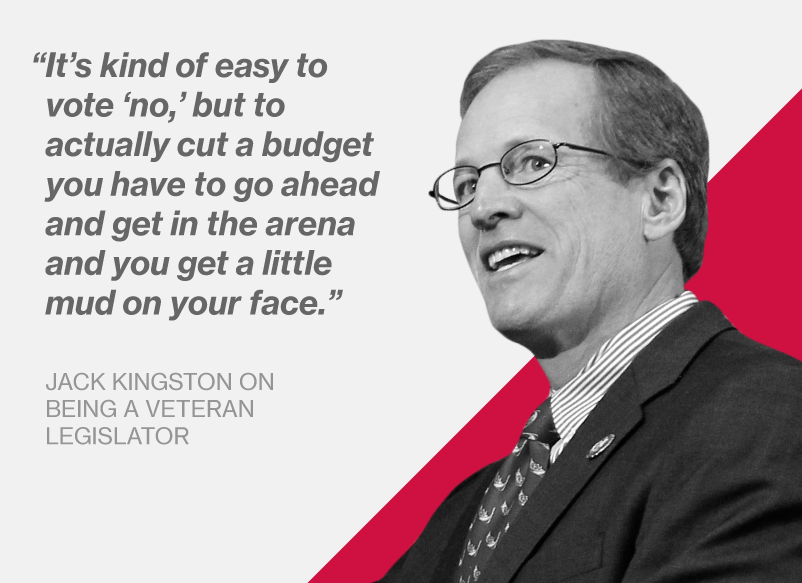
Even a candidate like Kingston, who is often pegged as the field’s “establishment” guy, boasts strong ratings from conservative groups, supported an earmark ban under President George W. Bush, and received tea party support in his failed attempt to take over the Appropriations Committee. Lately, he’s proposed requiring public school students to perform janitorial work in exchange for free lunches.
His biggest sin in the eyes of some activists is having been in Congress a long time: Handel has gone after him for voting for large spending bills over the years with earmarks attached for things like the Edward Kennedy Institute in Massachusetts.
“It’s kind of easy to vote ‘no,’ but to actually cut a budget you have to go ahead and get in the arena and you get a little mud on your face,” Kingston said in an interview.
With the entire group starting so far to the right, it can be hard for any one candidate to stand out. Still, they try their best.
Everyone supports the Second Amendment, for example, but only Broun’s campaign has raffled off an AR-15, the semi-automatic rifle made infamous by the Newtown school massacre. The whole field wants to get rid of Obamacare, but only Gingrey has promised not to run for re-election if he hasn’t successfully repealed it in one Senate term. Gingrey and Kingston have joined Broun in regularly voting against Republican bills from the right in order to prevent any one of them from gaining separation.
In debates, the candidates emphasize their biographical distinctions while competing with each other for the most anti-liberal sound bites. The Macon forum, for example, was a Russian nesting doll of populist conservative resentment.
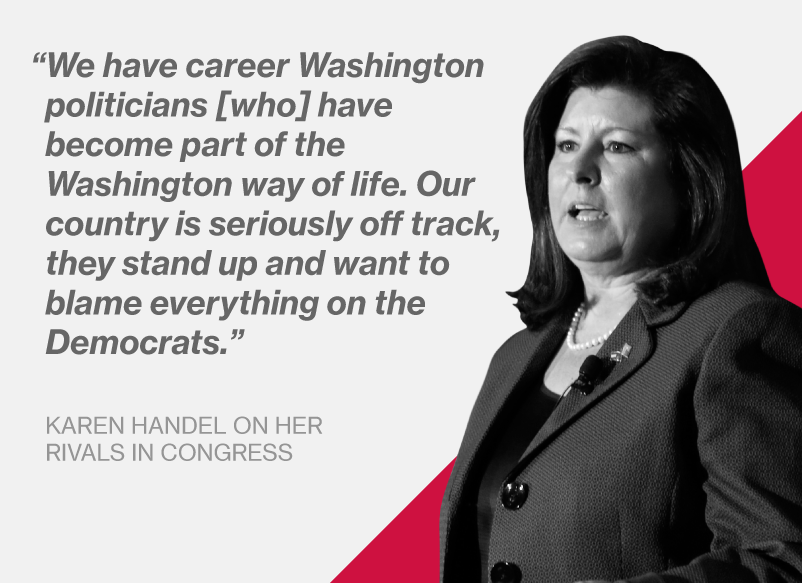
Kingston attacked Harry Reid while Gingrey condemned “rap music,” Hollywood, and trashy music videos for corrupting the youth (“What does the federal government do about it? Nothing!”). Broun accused Gingrey and Kingston of being typical Washington Republicans (“What separates me from my two colleagues here: I’ve never requested an earmark.”). Handel said all three have served too many terms in Washington (“[They] had a combined 42 years to do everything they’re talking about!”) Perdue went after the three of them plus Handel for having held elected office at all (“If you like what’s going on in Washington, pick one of those four politicians.”).
“It’s been halfway a contest to see who can dislike Barack Obama more,” Todd Rehm, a Republican strategist and editor of GAPundit.com, told msnbc.
Each candidate is also skilled enough to know exactly when to pull back from the anti-government jeremiads, namely when the topic turns to federal spending inside Georgia.
All the major contenders are incensed that Obama has yet to approve funding for a project to deepen the port in Savannah. At the Macon debate, Broun said the state needs more highways while Perdue bemoaned the lack of infrastructure spending in recent years. Asked about potential military base closures that could harm the state’s economy, Broun said the country requires more warships, more planes, and a bigger standing army while Kingston boasted: “I don’t want to kill a fly with a sledgehammer, I want to kill a fly with five sledgehammers.”
Culture clash
The candidates are well aware of party fears that they’ll produce the next Todd Akin and steer clear of social issues when possible. Even Broun is putting the fire and brimstone on ice for now.
“We’re not going to be voting in the Senate on my religious beliefs,” Broun told msnbc. “We’re going to be voting on trying to shrink the size and scope of government.”
Just because the campaign isn’t wading deep into social issues today doesn’t mean things will stay that way. Nobody knows how fast things can zoom to the right better than Handel, whose 2010 run for governor turned on the kinds of esoteric culture wars that make national party leaders cringe. Then-candidate Nathan Deal relentlessly attacked Handel for her past association with the Log Cabin Republicans, a gay GOP group, while the abortion fight wandered into extreme territory. Georgia Right to Life, the state’s most prominent anti-abortion group, opposed Handel because she favored exceptions to an abortion ban in cases of rape and incest and because she supported in vitro fertility treatments. Handel hit back hard, calling her own unsuccessful attempts to have children “the single greatest disappointment in my life.” GRTL president Dan Becker accused Handel of using her personal grief over being “barren” and “infertile” to justify taking innocent lives. She ended up losing by only about 2,500 votes. Today, Handel is one of the most famous (or infamous, depending on your views) anti-abortion advocates in the country, and the battle looks somewhat ridiculous as a result. After leaving government, she took a job as vice president for public policy with Susan G. Komen, the breast cancer advocacy group. There she led the group in cutting funding to Planned Parenthood for mammogram screenings, sparking a backlash that ended with her resignation. “In the governor’s race I wasn’t pro-life enough, fast forward and I became too pro-life,” Handel told msnbc. “My life is a string of ironies, what can I say?” This time around, the only Senate hopeful to win GRTL’s endorsement is Broun, which he secured by refusing to vote for a ban on abortions after 20 weeks supported by the National Right To Life Committee. That’s because the bill, which Gingrey and Kingston supported, included rape and incest exceptions. Republican strategists are skeptical if GRTL still has the same clout it once did, but if Broun wins it will be because he managed to rally the most hardcore anti-abortion and pro-gun activists to his side. Primary races – and especially runoffs – are low turnout affairs in Georgia, which can lead to upsets for candidates with motivated supporters. Broun won his own Congressional seat in 2007 by defeating a heavily favored Republican opponent in a sleepy special election runoff. “If it’s Paul Broun in the runoff, I think Republicans in Washington collectively soil themselves,” Red State’s Erickson said. Money talks Democrats are hoping Broun will stay competitive enough to push everyone to the right, but his candidacy could also have a freeing effect: if his rivals assume that Broun has a lock on the most conservative primary voters, they might turn their attention to winning moderate Republicans, many of whom are concentrated in the Atlanta suburbs. Perdue, the former CEO of Dollar General and Reebok and cousin of former GOP Gov. Sonny Perdue, is betting on this theory. While conventionally conservative on the major issues in the race, he’s positioning himself as a relatively non-ideological outsider. He has been critical of Senator Ted Cruz’s recent efforts to use the debt ceiling as a bargaining chip, for example, which he warns could frighten investors. While strongly opposed to the Dodd-Frank Wall Street reform law, he’s said that he favors working with Democrats to amend it instead of the usual repeal calls. “I don’t believe I have to give up my conservative ideals to offer up a compromise position in order to get progress,” he told msnbc. “I’d rather take an 85% solution on the economic issues then sit here and get 0%.” Perdue bears more than a passing resemblance to Mitt Romney, another well-coifed candidate from a political family who ran for office on his record in the private sector. Unlike Romney, whose complex buyout deals became a liability, Perdue’s most successful business ventures are easier to explain and quantify: his boast that he created 20,000 jobs while running Dollar General passes muster with Politifact, for example. Perdue’s personal wealth means he can self-fund and his polling surge has come during a period where he dominated the airwaves with an ad casting his four main opponents as crying babies. He’s uniquely problematic for Handel, who ascended the ranks of Georgia politics as a protégé of Sonny Perdue. The former governor is now backing his cousin’s campaign and Handel has struggled to raise cash without his network. Broun, who has never been popular with big donors, had just $187,000 cash on hand at the end of 2013. Money matters a lot in Georgia campaigns, where advertising in the Atlanta media market is expensive. Kingston had $3.42 million in the same filing period thanks to a significant war chest left over from past campaign and Gingrey had $2.36 million, giving both the potential for a serious run. Breaking from the PAC In another time, Broun’s lack of funds might have been disqualifying. But in the era of the super PAC, all it takes is one advocacy group or wealthy patron to vault a candidate into contention. “That is the big question mark, whether the super PACs come in,” Joel McElhannon, a Georgia Republican strategist, told msnbc. “It has the potential to be a big game changer.” Right now, the outside spending scene resembles Europe 1914, with the major powers – anti-establishment groups like Club For Growth and the Senate Conservatives Fund on one side, more traditional pro-business groups like the Chamber of Commerce and American Crossroads on the other – staying tentatively neutral while events play out on the ground. If any one of them decides to enter the race, however, it could suck them all into a massive air war. McElhannon raised another possibility: Democrats might pour money into a super PAC of their own to boost Broun’s chances. It’s less paranoid than it sounds. In 2012, Democratic Senator Claire McCaskill helped ensure Akin got the GOP nomination in Missouri with winking “attack” ads highlighting his conservative positions for Republican primary voters. The party line among state and national Democratic officials right now is that Georgia’s GOP candidates are equally flawed, but some leaders have cheered Broun on fairly openly in the past. “If there is a living God, we’ll be facing him as the Republican nominee in November of 2014,” Mike Berlon, then-chairman of the state Democratic party, told USA Today last year. “Unfortunately, we’re probably not that lucky.”
Benjy Sarlin Recommended