








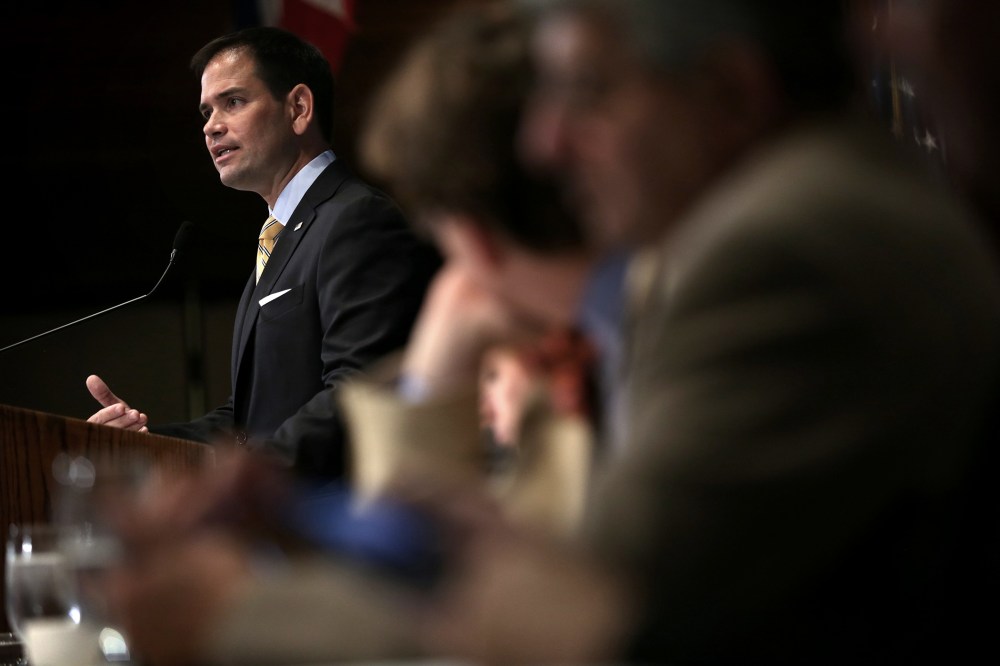
Sen. Marco Rubio offered up a confusing take on environmental policy Tuesday, after declaring in a weekend TV interview that he did not believe “human activity” is causing dramatic climate change.
In an appearance at the National Press Club, the Florida Republican clarified that he believed climate change was real, but he danced around the central issue of whether it was caused by carbon emissions, as the overwhelming majority of scientists have concluded.
“Headlines notwithstanding, of course the climate is changing, because the climate is always changing,” Rubio said.
Then things took a bizarre turn. Rubio said he objected to “cap and trade” legislation designed to reduce emissions — not because such reductions were unnecessary, but because he thought other countries wouldn’t follow suit with similar legislation of their own.

“What I disagree with is the notion if we pass cap and trade, for example, this will stop this from happening, when in fact half of the new emissions on the planet are coming from developing countries and half of that is coming from one country, China, that isn’t going to follow whatever laws we pass,” he said.
Given that Rubio said in an interview with ABC News over the weekend that he doesn’t believe “human activity” does much to influence the climate in the first place, this makes about as much sense as arguing against a bill to eliminate all vowels from the alphabet because Europe won’t match America’s letter-reducing fervor.
In general, Rubio’s comments Tuesday suggested that he wasn’t willing to rule out mankind’s role in climate change as definitively as he did on Sunday. He said that he was “all in favor of advances in technology and innovation that makes us cleaner and more efficient,” so long as they don’t hurt the economy.
He also said he supported “mitigation” efforts in his own state and elsewhere to deal with environmental effects associated with climate change, even if he avoided discussing what the dominant scientific consensus argues is its chief cause.
Rubio’s remarks came just days after the Obama administration released a dire report warning that climate change was both already occurring and that Rubio’s home state of Florida was especially vulnerable to flooding and storm damage if temperatures continue to rise.
Scientists also announced that new studies confirmed that Antarctic glaciers were melting faster than feared, an irreversible process that would raise sea levels worldwide.
Rubio was actually at the National Press Club to deliver a speech on retirement policy, not the environment.
In his remarks, Rubio proposed a number of changes to Medicare and Social Security, including an increase in the retirement age, lowering taxes for seniors who continue to work and partially privatizing Medicare.
The address was the latest in a series of policy speeches from Rubio over the last several months ahead of a possible presidential run in 2016. Other topics have included poverty and higher education.
Rubio’s speech also dovetailed with a renewed emphasis on tax cuts and policy changes that would directly boost many Americans’ incomes, a contrast with the party’s intense focus on austerity since 2009. Whether these goals can be reconciled with Rubio’s stated interest in rapidly cutting the deficit is another story.
Notably, Rubio enthusiastically praised Medicare Part D, a prescription drug benefit signed into law by President George W. Bush, as “a booming success by every conceivable measure.” In tea party mythology, Medicare Part D is considered a crucial betrayal that epitomized the GOP’s failure to rein in spending under the Bush administration. Under Rubio’s new proposals, seniors would no longer have to pay Social Security payroll taxes on their income after age 65. In another move designed to encourage seniors to work later in life, Rubio proposed abolishing the Retirement Earnings Test, a tax that affects seniors who accept early benefits while still remaining employed. “Many now choose to work well past the age of retirement,” Rubio said. “If any of you have doubts, I encourage you to come see the United State Senate at work.” While cutting taxes for working seniors would reduce tax revenues, Rubio argued that they would be offset by seniors paying taxes on income they would otherwise not have earned and by economic benefits associated with longer careers. Henry Aaron, a senior fellow with the Brookings Institution and expert on retirement programs, said he was skeptical whether the plan would save as much money as its proponents have argued. He also noted that its benefits would largely be weighted toward middle class and wealthy seniors in white-collar jobs. “What is pretty clear is that it would be a windfall for the well-educated and for comparatively high earners who comprise the bulk of those who now work after age 65,” Aaron said. “The less well educated and low earners are mostly long gone from the labor force.” To help cut costs for the program, Rubio proposed eventually raising the retirement age while using a less generous formula to calculate the growth of benefits for wealthier Social Security recipients. Rubio also suggested allowing Americans whose employers do not offer a 401k to use Congress’ own retirement program, the Thrift Savings Plan – although without the matching contributions that federal employees enjoy. As for Medicare, Rubio said he favored a plan by Rep. Paul Ryan (R-WI) to turn Medicare into a partially privatized program in which seniors would choose their plan through a subsidized exchange similar in structure to Obamacare’s.
Benjy Sarlin Recommended


