








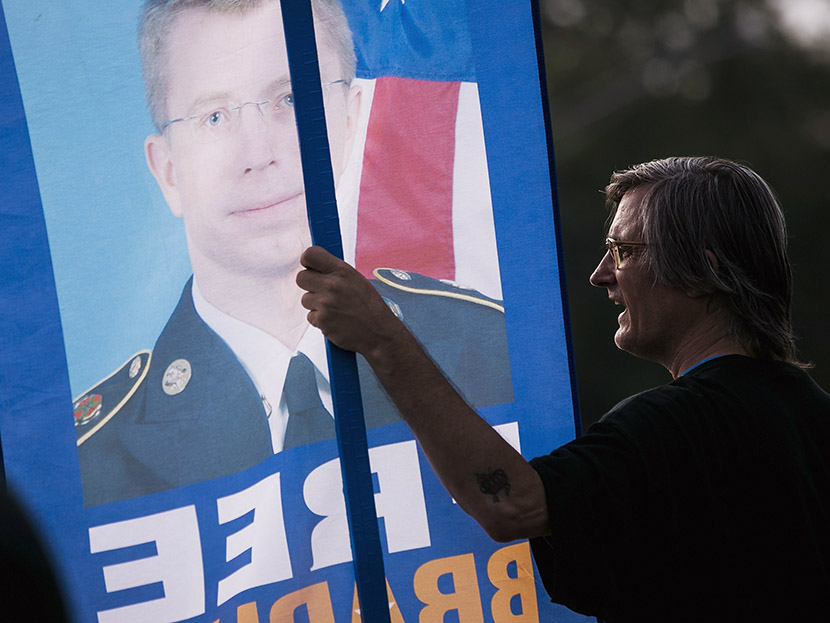
PFC Bradley Manning will likely spend the next decade in prison, thanks to a 35-year sentence his lawyer David Coombs said was “designed to send a message” to individuals weighing whether or not to leak information about government wrongdoing.
The sentence is a “watershed moment” in the history of the operation of press in America, Coombs said at a press conference after the sentencing, one that “should sound an alarm to journalists” who write about issues that involve classified information.
Manning was convicted on July 30 of 20 criminal counts including espionage and disobeying orders for providing 700,000 classified documents to online transparency group WikiLeaks in 2010.
Manning was also given a reduction in rank and a dishonorable discharge, although he will be eligible for parole and will get credit for the three and a half years he has already spent in jail. The 25-year-old had faced a possible maximum sentence of 90 years in prison. The prosecution had sought a sentence of 60 years.
During a sentencing hearing last week, Manning apologized for any harm he might have caused United States interests and said, “When I made these decisions I believed I was going to help people, not hurt people.”
The Center for Constitutional Rights issued a statement saying Manning “should never have been prosecuted.” They urged supporters to pressure President Obama to pardon Manning, and said, “We can only hope that Manning’s courage will continue to inspire others who witness state crimes to speak up.”
Julian Assange, Wikileaks founder, said that the sentence “represents a significant tactical victory for Bradley Manning’s defense, campaign team and supporters” but that while the outcome of the trial could have been much worse, the punishment is still too harsh. “The only just outcome in Mr Manning’s case is his unconditional release, compensation for the unlawful treatment he has undergone, and a serious commitment to investigating the wrongdoing his alleged disclosures have brought to light,” said Assange.
High-profile cases that involve as much classified information as Manning’s and National Security Agency contractor Edward Snowden’s raise questions about whether it is possible to have a fair trial. Guardian journalist Glenn Greenwald cited the government’s treatment of Manning as an explanation for Snowden’s decision to flee to Hong Kong and eventually seek asylum in Russia.
When asked if he thought Manning’s case was handled fairly, Coombs said, “When it comes to a fair trial, [what matters most is] the perception of the public. In this instance, the answer would have to be no…We did everything could to ensure that he got a fair trial but I don’t think the public is going to perceive it as such.”
Manning has been sentenced to a longer prison term than some soldiers convicted of murders in Iraq and Afghanistan, and there are national security threats who’ve received shorter sentences than Manning. While Manning’s leak launched a national debate about U.S. actions during war, government secrecy, and the media that continues because of Snowden, a federal U.S. appeals court ruling removed more workplace protections for government employees working in “sensitive” positions. The court ruled that federal agencies have the right to fire an employee after he or she has disclosed information even if they made it under legal whistleblower protections. The Project on Government Oversight condemned the “devastating” court decision. “For well over a century, the federal workforce has been protected from the tyranny of politics with crucial protections,” said the POGO in a statement. The group called on Congress to “rein in the unchecked discretion afforded to agencies that invoke national security without scrutiny.” The prospect of 35 years in prison–and possibly the death penalty, if U.S. authorities can successfully prosecute an individual of aiding the enemy for leaking information to the press–could be a strong deterrent against leaks to the press. “A legal system that doesn’t distinguish between leaks to the press in the public interest and treason against the nation will not only produce unjust results, but will deprive the public of critical information that is necessary for democratic accountability,” wrote ACLU Speech, Privacy and Technology Project director Ben Wizner. Manning supporters planned to rally at the White House Wednesday night, and Coombs urged supporters to encourage President Obama to pardon Manning.
Meredith Clark
Meredith Clark is a freelance writer and editor. She was previously a senior news producer for "Patriot Act with Hasan Minhaj," a reporter with MSNBC.com, the digital politics and culture editor at Glamour and a senior news and politics editor at Refinery29. She has written for Vulture, Rolling Stone, Self, Marie Claire, Cosmopolitan, The Daily Beast and Bustle. Recommended


