








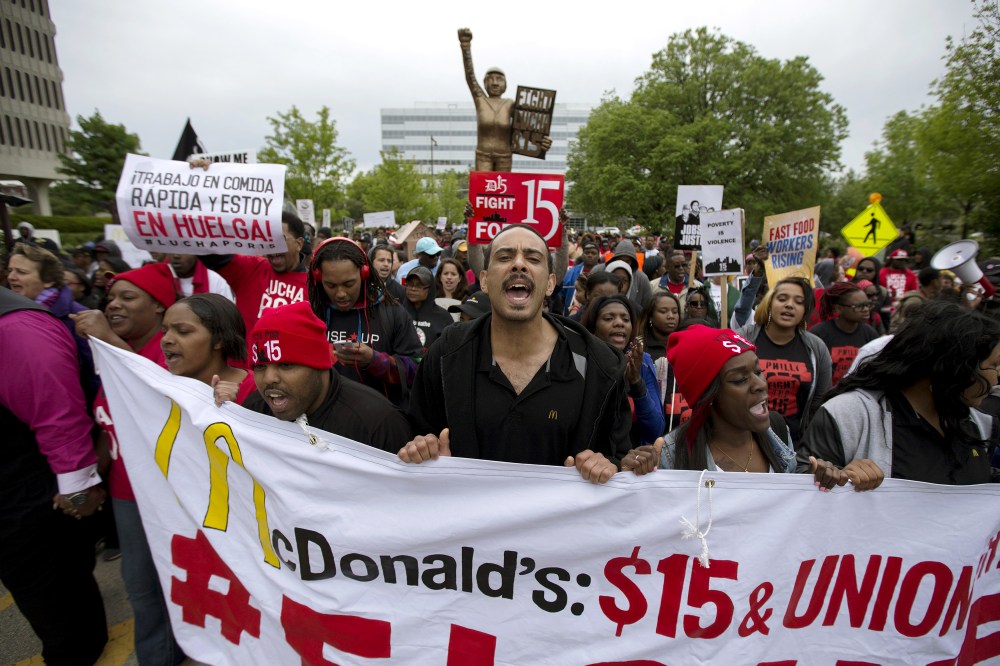
OAK BROOK, Ill. — Fast-food workers from across the country gathered outside McDonald’s corporate headquarters here Wednesday to press their demand for an hourly wage of $15 and the right to form a union.
With the company’s shareholders set to meet inside tomorrow, protesters offered a broad indictment of the burger behemoth, not only on the issue of low pay but also on related business practices that they call predatory and irresponsible.
%22I%20have%20to%20prioritize%20which%20bill%20is%20more%20important%20…%20having%20my%20electricity%20bill%20paid%20or%20having%20my%20water%20bill%20paid.%22′
Still, despite the unseasonably chilly weather, the protest at times had an optimistic, almost giddy air, buoyed by a sense that the movement has the wind at its back after a string of major victories, culminating in the news Tuesday that Los Angeles will set a $15 minimum wage by 2020, likely benefiting over half a million low-wage workers. The ’70s R&B hit “Ain’t No Stopping Us Now,” played on the loudspeaker as the crowd gathered.
Although organizers had predicted a crowd of 3,000-4,000, the actual number of people who turned out for the protest was about 2,000, according to Garrett Church, a spokesman for the Oak Brook police department.
Crowd size aside, it wasn’t hard to find McDonald’s workers who described struggling to survive despite working full time.
“I have to prioritize which bill is more important than the other,” said Smadar Itzhaki, a McDonald’s worker who makes $9 an hour and had traveled from San Diego to attend the protest. “Like, having my electricity bill paid or having my water bill paid.”
And a McDonald’s cook from Kansas City, Missouri, who gave his name as Terrance, said that although he’s worked there for 11 years, he still makes only $8 an hour. As a result, he’s had to take a second job at Burger King to help support his three daughters, and he now works from 7 a.m. to 11 p.m. daily.
Rev. William Barber, the North Carolina civil rights leader who has led the Moral Monday movement there, noted in a speech that low-paid fast-food workers are disproportionately young minorities.

“Fighting for 15 penetrates the continuing economic reality of systemic racial injustice,” Barber said. “What I am trying to say is, this is a race issue too.”
Several speakers denounced a McDonald’s plan to spend around $20 billion over the next two years on stock buybacks, saying the goal is to manipulate the company’s share price, and enrich investors and corporate executives. That’s money the protesters say could have gone to pay employees a living wage.
McDonald’s is being targeted on other fronts, too. Workers have filed lawsuits and complaints alleging wage theft, racial discrimination, and unsafe working conditions at the company’s restaurants. Meanwhile, the burger giant is locked in a high-stakes legal fight with the Obama administration’s National Labor Relations Board (NLRB) over whether it should be held responsible for violations of labor law by its franchisees, as the NLRB argues. If the courts agree, it could deal a major blow to the viability of the McDonald’s franchise model, which has been crucial to the company’s success.
RELATED: Workers file civil rights suit against McDonald’s
Earlier this week, the powerful Service Employees International Union (SEIU), which is backing the low-wage worker campaign, asked the Federal Trade Commission to probe the $800 billion U.S. franchise industry. It called the imbalance of power between franchisees and their corporate parents “abusive and predatory.”
The multi-pronged assault comes at an awkward time for the Golden Arches. Slumping sales and a declining stock price led to the departure in January of the company’s CEO after just a year in the job, and lately it’s been rebooting its menu in what some are calling a desperate effort to turn things around. Despite the controversy over franchising, McDonald’s also has said another element of its turnaround plan will be to increase franchise ownership.
“People have a right to peacefully protest,” McDonald’s Vice President of Communications Heidi Barker told msnbc, adding that buying back shares was a business decision that was part of their turnaround plan. But she criticized the gathering Wednesday as “part of an $80 million campaign that the SEIU has spent over the last two years against our brand because we are visible and because we are the biggest.”
%22This%20is%20part%20of%20an%20%2480%20million%20campaign%20that%20the%20SEIU%20has%20spent%20over%20the%20last%20two%20years%20against%20our%20brand%20because%20we%20are%20visible%20and%20because%20we%20are%20the%20biggest.%22′ “SEIU’s proud to play our part,” said Mary Kay Henry, the union’s president, in an interview after she addressed the crowd. “But we know it takes more than us to make a movement this big.” RELATED: Making the case for low wages In February, in an apparent effort to appease the low-wage worker movement, McDonald’s announced pay increases of a dollar per hour. But the raise went only to employees of non-franchise restaurants, who only make up about 10% of the company’s U.S. workforce. McDonald’s has about 12,500 restaurants in the U.S., with 840,000 employees. Of those, it owns 1,500 stores, employing 90,000, according to Harvard Business Review. The rest are franchises. Wednesday’s protest comes on the heels of a string of coast-to-coast successes for the low-wage worker movement, which is seeking a minimum hourly wage of $15 — the minimum level needed to avoid having to get a second job or rely on government benefits, activists say. Los Angeles joins San Francisco, Oakland, and Seattle, among other cities, in meeting the $15 target. Last week, Facebook COO Sheryl Sandberg announced that the tech giant, too, would raise its contractors’ minimum wage to $15 per hour. And earlier this month, New York Gov. Andrew Cuomo said he’d convene a wage board to recommend pay increases for thousands of fast-food workers. RELATED: Los Angeles raises minimum wage to $15 per hour Those wins followed a major nationwide protest last month, which saw tens of thousands of low-wage workers from the fast-food, retail, construction and other industries rally in hundreds of cities across the country. A growing number of fast-food and other low-wage employees have families to support, and they say $15 per hour, plus a basic benefits package, is the minimum they need to get by without having to take a second job or relying on government assistance. There has been progress in Washington, too. The White House offered “enthusiastic” backing to a Democratic proposal to raise the federal minimum wage, currently $7.25 per hour, to $12 per hour. And Hillary Clinton has endorsed the push for a raise, though she hasn’t yet offered specifics.
Zachary Roth Recommended


