









U.S. Attorney Loretta Lynch sought to distance herself from outgoing Attorney General Eric Holder in the first day of her Senate confirmation hearing Wednesday, emphasizing that the Constitution would be her guide if she becomes the first African-American woman to serve as U.S. Attorney General.
%22Every%20attorney%20general%20creates%20their%20own%20path.%20I%20will%20be%20Loretta%20Lynch.%20I%20will%20be%20the%20person%20that%20I%27ve%20always%20been.%22′
“It is that document and the ideals embodied therein to which I have devoted my professional life,” said Lynch in her prepared statement to the Senate Judiciary Committee. “Senators, if confirmed as Attorney General, I pledge to you and to the American people that the Constitution, the bedrock of our system of justice, will be my lodestar as I exercise the power and responsibility of that position.”
Lynch, who is currently the top federal prosecutor for Brooklyn, New York, appeared eager to contrast herself from Holder, who was frequently accused by congressional Republicans of prioritizing the administration’s political agenda over the rule of law.
For their part, the committee’s Republicans aimed to use the hearing to highlight their criticisms of Holder’s Justice Department and of the Obama administration broadly—especially on immigration and issues of executive power.
They also offered witnesses who seemed designed to advance grievances against the Obama administration. Both Sharyl Attkisson, a former CBS News journalist who has suggested that the administration hacked into her computer, and Catherine Engelbrecht, the founder of a group that bangs the drum about voter fraud, were scheduled to testify.
“We need to get back to first principles, and that starts with depoliticizing the Department of Justice,” Sen. Charles Grassley (R-Iowa) the committee’s chairman, said in his opening remarks.
Lynch faced the delicate challenge of avoiding alienating her allies and future colleagues or tying her hands in office, while reassuring Republicans that she would take a different approach.
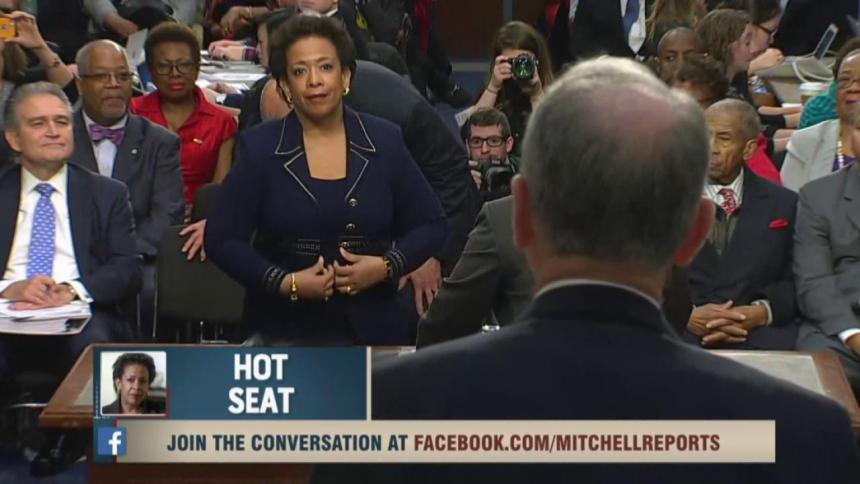
Asked by Sen. Ted Cruz (R-Texas) how she would differ from Holder, Lynch refused to be drawn: “Every attorney general creates their own path,” she said. “I will be Loretta Lynch. I will be the person that I’ve always been.”
And asked by Grassley about the legality of President Obama’s executive order from November deferring the deportation of millions of undocumented immigrants, Lynch said she wasn’t involved in the decision. But she called the Justice Department opinion approving the move “reasonable.”
Sen. Jeff Sessions (R-Ala.), who has led Republicans’ fight against the immigration order, asked Lynch whether she agreed with Holder’s statement that undocumented immigrants have a civil right to work and become citizens.
Again, Lynch at first avoided answering directly, saying she hadn’t studied the legal issue. But pressed by Sessions, she acknowledged that no such right currently exists in our system of justice.
Sen. Orrin Hatch criticized Holder for declining to defend the Defense of Marriage Act, and asked whether Lynch considers the Justice Department bound to defend laws passed by Congress, regardless of the attorney general’s personal views.
“It is the duty and responsibility of the Department of Justice to defend these statutes,” Lynch replied. “There may be certain circumstances where careful legal analysis raises constitutional issues, but those would be few and far between.” Lynch, 55, is expected to be confirmed, but she must win the support of at least three Republicans on the committee. Several, including Hatch, have already suggested that they’re open to backing her. RELATED: Loretta Lynch allies prepare for fierce confirmation fight Holder has had a strained and at times hostile relationship with congressional Republicans. The House voted to hold Holder in contempt after the Justice Department declined to release documents being sought in the congressional investigation into Fast and Furious, a flawed program to track illegal firearms. Holder frequently spoke out on issues of issues of race and civil rights, in 2009 saying that America is “a nation of cowards” for its inability to forthrightly discuss race. Lynch is said to see her role as that of a traditional prosecutor, rather than a crusader for political causes. “I look forward to fostering a new and improved relationship with this committee, the United States Senate, and the entire United States Congress — a relationship based on mutual respect and constitutional balance,” Lynch said. “Ultimately, I know we all share the same goal and commitment: to protect and serve the American people.” In response to questioning from Sen. Pat Leahy (D-VT), Lynch also confirmed that in her view, water-boarding is torture, “and thus illegal.”
Zachary Roth Recommended


