









At least 67 people are in prison right now, sentenced to die there for selling marijuana, according to the best available data. Until last week, Jeff Mizanskey was one of them.
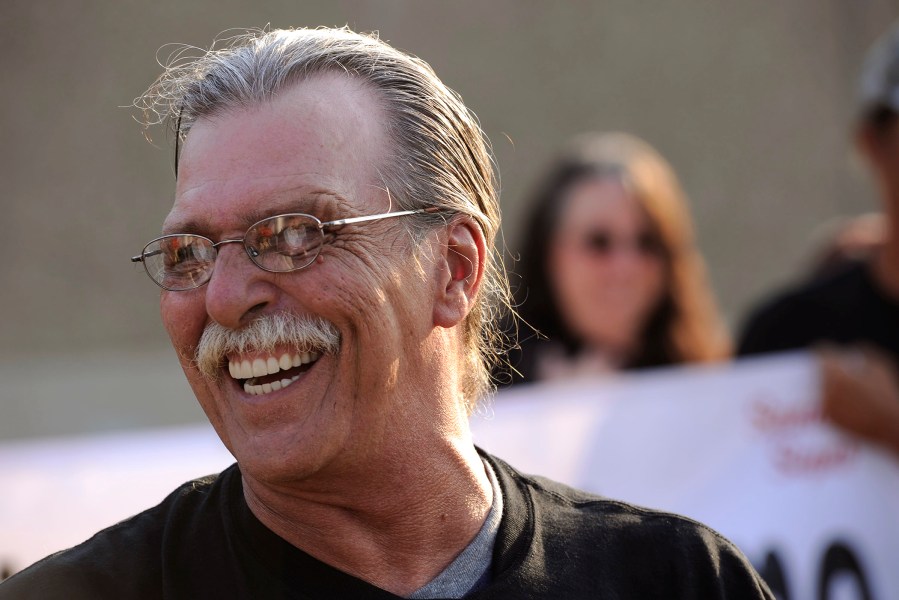
“Man, I feel great,” the great-grandfather told MSNBC, as he contemplated his first weekend as a free man in more than 20 years. His sentence was commuted in May from life without parole to simple life, and on Tuesday he walked out of a maximum security Missouri prison.
Someone helped him dial this wondrous new thing called a smart phone. “Do you have children?” he asked. “The day a child is born — that’s what this feels like for me. I’ve finally made it to freedom.”
Mizanskey received his harsh sentence in 1996, after he was convicted for trying to distribute six pounds of Mexican marijuana. There was no violence involved, no selling to kids. But Mizanskey had two previous convictions for the possession and sale of pot totaling 10 ounces.
With%20%2422%20billion%20in%20legitimate%20sales%20expected%20by%202020%2C%20pot%20has%20become%20a%20consumer%20product%20like%20any%20other.%20But%20new%20laws%20have%20done%20nothing%20for%20people%20with%20past%20convictions%2C%20including%20some%20with%20sentences%20heavier%20than%20for%20rape%20or%20murder.’
That qualified him as a “persistent” drug offender under Missouri law, subject to any punishment short of the death penalty. That law has since been repealed, but similar policies continue to echo down the halls of American prisons, dividing families across the country.
Today, more than twenty states have legalized marijuana in one form or another, and with $22 billion in legitimate sales expected by 2020, pot has become a consumer product like any other. But new laws have done nothing for people with past convictions, including some with sentences heavier than for rape or murder.
About 40,000 inmates of state and federal prison have a current conviction involving marijuana, according to research co-authored by UCLA professor Mark Kleiman. About half of them are in for marijuana offenses alone. And all of them are, in one way or another, victims of the stupendous drug panic that swept America in the 1980s and 1990s.
It can be hard to believe that it all really happened, but it wasn’t long ago that Navy pilots were buzzing the coast in hot pursuit of pot smugglers. Massive four-prop Air Force radar planes circled the Caribbean, spying on foreign ports and looking for the beep-beep of weed-laden ships. Even the FBI and CIA joined the hunt for marijuana.
RELATED: You can now smoke pot legally in Oregon
In the process, small-time, ex-hippie dealers like Mizanskey were redefined as enemies of the state. They were pursued like terrorists and prosecuted like armed combatants, hammered by laws that treated all drugs the same regardless of their individual dangers.
The war on marijuana dealers began in the 1980s, but it did not end in that decade. Between 1996 and 2014, federal judges sentenced 54 people to life without parole for marijuana offenses, according to new work by The Clemency Report, a project of former USA Today reporter Dennis Cauchon. The American Civil Liberties Union has found about a dozen more cases at the state level, and at least a dozen more are alleged by various advocacy groups.
Few if any of these lifers were kingpins, according to the ACLU. One man was busted for selling 32 grams of marijuana. Another conspired to sell 130 grams, the equivalent of less than a carton of cigarettes. Still others were nabbed in cases involving between two and 50 pounds of pot. They all got life in prison and, as far as can be known, that’s where they remain.
Mizanskey’s life story is a testament to changing attitudes toward drugs. He was born in 1953, the son of a car mechanic in Chicago, and grew into adulthood at a time when President Jimmy Carter was endorsing the decriminalization of marijuana. A lot of people then felt like legalization was around the corner.
“I remember the cops pulling us over, once when I was about 18. They made us pour out all our beer, but they sent us on our way with the marijuana,” Mizanskey says. “That’s how I grew up. I never thought marijuana was wrong.”
Not surprisingly, many of his fellow inmates agreed. Some thought he was lying when he claimed to be doing life for selling six pounds of pot. Impossible, people figured. This guy must be a sex offender, a pedophile. Why else would someone be doing life in a maximum security facility?
“At first I was really angry about the sentence,” Mizanskey says. “Then I was more disappointed. This is America. This isn’t supposed to happen in America.” The sentence made no sense to activists either, but it wasn’t until 2012 that Mizanskey’s story started to reach people on the outside. The advocacy group Show-Me Cannabis was trying to pass an initiative that would have legalized marijuana in the state and released all non-violent marijuana prisoners. RELATED: Colorado court upholds firing over pot The initiative failed, but Mizanskey’s son Chris got involved in the movement. He was 15 when his father went to prison, and the sentence upended his life as well. He dropped out high school and drifted for years without a dad he could see every day. “They took my father from me for 22 years. That’s a lot of time, a lot of memories,” he told msnbc. “He missed so much, and all of us have missed out on so much.” Chris got Show-Me Cannabis and its followers interested in his dad’s story. That led to some blog posts, which led to a feature by Ray Downs, a reporter for the Riverfront Times, an alternative newspaper in St. Louis. Downs’ profile of the elder Mizanskey paints him as a friendly stoner with a stable family and a good job who got in trouble with the law just one too many times. %22This%20is%20America.%20This%20isn%E2%80%99t%20supposed%20to%20happen%20in%20America.%22′ He was a construction worker who liked to have a joint to help his back pain, and who had started dealing a few pounds to help fund his habit. He wasn’t someone who deserved to spend his life in prison, according to the movement that swelled to include 400,000 signers to an online petition, a dozen state legislators, and ultimately Gov. Jay Nixon. In May, the governor’s office announced that Mizanskey would be eligible for parole, which is how the 62-year-old walked out of his cell last week. Unlike the wrongly accused, those who have been excessively sentenced get no payout from the state, and no apology either. Mizanskey is merely another parolee. He can’t drink or travel or see old friends from the marijuana trade. But he can hug his family again, and he can sit in comfortable chairs, and he can sleep in a soft bed. He’s grateful for those small rights, thankful for all the help he’s received. He can also join his son in the broader fight for legalization, and prison reform, and that’s what he plans to do — just as soon as he catches his breath. “I’ve never been on the Internet,” he says. “As far as a telephone, I used to walk into a telephone booth and drop a dime in there; it’s probably not even a dime anymore.”
Tony Dokoupil Recommended


