








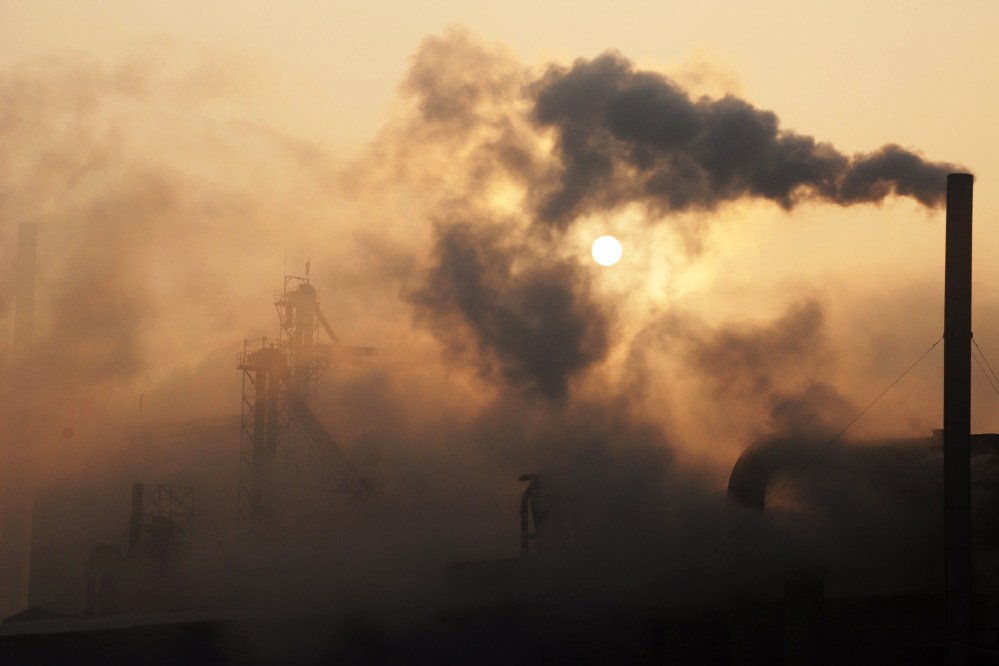
Many doomsday studies have shown how humankind is trashing the planet. But a new Lancet commission—developed in a partnership with the Rockefeller Foundation—is the first to put it all in the same report.
The result is a digest of abysmal and apocalyptic trends.
There’s a section on climate change, of course, but also water scarcity, biodiversity loss, overpopulation, excess consumption, land use, ocean acidification. You get the sense of an insurance man reviewing the damage to a hotel room.
It’s clear we’ve been partying hard.
RELATED: Greenhouse: Is the environment a public trust?
We’ve flattened a third of the ice-free and desert-free land for farming. We’ve slurped up half the fresh water and dammed 60% of the world’s rivers. In 90% of the world’s fisheries, we’ve harvested the stock at, or beyond, the ocean’s ability to replenish itself.
Humanity is driving other species to extinction at more than 100 times faster than the fastest rate ever before known. We’ve halved the population of the average vertebrate species in less than a half century. Halved!
“As a consequence of these actions,” the authors write, “humanity has become a primary determinant of Earth’s biophysical conditions, giving rise to a new term for the present geological epoch, the Anthropocene.”
Haven’t heard of the Anthropocene? That’s the name for a newly proposed geological epoch, a time when humanity has been recognized as the primary force on the earth’s systems, a power cosmic enough to show up in the fossil record. A different international team of experts is weighing that decision this year.
But perhaps the Lancet/Rockefeller commission can successfully reframe our problem in a way that helps us to act. They’ve certainly tried to do so. They begin by exploring an apparent paradox: in decades of declining planetary health, our own wealth and life expectancy has only improved.
After reading their explanation, you might want to get your kids an ice cream. A quality desert may be their best shot at happiness, the authors suggest. Here’s how they put it: “We have been mortgaging the health of future generations to realize economic and development gains in the present.” Fortunately, they end with some ideas on how to fix this mess. According to Frederick Boltz, the managing director of the Rockefeller Foundation, the solution may be in this idea of “planetary health.” He sees it as an intellectual evolution that’s larger than “medicine” or “public health,” and grander than “international health” or even “global health.” It requires a fundamental rethinking of how we relate to the planet and all its ecosystems. “We have lived our lives by the assumption that what was good for us would be good for the world,” the writer Wendell Berry argued in 1969. “We have been wrong.” His words are the opening epigraph of one of the articles in the Lancet report. His solution, however, has the feeling of a closing thought. “We must change our lives so that it will be possible to live by the contrary assumption, what is good for the world will be good for us.”
Tony Dokoupil Recommended


