








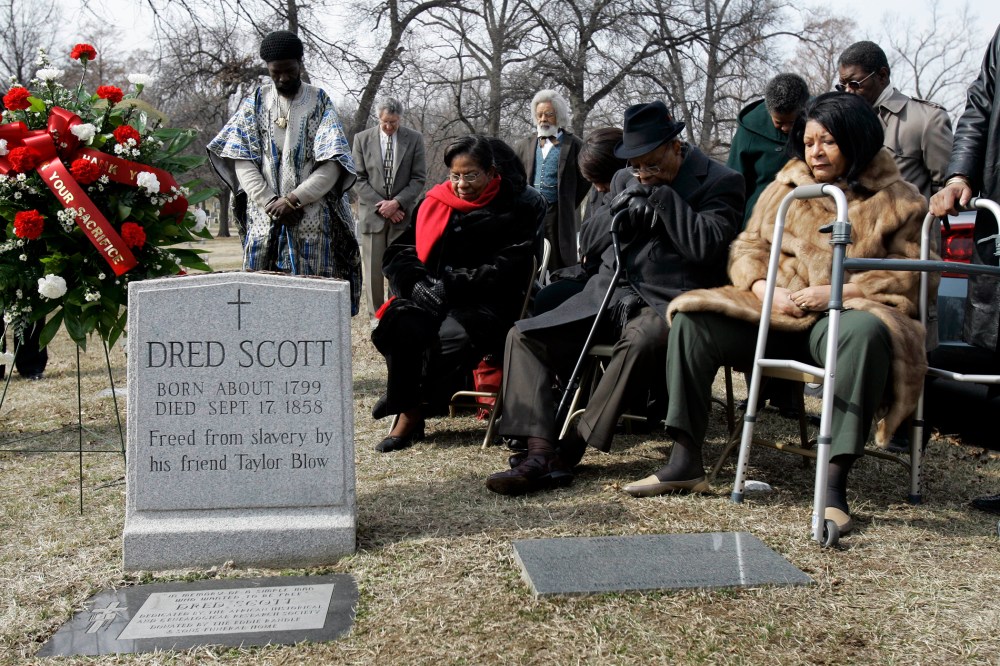
ST. LOUIS, Missouri — Arguably one of the single worst Supreme Court decisions in American history has deep roots here in St. Louis, a city where the legacy of slavery has not yet lost its hold.
The outcome of that infamous case, Dred Scott v. Sandford, is today viewed not only as a gross miscarriage of justice, but also as having fanned the flames of the American Civil War after Scott — an enslaved black man — tried and failed to secure his freedom through the high court in 1857.
Born a slave, Scott was taken from Missouri by his owner to live in Illinois and later Wisconsin, where slavery was prohibited. Because he had lived in free territory for many years, Scott argued that upon his return to the slave state of Missouri, he was still a free man. The court, however, disagreed.
In a 7-2 decision, the Supreme Court ruled that African-Americans — free or not — could not be considered U.S. citizens. The court said Scott had no rights and was unable to sue in federal court.
In the court’s majority opinion, Chief Justice Roger Taney, a supporter of slavery, insisted that granting citizenship rights to African-Americans would have been “utterly and flagrantly inconsistent” with the principles of the founding fathers.
“A free negro of the African race, whose ancestors were brought to this country and sold as slaves, is not a ‘citizen’ within the meaning of the Constitution of the United State,” Taney wrote.
The court also found the Missouri Compromise to be unconstitutional, thereby driving a wedge between the north and south. Under the conditions of the compromise, northern states and territories had been able to remain free and prohibit slavery. But the high court ruled that Congress did not have the authority to outlaw slavery, marking just the second time the Supreme Court found a congressional act unconstitutional.
The Dred Scott decision helped pave the way for Abraham Lincoln’s road to the presidency, which he referenced in his famous “House Divided” speech: “A house divided against itself cannot stand. I believe this government cannot endure, permanently half slave and half free.”
More than 150 years later, the stains of slavery have not yet fully washed away in Missouri. Just a few short miles from where Scott was buried, protests erupted in the streets last month after a white police officer shot and killed an unarmed black teenager in broad daylight. Residents here said racial tensions are nothing new for the St. Louis suburbs: One of the first lessons that students learn in school, they say, is that Missouri was one of the last states to cling to the vestiges of slavery. “The true feeling is that you still are not free in St. Louis,” Christopher Brown Sr., a lifelong resident and father of three, told msnbc last month. “That’s the truth.” This is part of msnbc.com’s “Road Trip ” series, which has msnbc.com reporters traveling across the country to profile movements that sparked change in America. For more, click here.
Amanda Sakuma Recommended


