








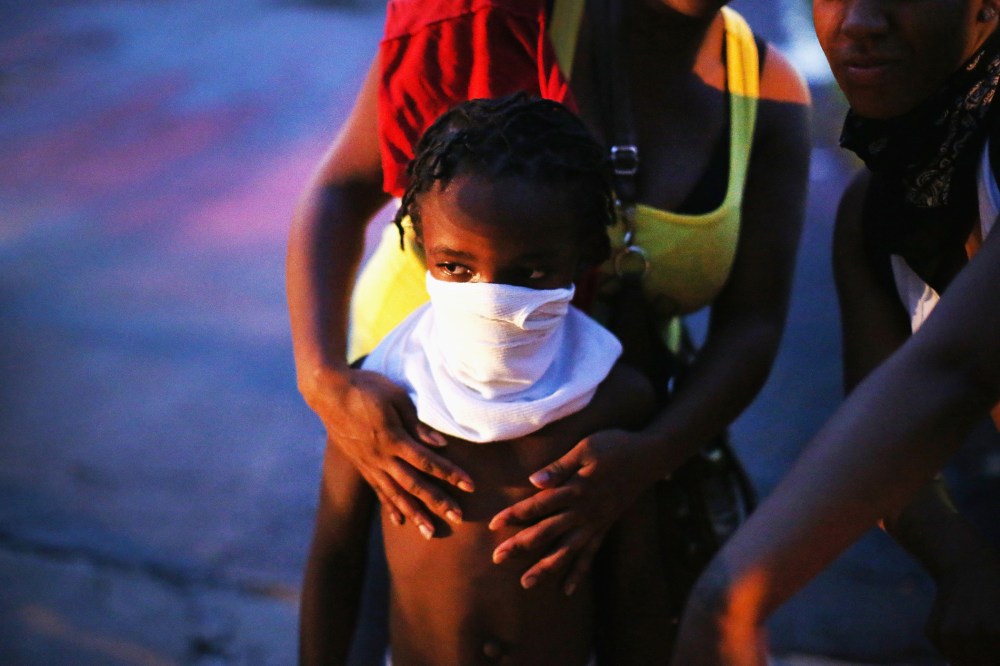
ST. LOUIS, Missouri — In schools here, children are taught that Missouri was one of the last states to cling to the vestiges of slavery. At home, they learn those wounds have not quite healed.
“The true feeling is that you still are not free in St. Louis,” said Christopher Brown Sr., a lifelong resident here. “That’s the truth.”
%22We%E2%80%99re%20guilty%20until%20proven%20innocent.%22′
Brown’s son attends the same high school that graduated Michael Brown, the 18-year-old from nearby Ferguson who was shot and killed by a police officer just over two weeks ago. A soft-spoken, polite young man, Christopher Jr. ends each sentence he speaks with a “yes, sir” or “yes, ma’am” in a nod of respect to his elders. He gets good grades, at his parents’ behest, and the sophomore is already a star on his football team.
But good manners alone aren’t going to save him from being stopped by the police, his father warns. In St. Louis and suburban pockets where mostly African-Americans live, there’s an unspoken code of how young black men must carry themselves through the day simply to limit their interactions with local law enforcement.
It’s a sensitive discussion held quietly around kitchen tables, between parents and sons. But last year, it grew louder after the acquittal of the man who shot and killed Trayvon Martin, an unarmed teenager in Florida. It was July and President Obama addressed the American people in deeply personal terms.
Like many young black men, Obama said he had been followed in department stores, seen people lock their cars when he crossed the streets and watched as a woman clutched her handbag a little tighter while riding the elevator with him.
The death of Michael Brown, who was shot at least six times in broad daylight on a Saturday afternoon, has brought that conversation back into St. Louis homes.
Christopher Brown Sr. said in an interview that he cautions his son about what to wear or how to dress. If he goes on a date, “I suggest it’s just you and a young lady when you want to travel at night.”
“These are all things that unfortunately you have to teach your kid as they’re learning how to drive,” the father said, as he sat with two daughters and cheered in the stands at his son’s football game Saturday, one of the first community events in the area since Michael Brown’s death. Despite searing heat, parents and school kids arrived early to show their support for the team and their fallen former student. Players dedicated the game to Brown with a moment of silence in his honor before they hit the field.
But in a community in search of both answers and normalcy, few are able to find closure or relief.
Stephanie Hall sat down with her son immediately after they found out about the tragedy. She used to cut Brown’s hair, and he had always been a good kid, Hall said. Her entire family rallied during the early days of the protests, shocked and angered over what they all felt was an unjust killing. But her son needed some guidance on how to channel his frustration.
“What I told him is, you have to learn to control your anger,” said Stephanie Hall, whose 14-year-old son was just starting school at Normandy High. “Everybody doesn’t understand your anger.”
At Normandy High School, students are challenged to cope with their anxieties and frustrations over Brown’s death and the greater symbolism his story represents. Counselors are being brought in to help deal with any trauma. Through coursework and conversations, Michael Brown is in many ways still alive through the hallways and classrooms of his alma mater.
“We’re using the protest around the school,” said Antwan Crossland, a junior at Normandy. “We put our hands up to every security guard and say ‘don’t shoot.’”
Walk up to any resident here, young or old, and they’ll have a story about when they felt targeted by police.
Tef Poe’s earliest memory of being profiled was from when he was maybe 12-years-old, he said, riding in a car with his dad. They were lost and driving around in circles. When his father pulled up into a driveway to turn around, Poe says a squad car pulled up behind them almost immediately. He recalled a police officer telling his father: “I know you don’t live here.” The two men argued, Poe remembered, and his father was asked to step out of the car. Poe watched from the passenger seat as the officer ran his father’s name and license through the system, he says. All because they got turned around.
“For black males in St. Louis, there’s a culture of after a certain time of night you don’t drive into certain portions of the city,” Poe, 27, said during a press conference this week with local youths. “You know for a fact that you’ll be pulled over. You also know that there’s a high chance that you will go to jail.” %22The%20true%20feeling%20is%20that%20you%20still%20are%20not%20free%20in%20St.%20Louis.%22′ In St. Louis, it’s not just local police with the authority to pull someone over. With more than 90 different municipalities within the county, a fragmented map carries an array of police departments with varying reputations. “I have disdain for every single one of them,” said Wes Suber, from St. Louis county. “The only good cops are the Highway Patrol. They use their judgement and they treat you like an actual human.” Days after violence erupted in Ferguson, Gov. Jay Nixon appointed an African-American captain of the highway patrol to help restore calm in the town. But local cops have built a reputation of stopping residents over minor violations. The frequency has created the perception among many African American that they are being singled out. “We’re guilty until proven innocent,” Poe said. Their stories are in no way unique, nor are they isolated to the St. Louis area. Attorney General Eric Holder made that point this week in recounting his experiences with being racially profiled by police. “I’m the Attorney-General of the United States, but I’m also a black man,” the nation’s top lawyer said in a press conference. “I remember how humiliating that was and how angry I was and the impact it had on me.” Though in many ways the circumstances of Brown’s death are nothing new in Ferguson, mothers, fathers, guardians and educators see the opportunity for a teachable moment. As Christopher Brown Jr. walked off the field Saturday, hot and victorious, his mother, Shonta Smith, cheered and clutched her son perhaps a little tighter Saturday as her mind wandered back to Michael Brown and his mother. “We want justice. I want it for her, her son, because it could have been my son,” Smith, said. “I want it for every mother and father.”
Amanda Sakuma Recommended


