








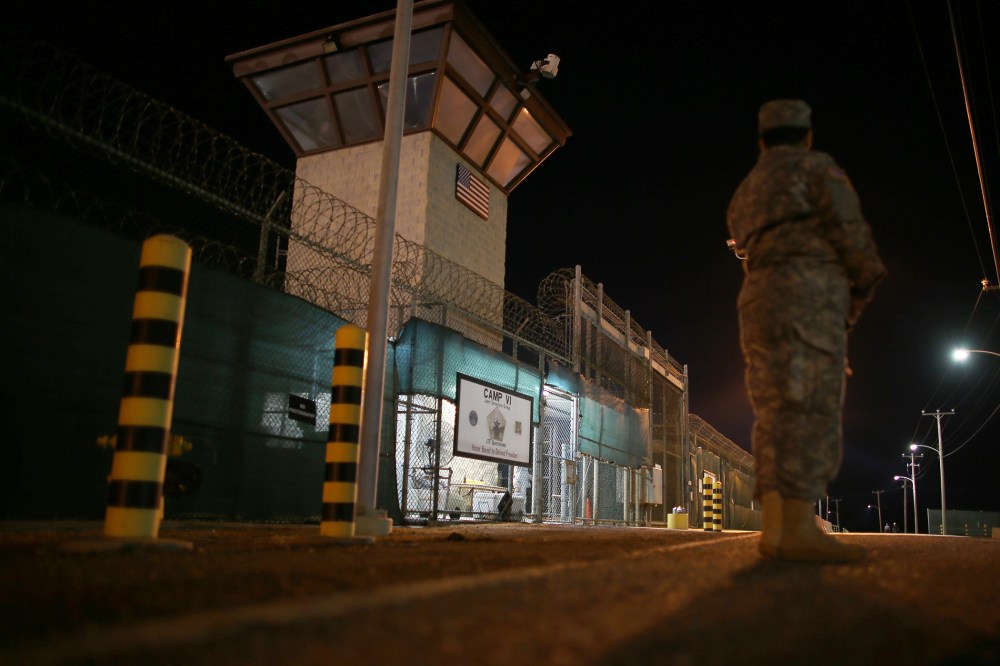
Information about how military commissions would handle executions is essentially non-existent — but that’s not acceptable for lawyers of the alleged mastermind behind the USS Cole bombing. They want the military to reveal exactly how it would put him to death if he is found guilty.
According to a Miami Herald report by Carol Rosenberg, constitutional concerns — and a series of botched executions in the U.S. — make it necessary to know the method the military would use to execute Rahim al Nashiri.
Nashiri is charged with coordinating the 2000 suicide bombing that killed 17 U.S. sailors. He also spent four years in the custody of the Central Intelligence Agency, where he was tortured by waterboarding and mock executions.
There are no established rules on how individuals convicted at military commissions should be executed. The last military execution — carried out more than 50 years ago — was done by hanging.
Without transparency, Nashiri’s attorneys argued, there is no way to safeguard against cruel and unusual punishment. They also argued that more detailed information was needed so the defense could question potential jurors on their feelings about capital punishment, according to another report from the hearing.
Many U.S. death row inmates have filed appeals challenging their death sentences on the grounds that state secrecy laws around execution protocols are a violation of their Eighth Amendment rights. So far, those appeals have been unsuccessful. There have been three lethal injection executions that have gone wrong since the start of 2014, most recently in Arizona where a death row inmate was injected 15 times during a nearly two-hour-long execution.
While most states in the U.S. keep details of their execution protocols secret, such as where execution drugs are obtained, the exact makeup of drugs used, and the identities of officials involved in carrying out the death sentence, prisoners know how they will die.
Prosecutors, according to the Herald’s report, argued that it is too soon to reveal information about how it would put Nashiri to death. Col Vance Spath of the Air Force heard the motion, which is one of several being heard during pre-trial hearings this week at Guantanamo Bay. He took over from another military judge, Army Col. James Pohl, who stepped down on July 10. The start date for Nashiri’s trial — a trial that has been pushed back repeatedly over many years — is currently set for February 9, but that date is also provisional. The other upcoming military commission, where Khalid Sheikh Mohammed and other alleged 9/11 conspirators will stand trial, does not yet have a trial date.
Meredith Clark
Meredith Clark is a freelance writer and editor. She was previously a senior news producer for "Patriot Act with Hasan Minhaj," a reporter with MSNBC.com, the digital politics and culture editor at Glamour and a senior news and politics editor at Refinery29. She has written for Vulture, Rolling Stone, Self, Marie Claire, Cosmopolitan, The Daily Beast and Bustle. Recommended


