








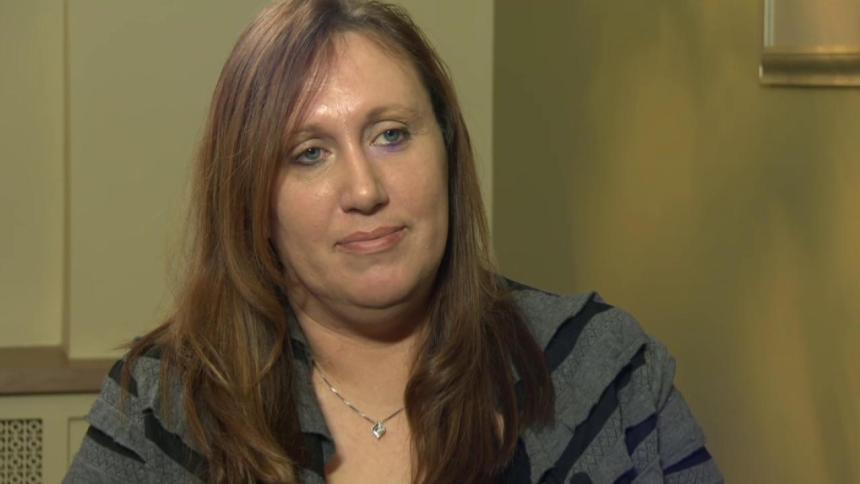
In 2013, Kelli Griffin went to vote in a local election in Montrose, Iowa.
She had been through some hard times — a survivor of domestic abuse who had suffered from drug addiction, she was convicted in 2008 of a drug-related crime, and served five years probation. But now Griffin was turning her life around, and voting was a rite of passage. She even took her four kids to the polls to teach them about the democratic process.
“I felt good,” said Griffin, 41. “I mean, it’s one of the steps to being back into society, to fulfilling that I am just like everybody else. I mean, I’ve overcome a lot.”
But what happened next would make clear that in the eyes of the law, Griffin wasn’t at all like everybody else. It would set this shy stay-at-home mom who never graduated college on a path to challenging her state’s highest officials. And it would help spark the latest step in a growing push-back against a set of laws that, five decades after the passage of the Voting Rights Act, still disenfranchise millions of Americans.
Not long after voting, Griffin got a worrying phone call from an agent with Iowa’s Division of Criminal Investigation. He was parked outside her house, and he said he wanted to verify the signature on her voter registration form. Last January, Griffin was charged with perjury in connection with illegal voting.
The charges stemmed from an aggressive investigation into voter fraud led by Iowa’s then-secretary-of-state, Matt Schultz, a Republican who had run for office on a pledge to impose a strict voter ID law to combat fraud. Schultz quickly blasted out a press release touting the charges against Griffin and eight others accused of voting illegally.
Schultz, who last year ran unsuccessfully for Congress and is now the attorney for a suburban Iowa county, didn’t return two calls for comment.
RELATED: These 5 states could be next to pass voter ID laws
When Griffin began probation for her drug offense in 2008, she was told by her lawyer that once she completed it, her voting rights would be restored. That was true at the time: In 2005, then-governor Tom Vilsack, a Democrat, issued an order automatically restoring voting rights to felons who completed their sentences. But in 2011, Gov. Terry Branstad, a Republican, took office. The second executive order Branstad issued was to reverse Vilsack’s order. Rights restoration for felons would now be at the discretion of the governor, and candidates would need to complete a lengthy and confusing application process.
%22These%20laws%2C%20with%20their%20disparate%20impact%20on%20minority%20communities%2C%20echo%20policies%20enacted%20during%20a%20deeply%20troubled%20period%20in%20America%E2%80%99s%20past%20%E2%80%94%20a%20time%20of%20post-Civil%20War%20discrimination.%22′
Vilsack’s 2005 order allowed approximately 100,000 Iowans to vote. Under the new process, just 64 people have had their rights restored.
At her trial, Griffin testified that she was unaware of Branstad’s rule change, and a jury quickly acquitted her.
“I was happy that I wasn’t going to leave my children,” said Griffin, “because I didn’t know how — not only how I would handle that, but how my children would handle not having a mother.”
Still, fighting the charges had cost Griffin about $10,000 in legal fees. And something else didn’t sit right with her: She still wasn’t allowed to vote.
Now she’s fighting to change that. Griffin is the plaintiff in a lawsuit, filed in November by the American Civil Liberties Union, which names Schultz and Branstad as defendants and seeks to drastically narrow the scope of Iowa’s ban on voting by felons.
Past efforts to have felon disenfranchisement laws struck down as racially discriminatory under the Voting Rights Act haven’t succeeded. But the ACLU suit takes a different approach. RELATED: GOP uses Loretta Lynch hearing to debate voting rights Iowa’s constitution guarantees the right to vote to anyone of age who hasn’t been convicted of an “infamous crime.” For decades, courts have understood that term to include all felonies, and even aggravated misdemeanors. But in a recent election law case, the state’s Supreme Court rethought that interpretation, and tentatively proposed a much narrower definition: crimes that are “particularly serious,” and that relate to “preserving the integrity of the election process,” and that involve “specific criminal intent.” If that definition were to be adopted, the crimes committed by Griffin and thousands of other Iowans wouldn’t lead to disenfranchisement. The suit is part of a broader push to challenge state laws — many imposed after Reconstruction by southern states looking for ways to suppress black political power — that, combined, disenfranchise nearly 6 million Americans, disproportionately African-Americans. That movement is itself part of a larger reassessment of tough-on-crime policies that’s been spurred by falling crime rates over the last two decades. “These laws, with their disparate impact on minority communities, echo policies enacted during a deeply troubled period in America’s past – a time of post-Civil War discrimination,” Attorney General Eric Holder said in a speech last year calling for felon disenfranchisement measures to be rethought. “And they have their roots in centuries-old conceptions of justice that were too often based on exclusion, animus, and fear.” RELATED: 2016 GOPers pay lip service to MLK while crippling voting rights There’s progress in numerous states. In Florida, whose law disenfranchises over 10% of voting-age citizens and nearly one in four African-Americans, voting rights groups recently launched a petition drive to get a constitutional amendment restoring felon voting rights on the 2016 ballot. Virginia Gov. Terry McAuliffe last year dramatically reduced the number of his state’s citizens denied the right to vote by ending the state’s practice of classifying drug crimes as violent felonies. In Kentucky, there’s growing support—including from Sen. Rand Paul—for a referendum to amend the state Constitution to allow non-violent felons to get their rights restored. In Minnesota, lawmakers from both parties have introduced bills that would restore voting rights to around 47,000 people. Similar legislation has been introduced in Wyoming and South Dakota, among other states. “It’s a lot of people,” said Julie Ebenstein, a lawyer with the ACLU’s voting rights program. “This is not 1% of the population or something like that. It’s really a significant chunk of U.S. citizens back in the community having finished any sentence, served their time, who are unjustly excluded from the democratic process. This is a very present, very significant problem in any election.” “It’s quite difficult from a policy perspective to say that someone who’s been convicted of a crime for the rest of their life cannot come back and rejoin democratic society,” Ebenstein continued. “The tides are starting to turn, and people are no longer accepting hook-line-and-sinker that this should continue in this way.”
Zachary Roth Recommended


