








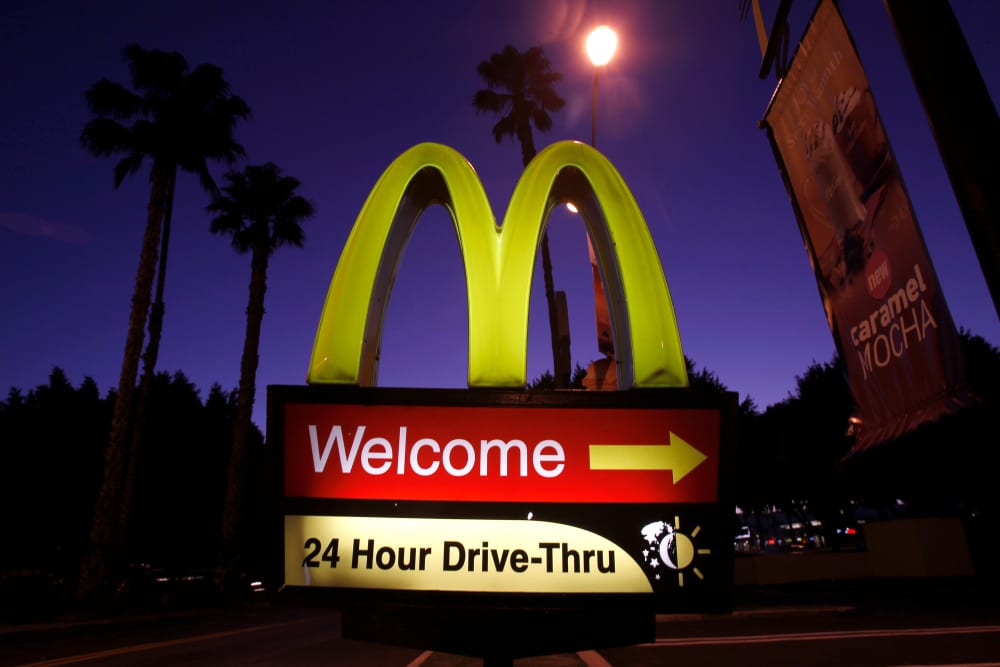
The general counsel for the National Labor Relations Board (NLRB) has determined that the McDonald’s corporation may be considered a “joint employer” with its franchisees, in what could be a major blow to the fast food behemoth and the franchising business model in general. If upheld, the decision would mean that corporations such as McDonald’s share legal responsibility for the working conditions at their franchise locations.
McDonald’s spokesperson Heidi Barker said the company would challenge the general counsel’s determination before an administrative law judge.
“This decision to allow unfair labor practice complaints to allege that McDonald’s is a joint employer with its franchisees is wrong,” according to a statement from the company, passed along by Barker. “McDonald’s will contest this allegation in the appropriate forum.”
In the meantime, the general counsel has directed NLRB regional offices to regard McDonald’s Corporation as one of the employers for workers at its franchised locations. That means that if a regional office finds merit in an Unfair Labor Practice (ULP) charge against one of the franchisees, the corporate headquarters itself will also be on the hook. Barker said that roughly 70 ongoing ULP cases against McDonald’s locations could be affected. Attorney Micah Wissinger, who represents McDonald’s workers in some of the cases against the company, put the number closer to over 100.
“McDonald’s can no longer get away with reaping all the profits and the benefits while saddling their franchises with all the risks and the blame for low wages,” he said.
By putting greater legal pressure on McDonald’s, the general counsel’s decision adds some juice to the fast food workers’ organizing campaign. Kendall Fells, organizing director for the campaign group Fast Food Forward, said the company would no longer be able to “hide behind franchisees for its illegal treatment of workers.”
“At some point, McDonald’s and the industry as a whole will decide that it makes sense to sit down at the table with these workers, because the workers will have changed the power dynamic,” he said.
The news out of the NLRB has made trade groups from fast food, retail, and other industries absolutely livid. A statement from the International Franchise Association (IFA) warned of the “devastating” consequences if franchisees and franchisors were considered joint employers.
“If franchisors are joint employers with their franchisees, these thousands of small business owners would lose control of the operations and equity they worked so hard to build,” said IFA president and CEO Steve Caldeira in that statement. “The jobs of millions of workers would be placed in jeopardy and the value of the businesses that employ them would be deflated.”
National Retail Federation senior vice president David French also voiced his opposition to the NLRB decision. “It is just further evidence that the NLRB has lost all credibility as a government agency established to protect workers and is now just a government agency that serves as an adjunct for organized labor, which has fought for this decision for a number of years as a means to more easily unionize entire companies and industries,” he said.
But Cathy Ruckelshaus, general counsel for the National Employment Law Project, dismissed the notion that “holding companies like McDonald’s accountable” would “portend the death of franchising.” “All it means is that corporations that exercise sufficient control over its franchised operations cannot feign ignorance or disclaim responsibility for the illegal acts which occur in its franchised stores,” she said. Ruckelshaus and other observers — including David Weil, the current administrator for the Labor Department’s Wage and Hour Division — argue that business models such as franchising currently allow companies to outsource the liability for suppressing wages and infringing on basic labor rights. Franchisees may use the brand, business model, and equipment of corporate headquarters, but they often carry sole legal liability as the employer of a franchise’s workforce. That’s a problem according to Weil’s book The Fissured Workplace, because franchisees “may be more willing to violate consumer, workplace, or environmental regulations in order to reduce labor costs than would be the case for company-controlled units.” Wissinger, and now the NLRB’s general counsel, argue that McDonald’s exercises significant control over employees in franchised restaurants, and therefore must be considered a joint employer. A series of recent wage theft lawsuits against the company make the same claim, bolstered by a detailed description of how McDonald’s Corporation supervises its franchisees’ business practices. Richard Eiker, a longtime McDonald’s franchise worker in Kansas City, Mo., joined Wissinger and Ruckelshaus on the conference call to describe how he says McDonald’s Corporation exercises control over his working conditions. The company’s methods, he said, include the use of secret shoppers and a corporate computer system “which gives up-to-the-minute reports on labor and sales.” “A representative from McDonald’s shows up at my store five to six times a year,” he said. “Sometimes he stands outside the drive-through counting cars.”
Ned Resnikoff is an urban policy analyst, researcher, writer, and editor. His byline has appeared in a variety of publications, including the New York Times, San Francisco Chronicle, Dissent, and The Nation. He writes the newsletter Public Comment, which can be found at publiccomment.blog. Recommended


