








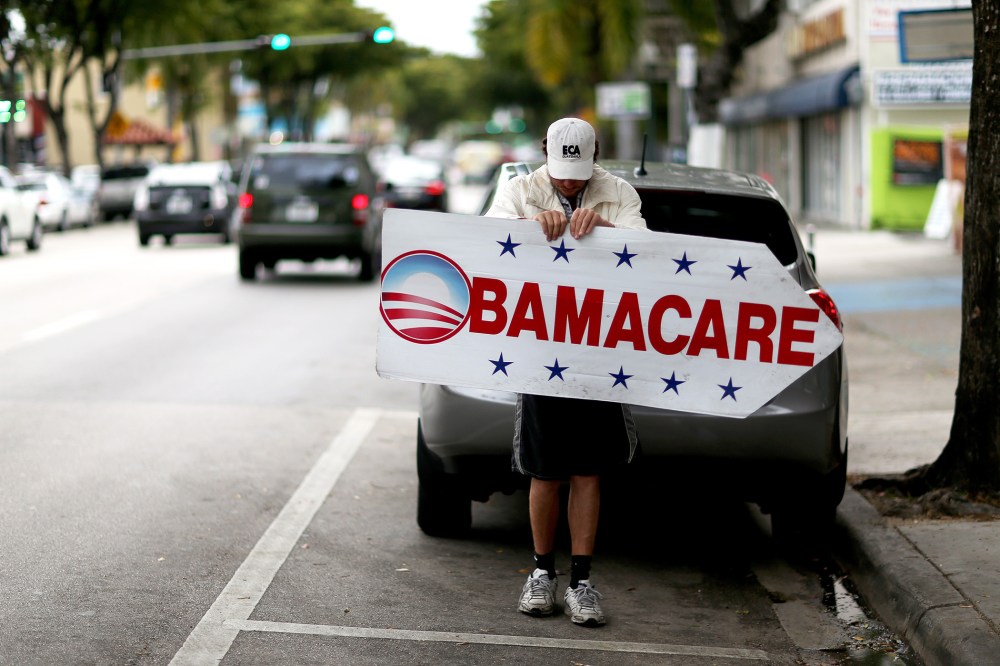
It might be easy for Republicans to fantasize about a Supreme Court victory striking a mortal blow against Obamacare. The party’s 2016 presidential candidates may want to consider who else will get hit along the way.
In a make-or-break case for the Affordable Care Act, the court on Wednesday will begin oral arguments in King vs. Burwell, a suit insisting the government cannot offer insurance subsidies in states using a federal health care exchange.
The case creates an unwelcome risk for Republican 2016 candidates just as they’re getting their campaigns off the ground, potentially placing them between voters who are benefiting from the subsidies and a fired up conservative base demanding full repeal. Making matters worse, the list of states whose residents are most threatened by the case include presidential battlegrounds Ohio, Florida, Wisconsin, Pennsylvania, Virginia, Michigan, and North Carolina.
RELATED: Scott Walker’s latest flub: foreign policy
Critics of the suit argue that it’s based on an absurd reading of a passage directing subsidies to exchanges “established by the State.” There is a mountain of evidence from contemporary lawmakers, staffers, and journalists who covered the law’s passage that, despte claims made by the suit’s lawyers, Congress wrote the law with the intention of doling out subsidies to every state.
No one knows how the court will rule. But if it sides with the plaintiffs, it could spark a crisis that could force upwards of 9.6 million people off insurance in as many as 37 states. The resulting chaos could cause insurers to spike premiums for everyone in the individual market or pull out of the exchanges entirely.
Republicans considering a run for the nomination in 2016 have been mixed in their willingness to align themselves with the case. Sens. Marco Rubio and Ted Cruz signed onto an amicus brief supporting the King plaintiffs, and Louisiana Gov. Bobby Jindal has cheered on the suit and offered the most detailed ACA replacement plan of the field. Former Florida Gov. Jeb Bush said last week he expects the court to rule against the administration, which “creates an opportunity for Republicans to offer an alternative.”
Representatives for Bush, Wisconsin Gov. Scott Walker, Kentucky Sen. Rand Paul, and New Jersey Gov. Chris Christie did not respond to an email asking whether those likely contenders personally support the King lawsuit and for what they would propose as an alternative to ACA if the case prevails. Only seven states have signed on to a brief supporting the King lawsuit, suggesting broad unease with the prospect of a victory among Republican state leaders.
If the suit does succeed, the resulting crisis would put Republicans in a bind. Explaining why the subsidies were cut off will be a complicated exercise, but the solution is incredibly easy to convey. All Congress has to do is pass a one-page – maybe even one-sentence – bill correcting the offending phrase in the law. President Obama could deliver a speech in front of a billboard-sized blowup of the newly christened “Give People Their Insurance Back Act” the day of the decision and take it on the road until Congress acts.
RELATED: Carson launches exploratory committee
Meanwhile, Republican governors, senators, and House members in affected states will wake up every morning to apocalyptic headlines about sick constituents on the verge of losing their insurance. Victims will be extremely easy to find and, per one study, would mostly be “white, Southern, employed and middle-aged” — a demographic with far more political clout in affected states than those hurt by Republicans’ refusal to expand Medicaid after the last time the Supreme Court ruled on an ACA case. While talk radio hosts are doing backflips in the end zone, politicians will have to answer to folks like Karen Hines, a 59-year old breast cancer survivor caring for an ailing mother thanks to her own guaranteed, subsidized insurance.
Already, polling from both left- and right-leaning groups suggest a ruling against subsidies would be rough political news for the GOP. One poll by the conservative Independent Woman’s Voice found 75% of respondents — including 62% of Republicans – favor restoring subsidies if the court invalidates them, even as they still disapprove of the overall law. Another survey, conducted by Hart Research Associates for the SEIU, found respondents disagreed with a hypothetical ruling against subsidies by a 63-29% margin and disapproved of Republicans who refused to offer a fix in its wake by a 59-21 margin.
This would be particularly troublesome for governors who are also 2016 prospects. Walker came up with a unique alternative to the ACA’s Medicaid expansion in Wisconsin, but it relies entirely on Obamacare subsidies to function. Ohio governor John Kasich expanded Medicaid in his state, but could struggle to get subsidies back online thanks to an already passed anti-Obamacare amendment.
Walker told WisconsinEye in January that the onus is on Congress to “create a time frame for a transition” and “alternatives for the states” if King succeeds.
Republicans are starting to take notice of the danger. In line with Walker’s suggestion, a number of GOP leaders are pitching a fix that would let Americans keep their subsidies temporarily while Republicans figure out their next move. It’s not just squishy moderates either – freshman Nebraska Sen. Ben Sasse, a tea party darling in 2014, wrote a Wall Street Journal op-ed this month calling on Congress to pass an extension of subsidies for current recipients that expires after the 2016 election or face “crippling” political pressure.
Rep. Paul Ryan, the House Ways and Means Committee chairman and 2012 GOP vice presidential candidate, has talked up a “bridge out of Obamacare.” A working group of senior Republican senators and House members is pitching a similar idea of “financial assistance” to Americans along with a vague plan to offer states an Obamacare alternative. Even Rush Limbaugh thinks temporary subsidies might be necessary to prevent political disaster.
“I think the one-page simple fix bill is going to be a nonstarter for Republicans,” conservative writer Phil Klein, author of “Overcoming Obamacare: Three Approaches to Reversing the Government Takeover of Health Care,” told msnbc. “I do not see how leadership can pass anything like that.”
Coming up with a short-term fix, let alone a complete replacement plan, is easier said than done. Conservatives will likely be wary about passing anything that comes short of repeal and some commentators are already warning an extension could be a prelude to surrender. Democrats are likely to oppose any measure that doesn’t let the health care law add new recipients as usual, otherwise Republicans could keep passing temporary fixes as the pool of people receiving subsidies shrinks due to natural churn in the market. They may even hold out for a one-page fix or bust.
As House GOP leaders’ unsuccessful fight over Homeland Security funding showed this week, the combination of a unified Democratic caucus and an angry conservative minority can upend the best laid Republican plans. The question then would become whether GOP leaders negotiate a compromise with Democrats or just let entire states’ health care systems collapse. Jim Manley, a veteran Democratic strategist and longtime aide to Harry Reid, sounded pessimistic in assessing Congress’ ability to find a workaround. “I think the smart Republicans are beginning to realize how potentially dangerous this situation can be, but they’re boxed in because the House, in particular, is absolutely ungovernable right now,” Manley told msnbc. The damage if no fix passes could be “the sleeper issue of 2016.” That’s just the immediate problem. When it comes to passing either an Obamacare replacement or more permanent fix, things get even tougher. Republican leaders have spent years promising votes on their own health care plan without delivering, mainly because the party is fundamentally divided over the issue. Republicans have had the luxury of being able to throw potshots at Obamacare the last few years, but a decision in the King case would put them on the hook to outline what trade-offs they’d make themselves. In the case of one recent proposal by Sens. Orrin Hatch and Richard Burr and Rep. Fred Upton, for example, the result would mean fewer subsidies for middle income Americans, the return of pre-existing conditions and to insurers not having to not cover maternity costs. It’s not hard to imagine that latter provision creating problems in an election where Republicans will likely face Hillary Clinton in November 2016. Some conservatives, most notably Jindal, have argued that Republicans need to accept that their proposed health plans will cover fewer Americans and give them less comprehensive coverage and just suck it up in the name of fiscal restraint. In an op-ed last month, Jindal derided conservative wonks for offering “Obamacare lite” by proposing some revenue raising measures in order to finance subsidies for health care. “There’s no easy way to resolve this issue in a way that will satisfy all sides,” Klein said. Jindal is not a top-tier presidential contender at the moment, but he doesn’t need to be in order to have a major impact on the conversation. By demanding Republicans use the old pre-Obamacare world of health care spending as its baseline, he could drag the whole field to the right. Ironically, this kind of intra-party one-upsmanship may help explain why we have Obamacare today. In 2007, then-candidate John Edwards released a universal health care plan that helped pressure rivals Barack Obama and Hillary Clinton to craft similarly sweeping blueprints of their own. Republicans have also made their path more difficult by bashing the law for health care outcomes that GOP alternatives would almost certainly create. After turning “If you like your plan, you can keep it” into a rallying cry, they’d be forced to contend with why many of their own plans would be disruptive for millions. After jumping on complaints of high deductibles in ACA plans, they’d have to explain why many Republican proposals are based on the idea that patients having more “skin in the game” when it comes to expenses helps drives down costs. As Democrats have learned over the last six years, it’s a whole lot easier to criticize the existing health care system than it is to pass your own reforms, which involve a whole host of tradeoffs that inevitably anger powerful voting blocs or interest groups. For Republicans, the only thing worse than Obamacare might be having to come up with Boehnercare, Mitchcare, or Jebcare themselves.
Benjy Sarlin Recommended


