








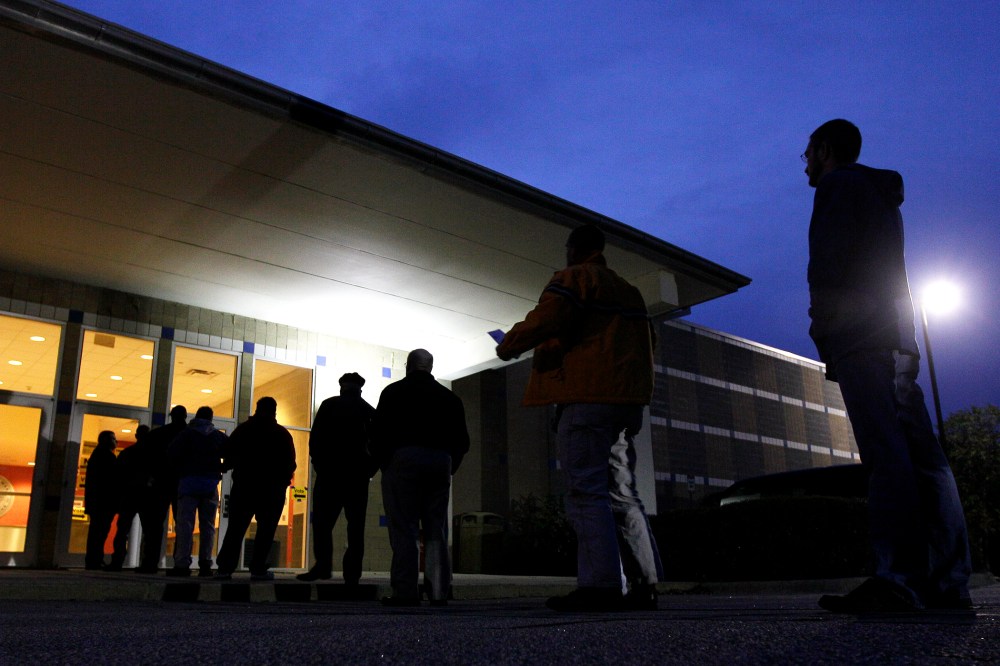
North Carolina lawmakers who backed the state’s restrictive voting law are going to have to cough up emails and other documents related to the law’s passage, a federal judge said Thursday evening.
Civil rights organizations sued North Carolina last August, contending that the law passed by the Republican-dominated state government discriminated against the state’s black and Latino residents. The Justice Department followed suit shortly afterwards. With the Supreme Court having eviscerated the requirement that states like North Carolina submit their election law changes to the Justice Department in advance, the state was free to pass one of the most restrictive voting laws in the country without federal interference.
North Carolina had sought to block a demand by the civil rights groups that the state turn over documentation that could shed light on what the legislators were thinking when they passed the law. In an order released Thursday evening, Judge Joi Elizabeth Peake ordered the state to turn over some of the documents sought by the civil rights groups.
Section 2 of the Voting Rights Act bars election laws that would have the purpose or effect of discriminating on the basis of race. In the past, communication between legislators has proved to be pivotal in cases involving election law discrimination, such as in a challenge to Texas redistricting in 2012, when emails showed state legislators discussing how to weaken the influence of the Latino vote in the state.
Thursday’s ruling didn’t give the law’s challengers everything they wanted, though. It said that emails that were shared only between legislators and their staffers might still be subject to legislative privilege, as North Carolina claims. Indeed, in some ways, the skirmish over the emails highlights the weakness of current voting protections since the Supreme Court invalidated the Voting Rights Act’s most effective pillar, Section 5, last summer. To get the North Carolina law struck down under Section 2, the plaintiffs will likely have to prove intentional racial discrimination, or at least show evidence of race-based considerations entering the mix—a far higher standard than was required before the Supreme Court ruling. But just getting access to the key evidence they’d need to make that case, in the form of lawmakers’ emails, has required a protracted, months-long court fight—and the law’s challengers likely still won’t get all of what they’re asking for. In a statement released shortly after the order, Dale Ho, director of the American Civil Liberties Union’s Voting Rights Project, praised the judge’s decision and said that “North Carolinians have a right to know what motivated their lawmakers to make it harder for them to vote.”
Zachary Roth
Adam Serwer Recommended


