








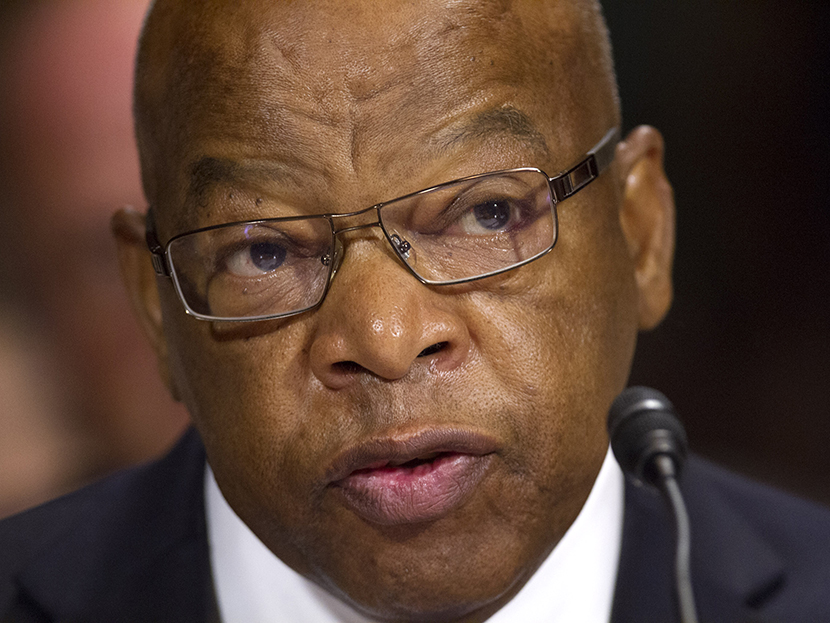
Racial discrimination in elections still exists, and the Voting Rights Act is no longer strong enough to stop it, Rep. Jim Sensenbrenner, a longtime Republican voting-rights champion, told a Senate panel Wednesday afternoon. Civil rights icon Rep. John Lewis was blunter: “The Voting Rights Act is needed now more than ever before,” he said.
The two lawmakers were testifying before the Senate Judiciary committee, as Congress looks into ways to bolster the Voting Rights Act in the wake of last month’s Supreme Court ruling that gutted the landmark civil rights law.
The court invalidated Section 5 of the law—which allows the federal government or the courts to block any election changes made by certain jurisdictions with a history of racial discrimination—unless Congress changes the formula that determines which areas are covered.
Section 2, which allows victims of racial discrimination in voting to file suit afterwards, remains in place. But Sensenbrenner, who led the reauthorization of the law in 2006, said that’s not nearly enough to ensure free and fair elections.
“There is no acceptable remedy for an unfair election after the fact,” he said. “Remedial actions can never be fully sufficient for elections, because often what is done cannot be undone, and voices silenced can never be heard.”
Lewis called Sensenbrenner “my friend, my brother.”
The Georgia Democrat movingly recounted being beaten by state troopers as he tried to lead a civil rights march across the Edmund Pettus Bridge in Alabama in 1965—an event that led to the passage of the Voting Rights Act later that year.
And he called on lawmakers to take up the voting rights cause.
“Who will take the charge?,” Lewis asked. “Who will lead the process for Congress to come together again and fight for the rights of minorities in South Carolina? In Texas? In South Dakota? In Michigan? In New York? In Alaska? In Arizona? Who will do what is right, what is just? Who will fulfill our constitutional responsibility?”
Sensenbrenner, too, called on Congress to create “a new formula that will cover jurisdictions with recent evidence of discrimination.”
The Wisconsin lawmaker also noted that jurisdictions covered under the law could “bail out” by showing that they had gone 10 years without discriminating. “The very fact that these jurisdictions have not bailed out is evidence that the VRA’s ‘extraordinary measures’ are still necessary,” Sensenbrenner said. Some Republicans appeared to argue that protections against racial discrimination in voting are no longer needed. Sen. Charles Grassley of Iowa, the panel’s top GOPer, noted that blacks turned out at a higher rate than any other racial group in the last election, and that minority candidates are running for office at higher rates than ever. But Sen. Dick Durbin, an Illinois Democrat, said racial discrimination in voting is “alive and well.” He gave several examples of discriminatory election changes blocked by Section 5, including a 2004 case in which officials of a Texas county threatened to prosecute two black students after they announced their candidacies for office. Since the Supreme Court’s ruling, officials or lawmakers in several southern states previously covered under Section 5, including Texas, North Carolina, South Carolina, and Mississippi, have said they’ll move forward with voter ID laws or other restrictive voting measures. Many other states, including Pennsylvania, Wisconsin, and Ohio, are also mulling voting restrictions. In a speech Tuesday to the NAACP, Attorney General Eric Holder called on Congress to fix the Voting Rights Act, and announced that the Justice Department would shift resources toward Section 2 cases in an effort to combat race bias in elections. Opposition to new voting rights legislation may be stronger in the House, which will hold its first hearing on the issue Thursday. It will be led by Rep. Trent Franks, a staunch conservative who voted against the 2006 re-authorization of the Voting Rights Act..
Zachary Roth Recommended


