








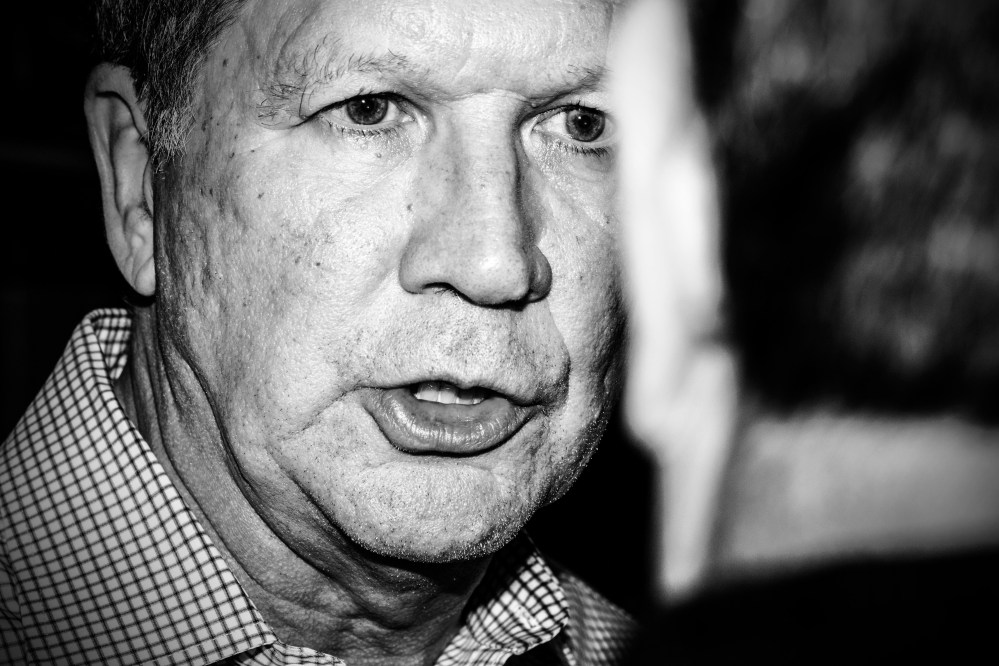
From near the start of his presidential campaign, John Kasich has built a reputation as a different kind of a Republican—a pragmatic centrist who avoids the kind of harsh rhetoric associated with many of his competitors. The genial Ohio governor certainly talks a good game about bringing people together. And he did split with most of his party by accepting the expansion of Medicaid under Obamacare, suggesting that helping the poor is a religious duty.
That image has helped Kasich makes the case that he’s the most electable Republican to take on Hilary Clinton this fall—an argument that, his campaign hopes, could yet help him steal the nomination if no one has a majority of delegates when the party convention kicks off this summer in Cleveland. Failing that, it could give him major influence at the convention and even make him an appealing vice presidential pick.
RELATED: Did Donald Trump break the Republican Party, or was it already broken?
But a look at both his record and his policies makes clear that Kasich is no moderate. From taxes to climate change, Kasich assiduously toes the line of modern Republican orthodoxy, which is to say, he’s a staunch conservative. And on some issues he goes even further. If Kasich does somehow emerge as the GOP nominee, it likely wouldn’t take Democrats long to highlight some of these stances—and undermine his moderate credentials.
Here’s a look at the real Kasich:
Taxes
Kasich’s tax plan is vague, but like that of every other Republican candidate, it amounts to a windfall for the wealthy. He would cut the top marginal tax rate to 28 percent, reduce the capital gains tax to 15 percent and repeal the estate tax, a long-standing conservative goal. Kasich does want to increase the Earned Income Tax Credit for working people.
“It’s going to be a tax cut for the rich,” Roberton Williams of the nonpartisan Tax Policy Center said. Williams said Kasich hasn’t released enough details to be able to say exactly who would benefit by how much. But, Williams said, the basic outline of the plan makes clear it offers “big tax cuts for the rich, smaller tax cuts for everyone else.” Still, it’s a little less regressive, he said, than the plans offered by Ted Cruz and Donald Trump, which skew even more heavily toward the rich.
Economy
A deficit hawk who served as a key lieutenant in Newt Gingrich’s Republican Revolution of the 1990s, Kasich would freeze nondiscretionary spending while increasing defense spending. And he would block-grant food stamp and Medicaid programs to the states, which likely would mean significant cuts to those programs for many of the most vulnerable Americans. In order to unleash “job creators,” he has called for no more federal regulations beyond health and safety for a year—essentially ruling out any new environmental or consumer protections, among others.
Unions
Kasich’s first major move after taking office in Ohio in 2011 was to push through a bill that severely limited the collective bargaining rights of public sector unions—similar to the one that caused weeks of protests in Wisconsin. The law was repealed by voters in a referendum later that year. After that Kasich backed off.
Health care
Though he accepted the Medicaid expansion in Ohio, Kasich would repeal Obamacare as president, ending health care coverage for millions of Americans. He has been vague about what would replace it.
RELATED: No unified GOP strategy to stop Trump Social Security Kasich wants to cut Social Security as part of his plan to balance the budget. When a New Hampshire audience member said a lower monthly benefit would be a problem for him, Kasich told him to “get over it.” Abortion Kasich has quietly made it much harder to get an abortion in Ohio, signing bills that bar the procedure after 20 weeks, mandate ultrasounds for women wanting to have an abortion and impose restrictive rules on clinics. “It’s hard to find a governor or anyone who has a better record,” the president of the anti-abortion Susan B. Anthony List has said. Global warming Unlike some Republican candidates, Kasich accepts the science of climate change. But that’s a bar low enough to give an ant a concussion. Kasich has also been careful to point out that we shouldn’t actually do anything about it. He wants to scrap the EPA’s climate regulations and has criticized the international climate deal reached last year in Paris, which many see as the last best chance to curb climate change. Voting rights Kasich has helped make it harder to vote in Ohio, signing bills that significantly cut early voting, restrict the availability of absentee ballots, and reduce the minimum number of voting machines counties must have on hand, potentially causing longer lines at the polls. He did nix a Republican effort to make it harder for students to vote.
Zachary Roth Recommended


