








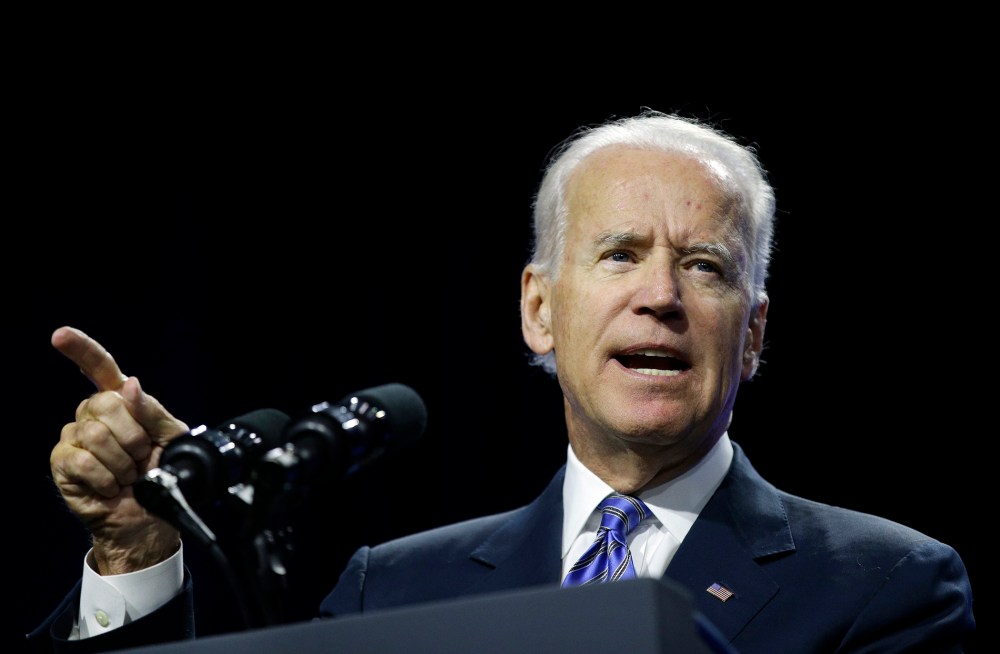
Overshadowed by Hillary Clinton at almost every turn, Vice President Joe Biden appears to be trying to create a path to relevancy in the early positioning for 2016 Democratic presidential primary that runs through black voters.
Biden riled up the crowd Wednesday at the NAACP convention in Las Vegas, promoting his deep ties to “the community” and his long support for civil rights. He’s scheduled to speak Thursday at The National Urban League’s meeting in Ohio.
Biden has also been re-establishing connections with Democrats in South Carolina, an early primary state where the large African-American community can sway the Democratic vote. Even after joining the White House, Biden has made regular visits to the Palmetto State, headlining state party fundraisers, giving commencement addresses and even vacationing.
“Many of us believe he’s a very viable candidate, and especially in South Carolina,” said Dick Harpootlian, the former state Democratic Party chairman, who played golf with the vice president on his most recent visit. Biden has maintained connections with African-American activists and leaders in the state, Harpootlian told msnbc, and knows many of them personally.
At the NAACP conference, Biden opened his remarks by crediting the civil rights organization with his first electoral victory to the Senate in 1972.
“I got elected because of the NAACP,” he said, adding, “they didn’t check my credentials at the door, so I’ll tell you them to you now: I am a lifelong member of the NAACP.”
Biden went on to explain his long history of supporting civil rights, going all the way back to his upbringing in Delaware, when he said he was “the only Caucasian boy on the East side of Wilmington for a long time.”
“Look folks, where I come from, in Delaware, everything is about the neighborhood,” he added, name-checking various leaders in the room with whom he has worked.
“One of the first people to take me under his wing was Louis Redding,” Biden said, referring to the first African-American admitted to the bar in Delaware, who would go on to argue major civil rights cases, including Brown v. Board of Education.
Biden went on to lay out the long sweep of history on voting rights, saying that after decades of increasing bipartisan support for expanding the franchise since the Voting Rights Act of 1965, progress has recently reversed itself.
“I thought we had finally won, I really did. It’s what got me involved in the first place, and I thought finally,” he said, pounding his fist on the podium for emphasis. “But those days appear to be over. This is not your father’s Republican Party. We are in a hailstorm of new attempts by states and localities to limit ballot access.”
Biden has been one of the administration’s more vocal surrogates to the African-American community and on the issue of voting rights. That got him in trouble during the 2012 presidential campaign, when he told a black audience that Republicans wanted to unshackle Wall Street and “put y’all back in chains.”
While much has been made of Clinton’s vulnerability on the ideological left, political scientist Tom Schaller and Slate columnist Jamelle Bouie have pointed out that losing the black vote by a huge margin in 2008 may have been more consequential for Clinton than losing liberals. More than anywhere else, this potential vulnerability could play out in South Carolina, where Clinton barely campaigned in 2008, expecting to lose badly. Clinton will likely be very strong in New Hampshire, given both her and her husband’s history in the Granite State. But she could be weaker in Iowa and South Carolina, perhaps enticing someone like Biden into the race. Last year, Biden headlined the South Carolina Democratic Party’s annual fundraising dinner, bringing in more money than any dinner in the previous 15 years, said Harpootlian, who famously sparred with Bill Clinton in 2008. But the Clintons themselves have deep ties in the African-American community, which they’ve worked to repair since Hillary Clinton’s last run. Even President Obama joked during the White House Correspondents Dinner that Clinton had the nomination all but sewn up, brewing resentment in Biden. Despite all that, Biden has repeatedly dropped hints about 2016, and he has said publicly that he’s considering a run. He told ABC’s “The View” that he’s “uniquely qualified” to be president and drew a subtle contrast with Clinton by highlighting his modest wealth. “I don’t take a back seat to anyone when it comes to fighting some of the toughest progressive battles the country has seen,” Biden told liberal activists last week at the Netroots Nation conference in Detroit. He also spoke last week at Generation Progress, a conference of young progressives in Washington, D.C. hosted by the Center for American Progress. “How old would you be if you didn’t know how old you were?” the 71-year-old Biden rhetorically asked the NAACP crowd, paraphrasing the late baseball great Satchel Paige. “Folks, I’m 42 years old, and I’m ready to go.”
Alex Seitz-Wald Recommended


