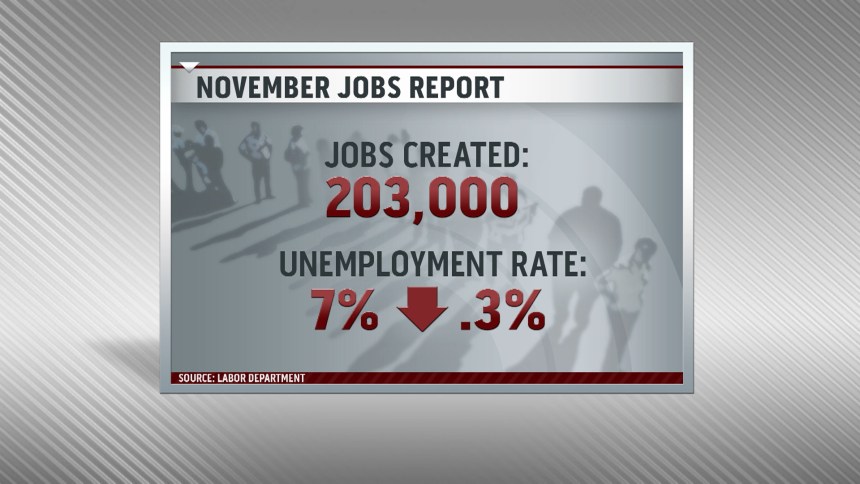
The latest jobs report, like most in recent years, can be summarized as “good direction, excruciatingly slow pace.”
Unemployment dropped from 7.3% to 7.0%. That exceeded expectations, as measured by a Bloomberg survey of 89 economists conducted before the Bureau of Labor Statistics released the latest numbers. The economists predicted a drop to 7.2%, from October’s 7.3%.
On the minus side, though, much of this drop can be attributed to the end of the government shutdown, which prompted furloughs of government workers that inflated unemployment numbers in October.
The more meaningful trends to consider are the longer-term ones. For example, unemployment is lower than it’s been in five years. That’s enormously important. But five years ago the country was one year into a recession. Today it’s four years into a recovery. As Jared Bernstein, an economist with the nonprofit Center on Budget and Policy Priorities (and former chief economist to Vice President Joe Biden), points out, job growth has been steady over the past year, but it hasn’t accelerated.
More hopefully, Jason Furman, chairman of the White House Council of Economic Advisers, points out that over the past year average hourly wages for private production and nonsupervisory workers rose faster, after inflation, than they did in any other year since 2009. But for half of 2009 the economy was still in recession. Current average hourly wages represent only a net 3% gain, after inflation, over where they stood way back in 1979, the year that the current trend toward ever-greater income inequality began. Echoing the president’s December 4 inequality speech, Furman pointed out that during the same period, the productivity of American workers improved 90%.
A newly-issued report on household income trends released by Sentier Research, a private firm run by former Census officials, tells a similar story. Since August 2011 (i.e., two years into the recovery), the report said, there’s been “an uneven, but generally upward trend” in pretax median household income, but only by 2.7%. Over the past year, household income didn’t rise at all by any statistically significant measure. (Sentier’s data went through October; they did not include November.)
Long-term unemployment remains a huge problem. The average duration of unemployment is 37.2 weeks, which is down from its 2011 peak but still higher than it was at the start of the recovery in June 2009 (and more than twice what it was before the recession). The median (i.e., more “typical”) duration is much lower, at 17 weeks, which is about where it was at the start of the recovery. The chasm between the average and the median indicates that “many of the remaining unemployed are concentrated at extremely lengthy durations of unemployment,” according to Furman.
That’s significant because congressional Republicans are pressing to end the current extension of unemployment benefits from the usual 26 weeks or so (it varies by state) to about 73 weeks. In place since the recession, the extension program is due to expire later this month. The Council of Economic Advisers noted in an earlier report that the long-term unemployment rate was about twice as high as it was at the expiration of any previous extension program. Conservatives argue that such extensions encourage workers not to re-enter the job market. But why would this dependency effect (generally judged by economists to be minor) be twice as pronounced in 2013 as it’s ever been before? Public employment, mostly by state governments, has fallen throughout the recovery—something that hasn’t happened, Princeton economist Alan Blinder wrote back in June, since World War II. In the past, rising government employment helped lead the economy out of the recession, but with more than half of all state legislatures controlled by (newly-ideological) Republicans, that option isn’t available. According to the nonprofit Economic Policy Institute (EPI), state governments aren’t just failing to recreate the 728,000 jobs they’ve lost since the recession; they’re also an additional 744,000 short of the jobs needed to keep pace with population growth. Then there are the “missing workers” who don’t factor into the unemployment rate at all because they’re no longer looking for work. Include them and unemployment stands at 10.3%, only slightly down from its 2011 peak. According to the EPI, the majority of these workers are of “prime working age,”–between the ages of 25 and 54. Fewer than one-quarter are 55 and older (i.e., plausible candidates for retirement). In sum, the economy is better than it was. But for many Americans, it needs to be much better.
Timothy Noah Recommended