








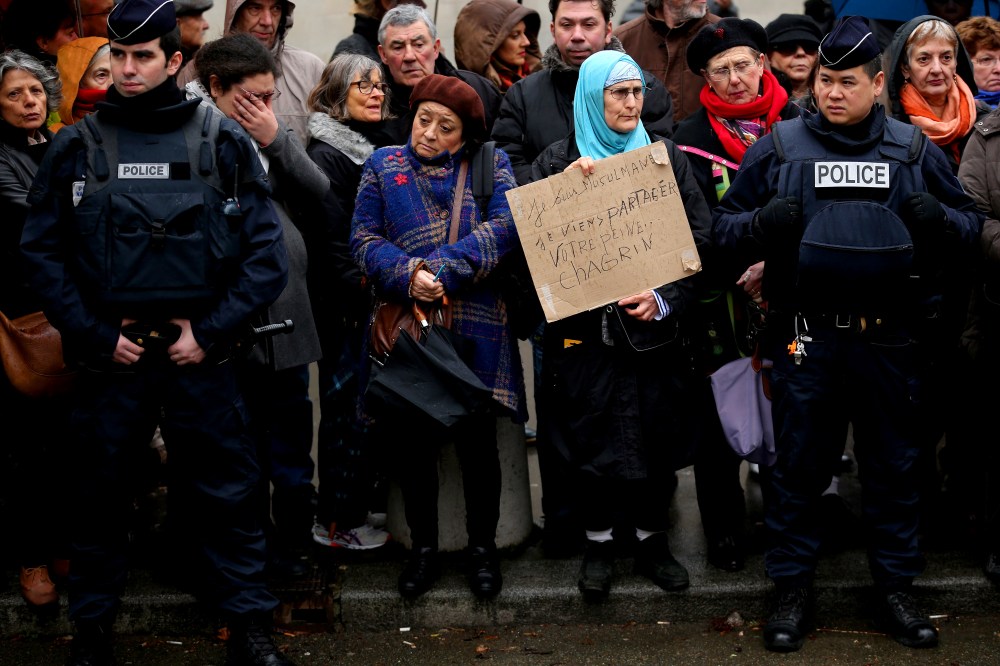
European leaders have urged their citizens to reject religious intolerance in the wake of violence that rocked Paris last week and left 17 people dead.
Leaders have pushed back Thursday against both the anti-Semitism that inspired a deadly attack on a kosher grocery store in Paris, and the anti-Muslim sentiment behind reprisal attacks against mosques in the area. The deadly attacks last week in Paris have sent shock waves through the Jewish and Muslim communities.
“The first victims of fanaticism and intolerance are Muslims,” French President Françoise Hollande said Thursday morning at the Arab World Institute.
“Islam is part of Germany,” German Chancellor Angela Merkel said Thursday in a separate speech. “We won’t allow ourselves to be divided by those who use the terrorist attacks to place Muslims under blanket suspicion. Every marginalization of Muslims in Germany, every blanket judgment, is unacceptable.”
RELATED: How to fight Islamic extremism without losing ourselves
These efforts to calm tensions come as security officials hunt for potential accomplices who might have assisted in the attacks in Paris. Last week, two al Qaeda-linked gunmen stormed the offices of satirical magazine Charlie Hebdo, killing eight journalists, a maintenance worker and two police officers. Another gunman linked to the Charlie Hebdo attackers killed four hostages in the kosher market before authorities stormed the store.
In Spain, officials are reportedly seeking out leads that the presumed shooter at the kosher supermarket, Amedy Coulibaly, was in Spain around the New Year, just days before the attack. His common-law wife, Hayat Boumeddiene, who is a fourth suspect in the case, was previously known to be in Spain before last week’s attacks.
Authorities are also seeking out potential accomplices in Paris. Officials in Turkey arrested a man as he attempted to enter Syria on allegations of terrorism in connection to the attacks.
Despite the leaders’ speeches, it’s clear an anti-Islamic sentiment has taken hold in some parts of Europe. In Germany, a political movement called Pegida, or the “Patriotic Europeans against Islamisation of the Occident,” is working to incite anti-Islamic sentiment in the wake of the Paris attacks. The group has hosted a dozen rallies protesting immigrants and Muslims, including one in Dresden that brought out 25,000 protesters.
In France, police have been deployed to protect mosques and other sites around the country, but officials reported that mosques had been attacked and defaced. There have been 60 attacks and threats since the terror attacks, the Associated Press reported earlier this week. French right-wing politician Marine Le Pen, leader of the National Front, argued that the attacks vindicated her party’s nationalist and xenophobic views shortly after the massacre at Charlie Hebdo. RELATED: Al Qaeda claims responsibility for terror in Paris “Anti-Muslim acts, like anti-Semitism, should not only be denounced, but severely punished,” Hollande said in his address Thursday. Merkel called anti-Semitism and Islamic terrorism “two of the great evils of our time,” and said fighting “anti-Semtiism is a state and civic duty,” for Germany, because of the Holocaust. Last year, 7,000 Jews moved from France due to an uptick in perceived anti-Semitism, according to The Jewish Agency, a nonprofit that facilitates emigration to Israel. That number was expected to top 10,000 this year, but those estimates are being revised in the wake of the anti-Semetic attacks, the agency told NBC News.
Jane Timm Recommended


