








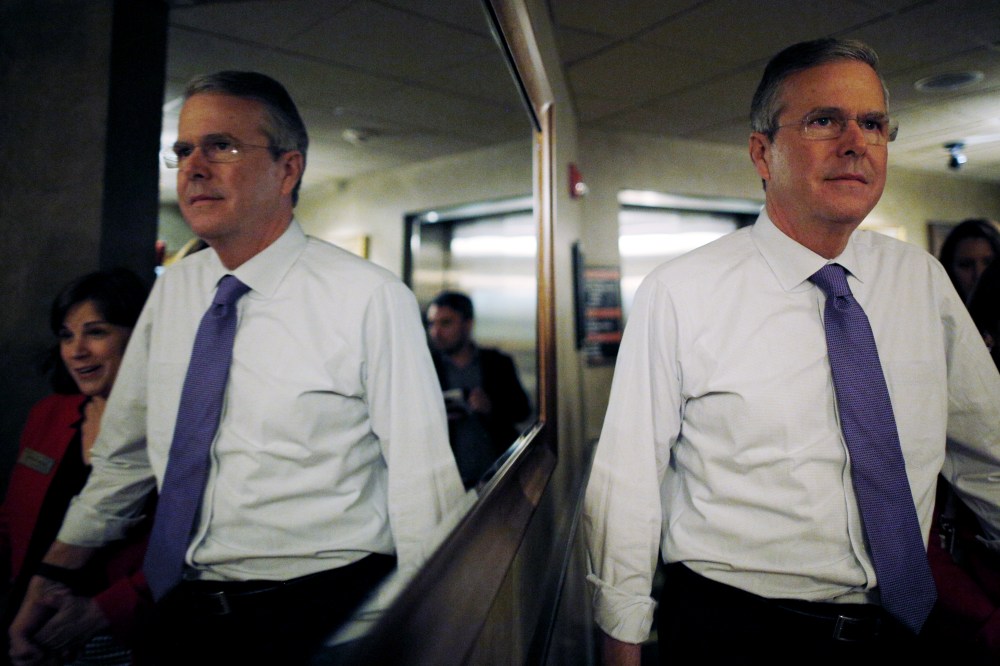
PORTSMOUTH, New Hampshire — Jeb Bush has cautioned from the start of his presidential flirtation that he would only take the final plunge if he can “do it joyfully.”
“In order to win a Republican has to be joyful, has to be hopeful, has to be optimistic,” Bush told a roundtable of business leaders here on Wednesday during a 2-day campaign tour of the nation’s first primary state.
That goal has never looked more daunting than it does now, as the nominal GOP frontrunner looks to shake off a rough period of questions about his position on the Iraq War, fend off ongoing attacks from the right on his stances on immigration and education, and — perhaps most importantly — unshackle himself from his brother’s legacy.
RELATED: Skeptical Jeb Bush calls for climate ‘debate’ in New Hampshire
“Joy” is one of his most frequently used words on the trail and there are laughs here and there in his speeches, but his one-liners tend toward the biting rather than the giddy. As he left a local Chamber of Commerce event at a bar in Concord on Thursday, he told reporters gathered outside his car that he had been told to smile more – then flashed a grin before driving off.
If Bush is having trouble smiling enough, it’s because there’s an implied underside to Bush’s talk of a “joyful” run, which is the modern political meat grinder that the campaign usually is in practice. Bush’s well-earned contempt for the show is borne out of generations of family experience and he got his first taste of its bitter reality earlier this month when he stumbled over an answer on the Iraq War, prompting a multi-day media frenzy that played out across multiple interviews with network TV and radio hosts and in scrums at high-profile GOP gatherings.
“It got a little bumpy, but all is well now,” Bush told a voter concerned about the Iraq episode in Portsmouth. “The ship is stable.”
With the worst behind him for now, Bush spent his two days in New Hampshire getting back to basics at four small retail events with just a few dozen attendees each. Along the way, he accepted hours of impromptu questioning from locals and the press alike on any topic that crossed their minds in between shaking hands and slapping backs. These are the kinds of personal grill sessions that state Republicans argue are the key to prevailing in what is likely a must-win primary for Bush. It was also, as Bush’s aides liked to point out, a pronounced contrast to the often inaccessible Hillary Clinton.
Bush is better versed in the X’s and O’s of political strategy than probably anyone in the field with the exception of Clinton and it showed. He has a habit of narrating his political thinking in real time, a kind of meta-commentary in which he tells audiences whether something he’s about to say might cause him problems with the press, or with a key voting bloc, or with his political opponents.
After an audience member in Portsmouth asked him about what he would do about the “pathological liar on the other side” in the general election– presumably Clinton — Bush straightforwardly said he “can’t rephrase that question because I’ll get in trouble with the ‘pathological liar’ part” before answering. He quipped that he was called “a lot of things I can’t repeat here in front of the press” as governor.
Later that evening, a state radio reporter asked Bush whether he regretted raising money for Republican Rep. Frank Guinta, who is now engulfed in a career-threatening campaign finance scandal. Knowing any response he gave would crowd out coverage of his remarks in the local press, Bush offered a bracing non-answer: “I am avoiding the question.”
Bush, who opens his speeches with earnest biographical anecdotes about his wife and family, even went into detail with one voter about the political logic to the way he discusses his personal life – it’s meant to insulate him from the character attacks that plagued the previous nominee.
“Mitt Romney was a successful, loving, caring, generous man and he never showed it,” Bush said.
But the obvious savvy Bush displayed on the road raised a troubling question for some attendees. How could someone with such a finely-tuned political radar get caught so flat-footed last week over an issue as predictable as the Iraq War?
“I would have thought if you were a presidential candidate or a serious politician you’d have had the answer down pat on the first try,” Joan Rice, who works at a financial planning business, told msnbc at the Portsmouth event. “It’s such an important question — how could not be prepared for it?”
Milling around a Bedford house party ahead of a visit from Bush, state representative David Milz said he was glad the 2016 hopeful had eventually distanced himself from the decision to invade Iraq. Not because Milz was critical of the Iraq War – as far as he’s concerned, George W. Bush has nothing to apologize for — but because it was the obvious political move.
“Bush gets blamed for everything – everything,” he told msnbc. “They’re still trying to hold him responsible for stuff Obama has screwed up for years now.”
It’s the topic of family that most threatens to harsh Bush’s vision of a mellow campaign. The former Florida governor seems almost physically pained discussing any kind of difference with his sibling or father. During the Fox News interview with Megyn Kelly launched the Iraq odyssey, he appeared most concerned about making sure viewers know that whatever criticisms of the war he cited were shared by his brother as well.
“I’m proud of my family, I love my mom and dad, I love my brother and people are going to have just get over that,” he said in Portsmouth, prompting a round of applause. “That’s the way it is.” RELATED: Bush supporters turn their backs on Jeb in key primary state At the house party, Bush turned to discussing the fall of the Soviet Union at one point, a development he credited to Ronald Reagan “and the guy who succeeded him who I’m supposed to somehow disown.” Bush scored a laugh at the same event by assuring the audience that he would differentiate himself from Marvin and Neil Bush, two non-politician siblings. He waxed philosophical about the issue after being asked an audience member to elaborate on his family ties, telling the crowd how reading the great historian Barbara Tuchman had reminded him of history’s “confounding way of repeating itself” and that even though the world had “changed dramatically” since his father was president, he planned to apply lessons learned from previous administrations. He got some encouragement along the way too. Bush met plenty of supporters in New Hampshire who thought the Iraq issue was overblown or said that the Bush name was a selling point, not a drawback. “If I’m hiring a plumber and he says his dad’s a plumber, I’m not going to say he can’t work on the house,” Lori Ashooh, who co-hosted the Bedford party with her husband, told msnbc. She’s uncommitted for now in the primaries. But the previous week also showed the danger for Bush of setting himself up, intentionally or not, as the Republican field’s defender-in-chief of the family legacy. Many Republicans say they like the younger Bush personally, but are concerned about encouraging a “dynasty” or worry that he’ll be constantly sucked into old political fights if he can’t mute the issue early on. Well aware of the problem, Bush offered the most pointed critique of his brother’s presidency yet to a voter in Concord who asked where they differed on policy. “I think in Washington during my brother’s time Republicans spent too much money,” Bush said. “I think he could have used the veto power, he didn’t have line item veto power, but he could have brought budget discipline to Washington, DC.” For most candidates it would be a relatively banal admission – almost nobody in the party defends Bush-era spending anymore. For the only candidate whose last name is Bush, however, it’s not so easy. He quickly followed up with a set of caveats – Obama’s deficits were bigger, nobody’s perfect, let’s not dwell on our differences, etc. “I don’t feel compelled to go out of my way to criticize Republican presidents,” Bush said. “I don’t know, just call me a team player here. Just so happens the last two Republican presidents happen to be my dad and my brother, but you’ll never hear me complain about Ronald Reagan either. Every president makes mistakes, the question is what do you do, what do you learn from those mistakes?” It did not look like a joyful moment. Only 536 days until the general election.
Benjy Sarlin Recommended


